

Summary
- Zagreb is the first European city where riders can book an autonomous vehicle through Uber's app.
- Pony.ai provides the driving system, Verne owns and operates the fleet, and Uber supplies customer distribution.
- A licensed operator remains onboard initially, leaving the larger cost shift towards fully driverless operation still to come.
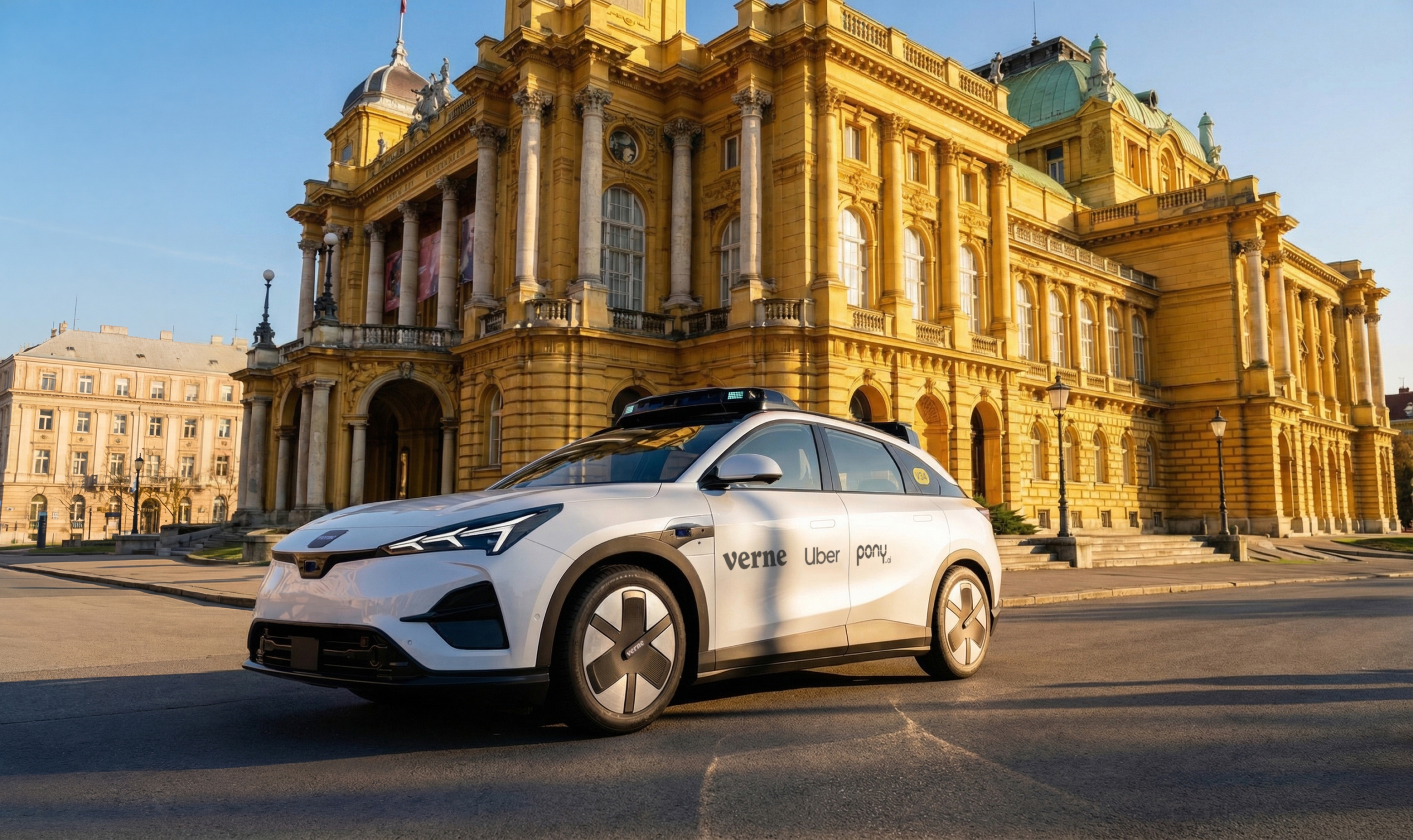
Uber has begun offering autonomous rides through its app in Zagreb, placing vehicles using Pony.ai technology and operated by Croatian mobility company Verne inside the same booking flow customers use for conventional rides.
The launch makes Zagreb the first European city where an autonomous vehicle can be booked through Uber’s platform. Riders requesting UberX or Comfort in supported parts of the Croatian capital may be matched with a robotaxi, with the app providing the vehicle details and instructions associated with the autonomous journey.
A licensed operator remains onboard during the initial phase, meaning the service is not yet fully driverless. Pony.ai provides the autonomous-driving system, Verne owns and operates the fleet, and Uber supplies customer distribution through its established ride-hailing network.
Zagreb already had commercial activity around the Verne and Pony.ai service before this week’s announcement, making the new development specifically the integration of those vehicles into Uber’s mainstream booking platform rather than the arrival of robotaxis in the city for the first time.
Distribution becomes part of robotaxi economics
Autonomous-driving companies have spent years concentrating on whether vehicles can navigate roads safely enough to operate commercially, yet that technical problem is only one part of a viable transport service. Fleets also require customers, maintenance, charging, cleaning, insurance, local operating capacity, regulatory approval, and enough utilisation to spread the high cost of vehicles across paid journeys.
Uber’s role is therefore strategically different from Pony.ai’s. It does not need to manufacture the vehicle or own the autonomy stack to become the route through which customers encounter the technology. Its existing marketplace already provides demand, payments, support operations, mapping, and a familiar booking interface.
Verne takes responsibility for fleet ownership and operation, producing a three-company structure in which the driving technology provider, local operator, and customer marketplace remain separate. The arrangement allows specialisation, but also creates dependencies that have to work reliably if deployment expands beyond a relatively small initial footprint.
Uber and Pony.ai have separately announced plans to deploy more than 2,000 robotaxis across Europe, giving the Zagreb launch a role as an early test of a considerably larger expansion strategy.
Techopia recently examined that shift as Europe’s robotaxi market moved towards larger fleet commitments. Zagreb now shows what those commitments begin to look like when autonomous vehicles are inserted into an established mobility marketplace rather than remaining future deployment targets.
Europe will scale city by city
Autonomous ride-hailing is unlikely to spread across Europe through one uniform launch because vehicle rules, licensing, road conditions, liability frameworks, and local transport markets differ between countries and cities. A system operating in Zagreb cannot simply be copied into another capital without further regulatory and operational work.
That makes city-level fleet partners useful. They can manage the physical vehicles and local operating requirements while an autonomous-driving supplier concentrates on software and a ride-hailing platform supplies demand.
If the structure proves repeatable, technology developers could expand without independently building a complete consumer transport company in each market. It also leaves Uber relatively neutral about which autonomy provider ultimately performs best.
The presence of a licensed operator in the current service, however, shows how far commercial availability can remain from the cost structure promised by fully autonomous transport. Removing the driver is central to much of the robotaxi economic case because labour represents a substantial proportion of conventional ride-hailing costs.
Supervised deployment can generate operational data and introduce customers to autonomous vehicles, but it does not demonstrate that the economics work without an employee monitoring every car. The shift from supervised commercial journeys to genuinely driverless operation will therefore be considerably more important financially than the appearance of the vehicle inside an app.
Europe also presents a different market from China or parts of the United States. Dense cities, established public transport, labour regulation, and fragmented vehicle rules mean autonomous fleets will have to demonstrate that they add useful capacity without depending indefinitely on pilot conditions.
For Uber, that does not require one autonomous-driving supplier to dominate. The company has increasingly pursued partnerships with different AV developers, allowing it to protect its position as the marketplace through which passengers book journeys while the technology underneath remains competitive.
Zagreb is an early European expression of that strategy. The driving intelligence belongs to Pony.ai, the fleet belongs to Verne, and access to a large pool of customers comes through Uber — a division of responsibilities that may prove as important to commercial adoption as the autonomy software itself.


