

Summary
- The partnership will expand from Zagreb to four additional European cities, targeting more than 2,000 Pony.ai robotaxis overall.
- Pony.ai supplies the autonomous technology while Uber provides the customer platform, with local partners able to own and operate fleets.
- Regulatory approvals, insurance, utilisation and human support will determine whether a large vehicle target becomes an economically durable transport service.
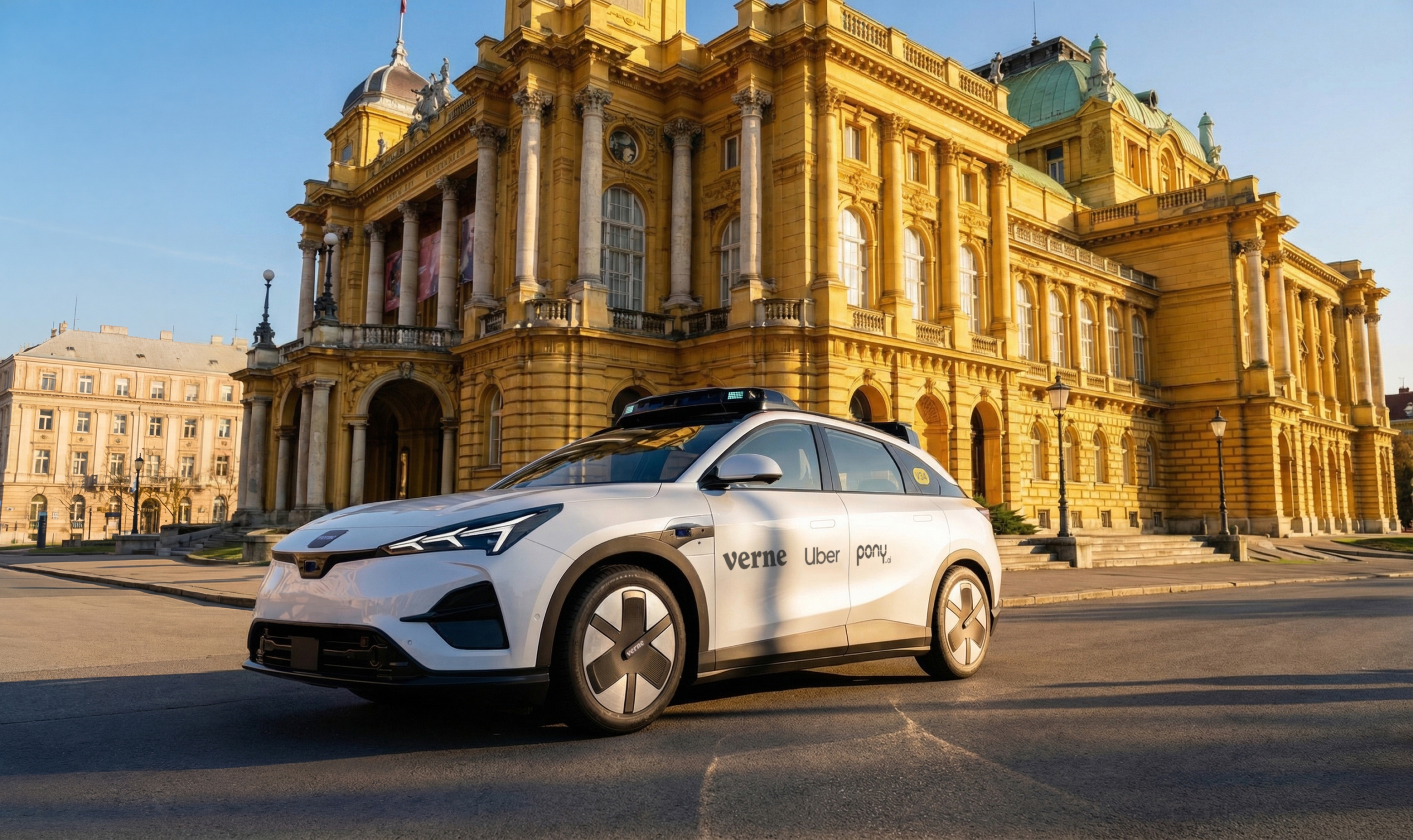
Uber and Pony.ai are preparing to move their European robotaxi partnership beyond individual city launches, with plans for more than 2,000 autonomous vehicles across Zagreb and four additional cities.
The four new markets have not yet been named and the companies have not set out a full deployment timetable, so the figure remains a target rather than an operating fleet. Even so, the structure of the agreement shows how autonomous mobility is being organised for a more repeatable commercial phase, with the technology developer, ride-hailing platform and local fleet operator able to remain separate businesses.
Pony.ai will provide Level 4 autonomous driving technology as well as operational expertise, while Uber will handle booking, payments, customer service and access to its existing mobility marketplace. Vehicle ownership can sit with different partners by market, and local operators can take responsibility for the daily work of running fleets rather than leaving the autonomous-driving company to recreate a complete transport operation in each country.
Sarfraz Maredia, Uber’s global head of autonomous mobility and delivery, said: “The next chapter for autonomous mobility is about moving from individual launches to repeatable commercial scale”. Zagreb provides the first European model for that arrangement, with Croatian mobility company Verne acting as local fleet owner and operator.
Fleet scale changes the operating problem
Once robotaxis move beyond relatively small pilots, much of the difficult work shifts from proving that a car can drive autonomously to operating hundreds of vehicles reliably every day. Depots need to handle charging, cleaning and maintenance, while remote support teams have to deal with unusual road situations, customer problems and vehicles that cannot complete a journey without assistance.
Removing the person behind the wheel therefore does not remove labour from the service. It changes the type and location of that labour, while adding specialised hardware, software support and safety processes that conventional taxi fleets do not carry to the same degree. The commercial calculation depends on whether those costs fall far enough as fleets expand to outweigh the labour savings associated with autonomous driving.
European regulation adds another layer because deployment conditions are not uniform across the continent. Vehicle approval, local road rules, insurance and operating permissions can vary between jurisdictions, while individual cities can take different approaches to kerb access, public transport integration and the use of autonomous vehicles in busy urban areas.
A joint-deployment model can spread that burden among partners. Local fleet companies already understand vehicle operations and municipal requirements, Pony.ai can concentrate on the driving system, and Uber can bring an established customer base without having to own every car itself.
The economics arrive after the demonstration
Pony.ai says it has achieved city-wide breakeven unit economics in several Chinese markets, although European operating conditions will not reproduce those results automatically. Labour costs, insurance, vehicle prices, utilisation patterns and regulatory requirements differ, while fragmented deployment can make it harder to spread fixed costs over very large fleets.
Uber is also pursuing autonomous-vehicle partnerships with several suppliers rather than tying its network to a single driving system. That gives the platform flexibility as the technology develops, although it leaves Uber with the practical task of presenting a consistent service when the vehicles underneath that service may come from different manufacturers and autonomy providers.
Employment effects are likely to appear gradually as well. A few hundred vehicles in an individual city would sit inside a much larger taxi and private-hire market, while scaled deployment would create work around maintenance, fleet supervision and remote operations even as it reduced demand for drivers on the routes being automated.
The first useful measure of the expanded partnership will consequently be the identity of the four additional cities and the approvals obtained in each one. After that, utilisation, intervention rates, operating costs and customer demand will show whether the European robotaxi market is moving towards ordinary fleet economics or simply producing larger trials.


