Summary
- The government announced eight hubs on 9 October, backed by a £40 million programme.
- A separate £1.7 million convening body and £2.5 million training strand are identified in the announcement.
- The £9.8 million Greater South West hub expects full operation in January 2027.
Britain has announced £40 million backing for eight Robotics Adoption Hubs intended to help businesses and public services assess, procure and deploy automation. The government said on 9 October that the network would connect prospective users with independent advice, technology demonstrations, suppliers and financing expertise. It is an adoption programme rather than a claim that eight fully operational facilities or new fleets of robots already exist.
The locations and specialisms are diverse: a national surgical robotics hub, the Greater South West hub, Lincoln-based HARVEST for agriculture and food, a Milton Keynes initiative for public-space services, a Welsh manufacturing pathway hub, a national waste and recycling hub, a Yorkshire manufacturing hub and a South Wales hub. Although the announcement describes a rollout beginning on 9 October, individual facilities have different implementation schedules.
Existing robotics capability can be difficult for smaller organisations to translate into an investment decision. A supplier demonstration may show that a machine can perform a task, yet a purchaser also has to assess maintenance, operator training, safety, integration and the effect on surrounding work. The new hubs are intended to provide help with those decisions rather than simply promote particular products.
The Greater South West hub provides a more detailed account of how the initiative will operate. Bristol Robotics Laboratory will lead a consortium of 23 industry, university and local-government partners. UWE Bristol puts the project value at £9.8 million, comprising £7.2 million from Innovate UK and £2.6 million contributed by partners. Those are project funding figures, not evidence that the whole amount has already been spent.
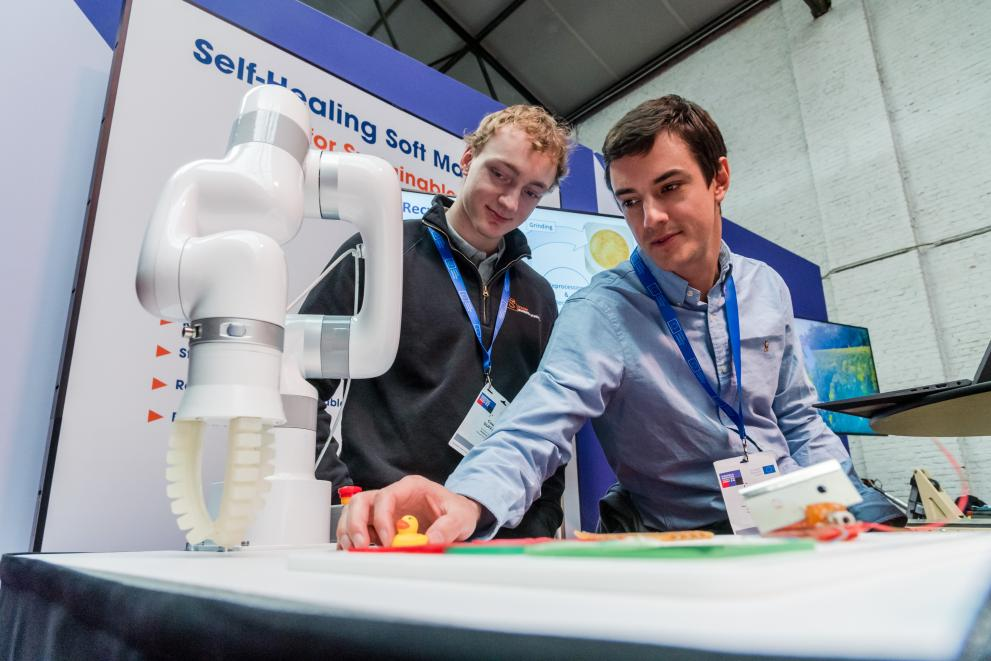
The consortium includes the University of Bristol, UWE Bristol and NCC. NCC is expected to lead a business advisory service that helps companies identify appropriate applications, build investment cases and obtain access to support. Demonstrations and proof-of-concept work will sit alongside a programme connecting adopters with suppliers and other organisations.
UWE Bristol says the South West facility is expected to become fully operational by January 2027. That timetable is important when interpreting the national announcement: a newly funded network cannot be treated as having already delivered operational productivity improvements. Further reporting will need to examine how many organisations undertake trials and how many progress to sustained use.
Examples range from maritime infrastructure and energy asset maintenance to food production, aerospace manufacturing and healthcare. The financial and technical case will differ between them. A robotic inspection system may reduce human exposure to hazardous locations, while an agricultural machine must withstand variable crops, weather and seasonal utilisation. Surgical systems face clinical evidence, procurement and training requirements.
The government also identified a £1.7 million national convening body, AURA, to be delivered by The Welding Institute with Anglia Ruskin University. Another £2.5 million supports 12 training projects covering practical robotics skills, apprenticeships and workforce outreach. These strands acknowledge that buying equipment does not establish the competence needed to deploy it safely.
The government cited a projection that robotics and autonomous systems could add £150 billion to the economy by 2035 under maximised adoption, compared with £6.4 billion at present adoption levels. Those figures describe a modelled scenario, not a guaranteed return from the hub funding. Outcomes will depend on business decisions, utilisation and the performance of systems after installation.
The hubs are not interchangeable. Lincoln’s HARVEST programme is centred on agri-food, with testbeds for arable production, fruit, vegetables and food manufacturing; Milton Keynes will examine service robots, drones and automated vehicles in public spaces. A national waste and recycling hub will examine equipment for sorting and recovery sites, while the surgical hub is intended to support evidence-based adoption in clinical services. These separate applications require different safety cases and commercial evaluation methods. The announcement does not report results from new deployments at any of these hubs.
Training support includes work on port logistics, industrial inspection, maritime autonomy and robotics technician apprenticeships. The government has also identified a scheme involving 48 schools across Somerset, Devon and Cornwall. Such projects address workforce capability at different levels, from employees specifying an automation investment to technicians responsible for maintaining equipment. The training allocation is for programme development, not an announced count of workers who have already completed courses.
For participating organisations, the decisive evidence will be documented feasibility work, realistic cost assessments and systems continuing to operate after a demonstration ends. The South West hub’s January timetable provides an early milestone against which that shift from support infrastructure to actual adoption can be measured.