Summary
- AI’s environmental footprint is shaped by energy demand, grid location, cooling systems, and the carbon intensity of electricity.
- The largest sustainability gains may come when AI is used to reduce waste, emissions, and risk across supply chains and operations.
- Responsible deployment means matching AI models to task complexity, reducing unnecessary token use, and backing infrastructure with cleaner power and storage.
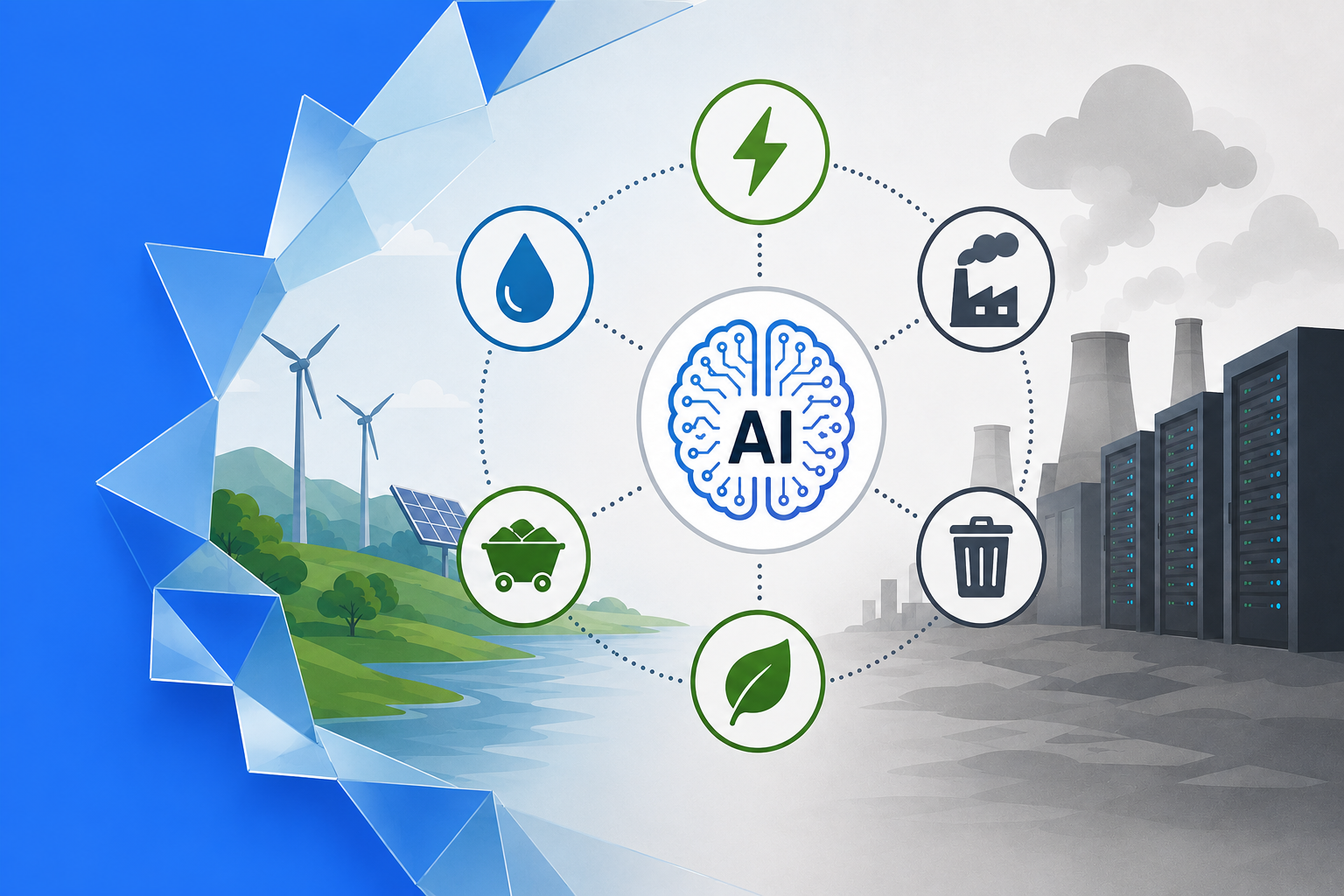
With the meteoric growth of AI, its environmental footprint is becoming one of the most important sustainability conversations of our time. Rather than viewing AI as either a climate challenge or a sustainability solution, we need to understand the complexity of its impacts and the opportunities to deploy it responsibly.
Energy and Carbon Emissions
As AI scales, the energy needed to power data centres is growing rapidly. Data centre electricity demand is expected to increase significantly over the coming years, driven in large part by AI workloads. Currently, AI workloads make up about 20% of data centre usage, which is predicted to grow to 40% by 2030.
The growing demand for electricity coincides with the transition away from fossil fuels for buildings and transportation. The biggest questions are whether we will have enough energy in the right places to power data centres and whether that energy will be clean or dirty.
Currently, a mix of clean and dirty energy is powering data centre growth. Across the U.S., Europe, China and India, renewable technology has become more efficient and affordable, although some fossil fuel plants are staying online longer than expected to meet demand.
The International Energy Agency estimates that carbon emissions attributable to data centre energy use could increase significantly in the coming years unless we scale cleaner energy sources at the same rate.
The good news is that most hyperscalers are aggressively investing in near-zero carbon energy sources, including wind, solar and nuclear. One of the most promising innovations is distributed battery storage, which can take advantage of existing electricity capacity. Combining accelerated renewable energy adoption with battery storage, it is technically possible to offset AI’s growing energy demand with cleaner energy sources.
Reducing the Water Footprint of AI
The water footprint of AI infrastructure is an increasingly important sustainability consideration as data centre growth accelerates.
Data centres use a lot of water, primarily for cooling. Their location, chip density and local water availability all influence total water use. In water-stressed regions, any new water consumption elevates the risk of future supply challenges.
Immersive cooling, which uses heat-absorbing liquids to cool equipment directly, can significantly reduce water use, although it remains expensive. Shifting to renewable energy and battery storage can also help lower AI’s overall water footprint.
AI’s Potential for Sustainability
There are numerous use cases for AI to solve sustainability challenges. If we do this right, the environmental footprint of AI can be more than offset through mitigation strategies and the adoption of AI to address carbon emissions, waste and other environmental issues.
In sustainable supply chain management, AI can be a supercharger for improving efficiency and reducing waste and carbon emissions. Enhancing planning and inventory accuracy reduces waste and upstream impacts from overproduction. Improving transportation through load building, route optimisation and electric vehicle utilisation reduces carbon emissions and pollution. Maximising manufacturing and warehousing operations reduces energy use and avoids waste.
AI can also improve risk monitoring and mitigation, including climate-related risks such as severe storms and drought, helping organisations identify alternative sourcing strategies and build more resilient supply chains.
Outside of the supply chain, there are countless use cases to support sustainability goals. For example, AI sensing can improve farming resilience and crop yields while reducing chemical and water use by informing planting times, fertiliser and pesticide applications.
Taking Action to Reduce AI Footprint
Training models consumes a lot of energy, but ongoing use, or inference, consumes the most lifetime energy. This is why how we use AI plays a large role in its footprint.
There are several actions we can take:
- Use AI for complex problems, not simple fact checking. Using AI to look up basic facts unnecessarily uses tokens and associated electricity.
- Use the right model for the task. Domain or vertical models can use significantly less energy than general-purpose AI. Within general-purpose models, select the model that matches the complexity of the task.
- Start a new chat when appropriate. AI chatbots re-read the whole discussion with every new prompt. If you don’t need the full context, starting a new chat can reduce unnecessary processing.
- Track your tokens. Since computation scales with tokens processed, tokens are a useful proxy for how much energy is being used.
AI’s environmental footprint is not predetermined. With continued investment in clean energy infrastructure, smarter deployment of AI technologies, and a focus on sustainable innovation, we have an opportunity to harness AI’s benefits while reducing its environmental costs.
| About the author | |
|---|---|
| Saskia is an environmental scientist with 17 years of experience in sustainability working across consumer products, retail, government, and manufacturing. She currently serves as the Chief Sustainability Officer of Blue Yonder, where she is responsible for developing and executing Blue Yonder’s sustainability strategy and driving sustainability initiatives in product roadmaps and across the company. |  |