

Summary
- Corenix will factory-build and test modular data-centre systems combining IT, power, cooling, and networking before shipment to customer sites.
- The platforms use Nvidia reference designs but are customised to individual projects, with Corenix retaining responsibility through installation, commissioning, and operational readiness.
- The model reflects pressure to make AI infrastructure construction more repeatable as high-density compute collides with long lead times for power, cooling, engineering, and site work.
AI infrastructure is beginning to acquire some of the characteristics of industrial manufacturing, with Barcelona-founded Submer creating a dedicated business that will assemble and test complete data-centre modules in factories before shipping them to the sites where the compute will ultimately run.
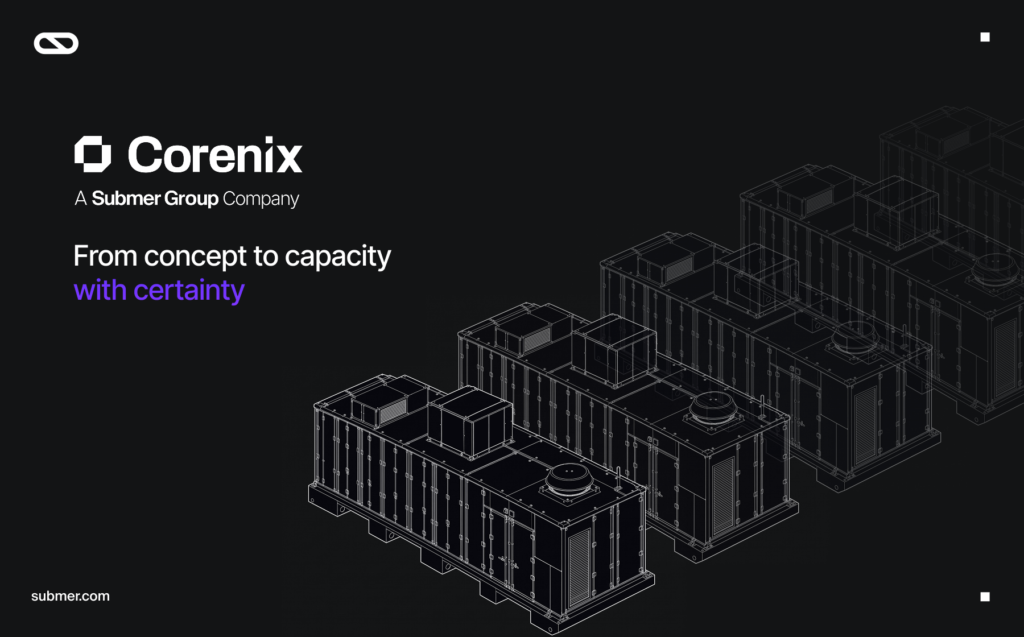
Submer Group has launched Corenix, a modular data-centre company aimed at neoclouds, hyperscalers, and other operators building infrastructure for accelerated computing. Rather than supplying an isolated cooling product or prefabricated shell, Corenix intends to integrate IT equipment, electrical distribution, cooling, and networking into functional modules before they leave a production facility.
Those modules will then be transported to the customer site for installation, connection to local infrastructure, acceptance testing, commissioning, and final preparation for operation. Corenix says the same organisation will remain accountable across the factory and site stages, reducing the number of hand-offs between engineering, manufacturing, equipment suppliers, construction teams, and operators.
The platforms will be based on Nvidia reference designs but adapted to customer requirements, placing Corenix somewhere between standardised manufacturing and bespoke data-centre engineering. Martin Renkis, formerly an executive director of Data Center Infrastructure Services at Johnson Controls, has been appointed chief executive of the new business.
AI capacity is becoming a delivery problem
The commercial logic behind modular construction has become stronger as AI systems have pushed rack densities and infrastructure requirements far beyond conventional enterprise computing. Power distribution, liquid cooling, networking, and mechanical systems increasingly have to be designed as one operating environment, while each new accelerator generation can alter the amount of electricity and heat that an individual rack has to handle.
Traditional data-centre construction divides much of that work between specialist suppliers and contractors before integration takes place on site. That approach can work well for facilities built around relatively predictable requirements, but it leaves more engineering and testing exposed to construction schedules when operators are trying to bring expensive GPU capacity online quickly.
Corenix is attempting to move more of that uncertainty into a controlled manufacturing environment. Complete modules can be wired, plumbed, integrated, and tested before they are shipped, leaving the site team with a more defined unit to connect rather than a collection of systems that first meet one another inside a live construction programme.
Factory construction does not remove the harder constraints outside the module. A customer still needs land, planning consent, enough electricity, grid connections, fibre, water or alternative cooling infrastructure, and the civil engineering required to support the equipment. A prefabricated AI hall cannot manufacture a missing megawatt or shorten a transmission-network queue.
It can, however, compress the part of the programme controlled by the data-centre developer. Submer says its experience includes a fully modular compute campus with hundreds of megawatts of capacity delivered within nine months from order to delivery, although that performance claim comes from the company and does not establish a standard delivery time for future Corenix projects.
Cooling is being designed with the building
Submer’s origins in liquid cooling shape the new company’s proposition. The group says it has deployed more than 500MW of liquid-cooled infrastructure, while its wider organisation now spans thermal engineering, data-centre development, modular systems, and GPU infrastructure services.
That evolution reflects the way cooling has moved from a component choice towards an architectural decision. As higher-density AI systems push data-centre cooling towards liquid, operators have to coordinate processor design, rack power, heat rejection, pipework, facility layouts, maintenance procedures, and electrical systems rather than specifying each layer independently.
Corenix will integrate those systems into modules that include rack power, cooling, networking, and IT equipment. The objective is not to create an identical container for every customer, but to start from known designs and repeatable manufacturing processes before adapting them to the hardware, location, capacity, and operating requirements of a particular deployment.
That distinction is significant because accelerated-computing infrastructure changes too quickly for a rigid prefabricated design to remain useful indefinitely. An AI facility ordered for one accelerator generation may have to accommodate subsequent systems with higher rack density, different cooling connections, revised networking, or altered power distribution during a building lifespan measured in decades.
Standardisation meets an uneven physical world
Industrialised construction works most easily when the inputs are predictable, whereas data-centre locations remain highly variable. Electrical standards differ between markets, ambient temperatures affect cooling design, individual sites have different grid arrangements, local regulations vary, and customers can have very different approaches to redundancy and network architecture.
Corenix therefore has to extract enough repetition from the engineering process to improve manufacturing speed without pretending that every AI data centre can be assembled from an identical kit of parts. The use of Nvidia reference designs provides a common technical starting point, but customers still need infrastructure compatible with their chosen servers, network fabric, operating model, and future hardware roadmap.
Submer Group has been expanding across more of that infrastructure stack rather than remaining solely a cooling supplier. It now describes more than 8GW of powered land across the Americas, EMEA, and Asia-Pacific, alongside its modular infrastructure and compute businesses. Those figures are company disclosures rather than independent measures of operating data-centre capacity, but they show the scale of the group’s ambition.
The creation of Corenix gives that strategy a dedicated deployment business whose product is effectively the process of turning an AI design into functioning physical capacity. Equipment specifications still matter, although customers building large GPU estates increasingly face another expensive question: how reliably can all the necessary pieces be assembled before the hardware they ordered has moved another generation forward?
Factory-built infrastructure will not solve Europe’s grid constraints or the global competition for accelerators, but it may change how much of a data-centre programme has to be improvised on site. As AI construction becomes more capital-intensive and schedules become commercially sensitive, repeatable engineering is becoming a technology problem in its own right.


