

Summary
- Oceanloop plans to begin building a 250-tonne Giant Grouper facility near Kiel in 2026 after starting commercial sales from its existing farm.
- A larger Gran Canaria project is intended to take the company’s recirculating aquaculture model towards industrial-scale production.
- Scaling RAS depends on energy, biology, water treatment, software, and operating economics working together rather than simply increasing tank capacity.
German aquaculture technology company Oceanloop has secured up to €38.5 million to expand its software-controlled land-based farming system, moving from an existing commercial Giant Grouper operation near Kiel towards facilities intended to test whether recirculating aquaculture can be repeated at much larger scale.
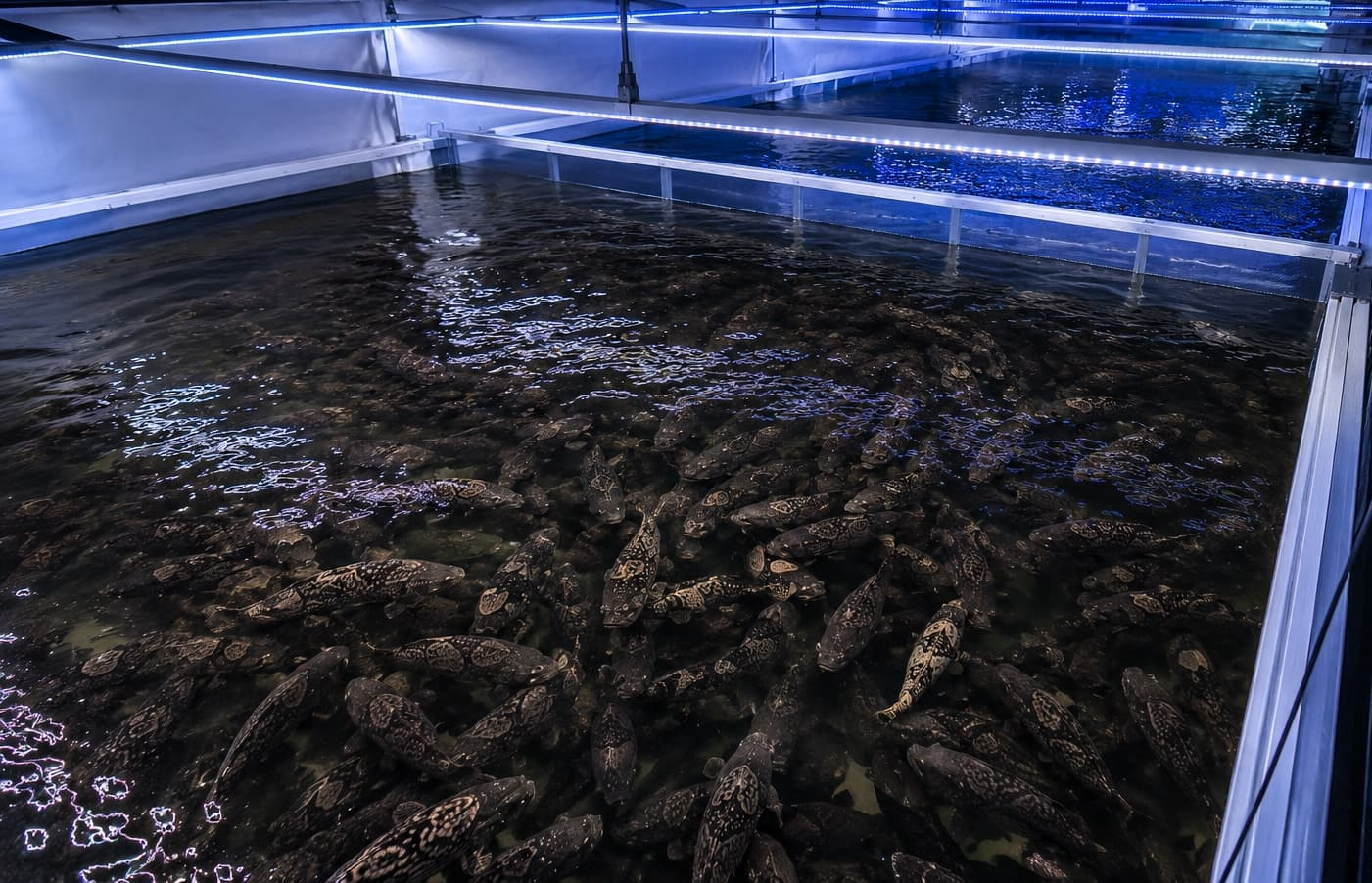
The first new project is designed to produce about 250 tonnes of Giant Grouper annually beside Oceanloop’s existing facility at Strande, with construction due to begin in 2026. The company says the site will operate as both a commercial farm and a technology and training centre where software, biological processes, water treatment, laboratory work, and operator procedures can be developed together.
Oceanloop’s current facility produces roughly 20 tonnes of Giant Grouper a year and began commercial sales in 2026, giving the company operating experience before it increases output by more than an order of magnitude. A planned Gran Canaria development would move the model further again, with the company describing a modular site capable of reaching around 2,000 tonnes after successive phases.
The financing combines new equity from specialist aquaculture investors with European Investment Bank venture debt that has supported Oceanloop’s wider technology and expansion programme. The EIB facility was originally approved around shrimp farming and research, while Oceanloop says its current financing arrangements have since been amended as the commercial strategy shifted towards Giant Grouper.
Scaling biology is different from scaling software
Recirculating aquaculture systems, or RAS, raise fish in controlled land-based environments while filtering and reusing water through a network of tanks, pumps, treatment equipment, and sensors. The approach gives operators greater control over temperature, water chemistry, feeding, disease exposure, and waste than open-water farming, but it also concentrates technical dependencies inside the facility.
Software can coordinate those systems by monitoring conditions, detecting anomalies, recording biological performance, and supporting maintenance decisions. Yet the data remains tied to living animals whose growth and health can change if environmental conditions drift, which means an operating mistake cannot always be corrected as easily as a software configuration.
The Kiel expansion will therefore test more than whether Oceanloop can construct larger tanks. Stocking density, filtration capacity, oxygen, feed, animal welfare, energy use, labour, harvesting, processing, and maintenance all change as throughput increases, while a biological problem can affect the economics of an entire production cycle.
Standardising the equipment and operating procedures can make future farms more repeatable, but industrialisation requires evidence that performance remains stable as the company moves between sites and production volumes. The Gran Canaria project would provide a more demanding test because local energy, seawater, climate, logistics, and staffing conditions differ from northern Germany.
The economics are as important as the engineering
Land-based aquaculture has attracted investment partly because it can place seafood production closer to consumers while reducing some exposure to marine pollution, escapes, and environmental variability. However, pumps, water treatment, temperature control, and other equipment create electricity and capital costs that open-water producers may not face to the same degree.
The commercial case therefore depends on the value of the species being farmed as well as technical efficiency. Oceanloop is positioning Giant Grouper as a premium white fish for restaurants and professional food service, where reliable year-round supply and freshness may support higher prices than commodity seafood markets would tolerate.
That strategy reduces the need to compete directly with low-cost mass-market species, although it creates a different demand risk because premium buyers still need enough volume to absorb production as the company scales from tens to hundreds and eventually thousands of tonnes.
Public finance is sharing part of the industrial risk through the EIB’s venture-debt support. Companies building physical production infrastructure often sit awkwardly between venture capital, which is accustomed to asset-light growth, and conventional project finance, which generally prefers proven cash flows and mature operating assets.
Oceanloop needs capital before the new farms can generate revenue, while investors have to judge a technology platform whose economics will become clearer only after larger facilities have operated through multiple biological cycles. That makes the Kiel project a reference site in the financial sense as well as the technical one.
Environmental claims will require similar evidence. Closed-loop farming can reduce some impacts associated with conventional aquaculture, but energy consumption, feed sourcing, animal welfare, mortality, and waste handling remain material factors. The EIB’s own project scrutiny has considered several of those issues rather than treating a land-based system as automatically sustainable.
Oceanloop’s €38.5 million package is consequently more useful as an industrial scale-up story than as another startup funding announcement. The company has specified its sites, production targets, technology model, and expansion sequence, creating measurable points against which the next phase can be judged. If Kiel can reproduce the existing farm’s biological performance at far greater volume, the RAS platform will move closer to a repeatable industrial system; if costs and complexity rise faster than production, the same facility will show where the model’s limits lie.


