

Summary
- Cerebras and Compute Nordic Finland are developing a 165MW AI data centre in Mikkeli, beginning with 50MW already under construction.
- The capacity is backed by service orders carrying seven-year terms, giving the project firmer demand commitments than many proposed AI infrastructure developments.
- Regional investment estimates reach €1 billion to €1.7 billion, while cooling and heat recovery plans expose the growing relationship between compute and local energy systems.
Cerebras has committed to a 165MW AI data centre in the Finnish city of Mikkeli, turning a large part of its planned European compute expansion into contracted physical capacity rather than another speculative entry in the continent’s growing pipeline of proposed facilities.
Cerebras is developing the campus with Compute Nordic Finland, which will lead project development, operations, customer management, and programme governance. Construction of an initial 50MW phase is already under way, with capacity expected to rise first to 80MW and eventually to 165MW.
The commercial structure gives the project more weight than the headline capacity alone. Cerebras says the agreement is formalised through a series of service orders carrying seven-year contract terms, tying the expansion to a long-term customer commitment rather than relying entirely on anticipated demand.
At full scale, an earlier Ramboll assessment cited by the companies estimates regional investment of between €1 billion and €1.7 billion, alongside 80 to 250 permanent direct jobs and €0.8 million to €2.5 million in annual property tax revenue. Those figures remain indicative estimates from a September 2025 study rather than confirmed capital expenditure or employment commitments.
The development also gives greater definition to Cerebras’s European infrastructure strategy. In July, the US AI computing company said it intended to establish 200MW of European AI capacity by the end of 2027, with facilities planned across France and the Nordics. A fully delivered 165MW Mikkeli campus would therefore account for most of the capacity within that earlier target.
Contracted megawatts carry more evidence
As AI infrastructure investment has accelerated, megawatt figures have become shorthand for ambition, although the numbers can conceal large differences between land options, grid applications, permitted projects, financed construction, contracted demand, and operating facilities. Construction status and commercial commitments offer a better indication of how much of a project has moved beyond planning.
Mikkeli has two concrete markers: its first 50MW is being built, while the broader arrangement is supported by seven-year service orders. Neither guarantees that every later phase will arrive exactly as proposed, but together they place the project further along than developments that have not yet established a committed compute customer.
Finland has become an increasingly attractive location for compute-heavy infrastructure because large AI facilities need more than cheap land. Power availability, grid access, cooling conditions, construction capability, fibre connectivity, planning, and the potential to use waste heat all determine whether an announced site can become a working data centre.
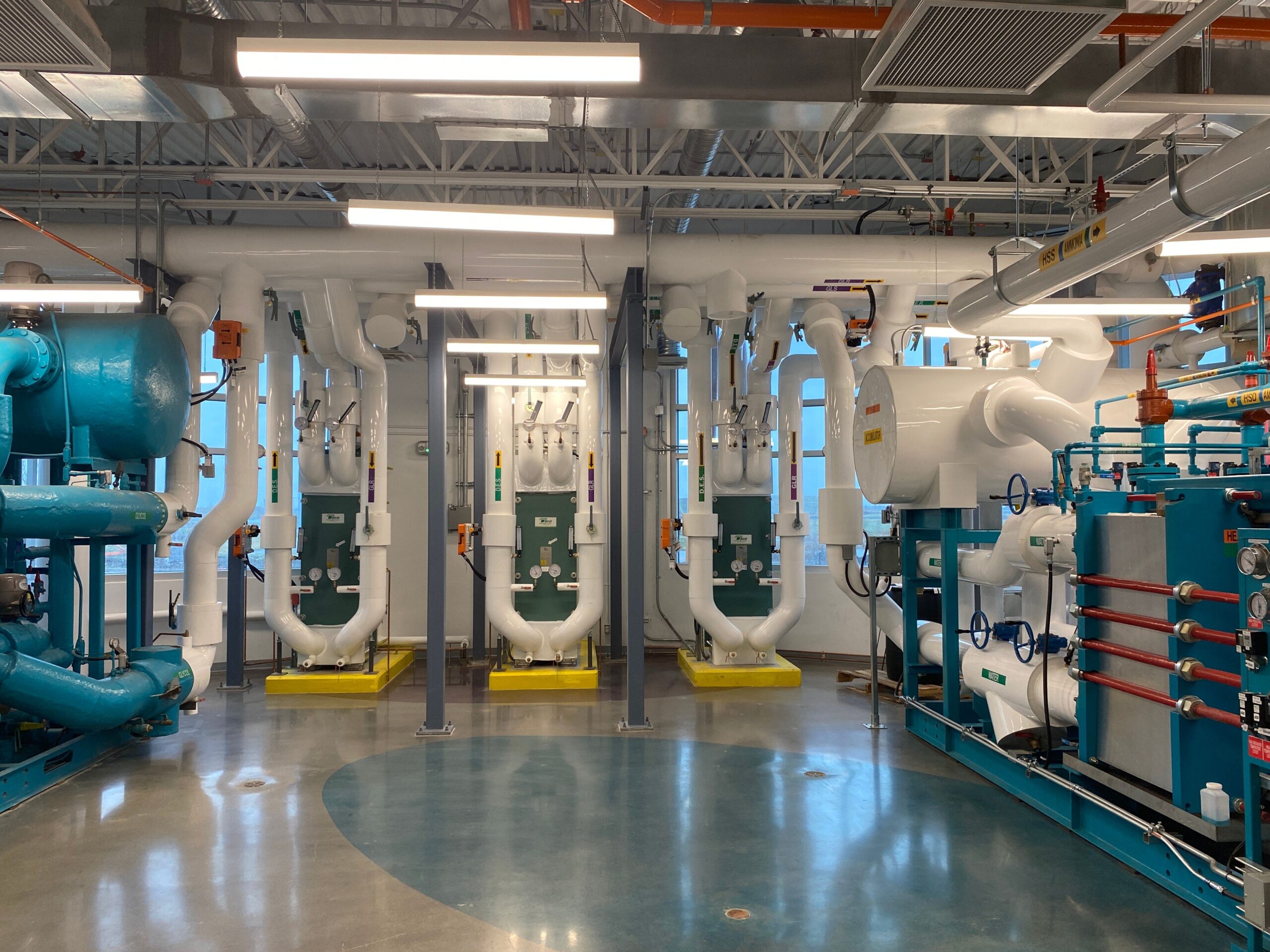
The Mikkeli design includes closed-loop cooling intended to recirculate water instead of drawing continuously from the municipal supply. It is also designed to support heat recovery, allowing thermal energy produced by the compute equipment to be reused locally if an appropriate customer and distribution system can be established.
That qualification is important because producing waste heat is not the same as creating a useful energy source. A data centre needs a district heating system, industrial process, or other nearby customer capable of taking the heat at the required temperature and times. In Helsinki, a separate AI facility has already linked recovered heat to an identified customer, showing how compute and local energy systems can be planned together.
The Nordic supply chain is expanding with compute
Construction spending is also spreading through the Nordic engineering and contracting market because AI facilities require specialist electrical, cooling, mechanical, power, security, and commissioning work. As regional contractors reorganise around data centre demand, infrastructure spending is reaching businesses well beyond the companies selling AI processors or cloud capacity.
Cerebras and Compute Nordic are presenting Mikkeli as a long-term industrial project rather than a temporary construction programme. Pyry Virrantaus, chief executive of Compute Nordic Finland, said: “The clearest measure of a project like this isn’t the number of construction jobs it creates upfront; it’s what remains ten or twenty years later.”
The claim will ultimately be tested against the permanent technical work that remains once construction crews leave. Data centre operations, networking, security, power engineering, and facilities management can support skilled employment, although modern facilities are capital-intensive and do not necessarily create large numbers of jobs relative to their investment value.
For Cerebras, securing capacity also illustrates how competition in AI chips is extending into infrastructure. Selling specialised processors is only one part of the commercial model when customers increasingly consume AI performance as cloud capacity. Power, facilities, and regional deployment therefore become part of making the hardware commercially usable.
A European location can add further value where customers care about latency, data residency, or the jurisdiction in which workloads run. Yet those advantages have to be balanced against electricity supply, construction cost, grid constraints, and local acceptance as ever-larger facilities compete for physical resources.
Mikkeli still has later phases to deliver, and the regional economic estimates will need to survive the transition from modelling to operation. However, 50MW already under construction and seven-year commercial commitments make it a more concrete test of Europe’s AI infrastructure boom than projects whose most developed asset remains a planning announcement.


