

Summary
- Hanover-based INLEAP Photonics has raised approximately €20 million in a seed round led by UVC Partners.
- Funding will support series production, testing, certification, sales, and further development of laser-based counter drone systems.
- The move from industrial laser technology into defence shows how European dual-use companies are trying to turn engineering capability into deployable infrastructure protection.
German laser specialist INLEAP Photonics has raised approximately €20 million to move its counter drone technology towards series production, as Europe’s defence investment boom increasingly reaches the less glamorous work of manufacturing, testing, and certification.
The seed round was led by UVC Partners, with Germany’s HTGF, Poland’s Balnord, Estonia’s Sentris, and Denmark’s Scale Capital also participating. INLEAP says the capital will expand production and testing capacity, support further research and development, strengthen quality assurance and certification, and fund European sales and service expansion.
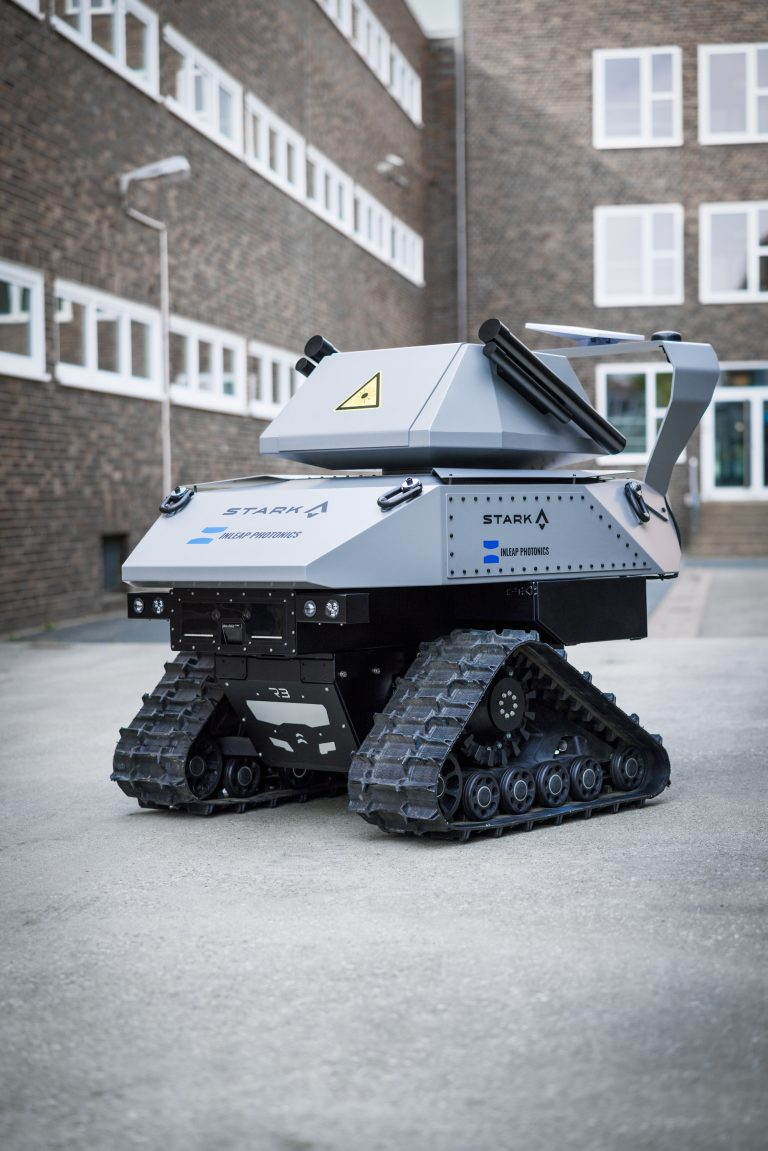
The Hanover company began with high speed laser beam steering technology developed for industrial applications and has adapted that engineering to systems intended to disable drones. Its FASTLIGHT SHIELD product directs a concentrated laser at selected parts of an unmanned aircraft, while a mobile configuration combines the effector with an unmanned ground platform and counter drone software.
Those performance descriptions remain company claims rather than independent evidence of battlefield effectiveness. INLEAP is nevertheless beyond the laboratory concept stage, working with Germany’s Federal Ministry of Defence and the Bundeswehr Cyber Innovation Hub on testing intended to expose the technology to more realistic operating conditions.
Manufacturing becomes the harder test
The funding plan is notable because much of the money is aimed not at discovering a new physical principle but at making an existing system reproducible. INLEAP says series production requires standardised assembly and testing, defined acceptance conditions, dependable supply chains, and quality controls capable of ensuring that one manufactured unit behaves like the next.
That transition is becoming increasingly important across Europe’s defence technology market. Venture-backed companies can build prototypes quickly, particularly when commercial components and existing industrial technologies can be adapted for military use, while defence customers need equipment that can be maintained, supplied in quantity, integrated with existing command systems, and accepted through procurement and safety processes.
Counter drone systems make the problem harder because there is no single interception method suited to every environment. Electronic warfare can disrupt communications or navigation but may struggle against autonomous systems, while missiles and conventional ammunition can become uneconomic against large numbers of inexpensive drones and create additional risks around populated sites.
Directed energy promises a lower marginal cost per engagement, but performance depends on power, atmospheric conditions, targeting, range, and the ability to keep sufficient energy on the right part of a moving target. INLEAP says its beam steering technology originated in demanding industrial settings and avoids some of the moving mirror systems used by conventional designs.
The company claims an operational range of up to three kilometres for its mobile configuration and places considerable emphasis on safety around nearby personnel. Those assertions will require independent evidence and relevant certification before airports, energy companies, transport operators, or other civilian infrastructure owners can treat the system as an operational security tool.
Dual-use technology returns to industrial roots
INLEAP’s development path illustrates the increasingly porous boundary between industrial and defence technology in Europe. Precision optics, robotics, autonomous navigation, sensors, advanced materials, and manufacturing software all have established civilian uses, while the changed security environment has created demand for variants designed around military and critical infrastructure requirements.
The company remains active in industrial laser applications alongside defence, giving it an engineering base that predates the current investment surge. That can support technical maturity and supplier relationships, although defence markets introduce longer procurement cycles, export controls, certification requirements, and customers dominated by governments and major infrastructure operators.
INLEAP has partnered with German defence company STARK on integrating its laser technology with unmanned systems, while a six-month programme with the Bundeswehr Cyber Innovation Hub is testing the counter drone platform in swarm scenarios. Programmes of this kind can bring developers closer to operational users, but successful trials still have to translate into repeat orders before production investment generates durable revenue.
European defence spending is creating a favourable financing environment for companies able to make credible claims around regional production and technological control. Yet supply resilience depends on more than where a company is headquartered: optical components, laser sources, electronics, semiconductors, software, and manufacturing equipment can all expose dependencies once production volumes rise.
INLEAP says part of the new capital will therefore go into supply chains alongside standardised manufacturing and quality assurance. A prototype demonstrates that an engineering approach may work; a production operation has to show that it can be delivered repeatedly, serviced, certified, and integrated into a customer’s existing systems.
Laser weapons have attracted ambitious promises for decades, and technical progress does not remove their physical constraints. INLEAP’s financing is therefore better understood as a test of industrialisation than as evidence that directed energy has already solved the counter drone problem. Manufacturing performance, independent testing, certification, and orders will provide the next meaningful evidence.


