

Summary
- GXO’s Venlo site now uses 127 Exotec robots, 60,000 storage locations, eight picking stations, and 200 metres of conveyors.
- The system handles between 40,000 and 70,000 pieces daily and reaches 2,200 order lines an hour at peak.
- The deployment shows warehouse automation being designed around seasonal variability and SKU complexity rather than simply replacing individual manual tasks.
GXO Logistics has deployed 127 Exotec warehouse robots at its Venlo operation for Guess, building an automated fulfilment system capable of handling as many as 70,000 pieces a day across the fashion company’s distribution network.
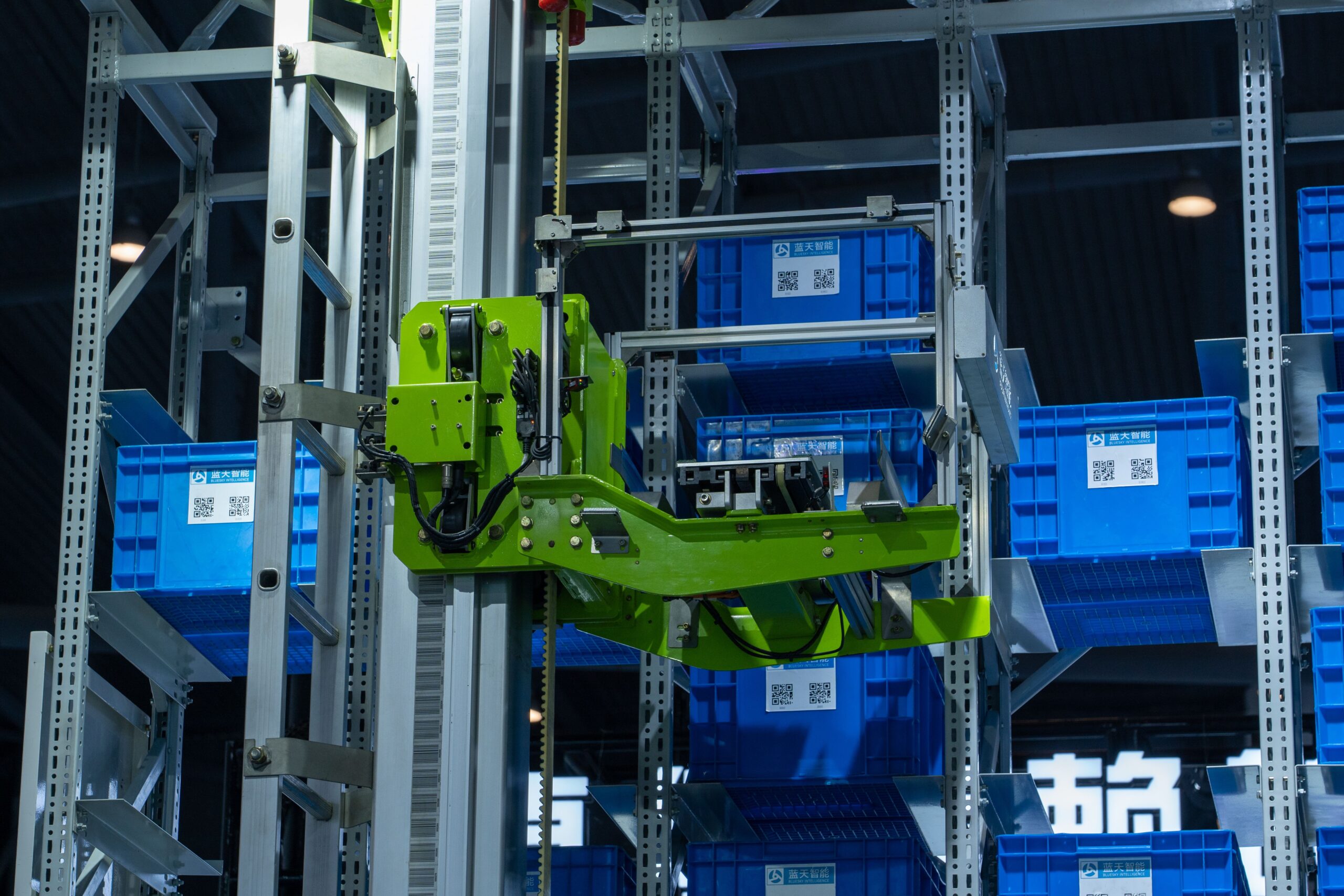
The Dutch facility combines the robots with 60,000 rack locations, eight goods-to-person picking stations, and roughly 200 metres of conveyor infrastructure. At peak, the installation can process 2,200 order lines an hour, while daily volumes range from about 40,000 to 70,000 pieces depending on demand.
GXO operates the site on behalf of Guess, handling inbound logistics, quality-control and garment-conditioning work, and outbound distribution to stores across Europe, the Middle East, Africa, and Asia. The operation is also preparing to absorb additional e-commerce fulfilment for Benelux, adding another demand profile to a site already dealing with seasonal fashion cycles and a large catalogue of sizes, colours, and product lines.
Exotec acted as systems integrator as well as robotics supplier, joining its Skypod storage system with conveyors and specialist handling equipment rather than treating the robots as an isolated automation project. That structure is important because warehouse robotics often encounters its hardest problems at the boundaries between systems, where inventory has to transfer between storage, picking, packing, consolidation, and dispatch.
Fashion exposes the limits of fixed automation
Fashion logistics has an unusually awkward demand pattern for automation because product ranges turn over quickly while volumes rise and fall around launches, promotions, seasons, and regional demand. A warehouse can therefore need very high capacity at certain points in the year without wanting to carry the cost of permanently overbuilding every part of the operation.
The Venlo system uses mobile robots that travel beneath and vertically along storage racks, retrieve containers, and bring them to operators rather than requiring workers to walk through large storage areas. Goods-to-person architecture can reduce travel inside a warehouse, although the broader benefit depends on how effectively receiving, replenishment, picking, packing, and dispatch remain balanced around it.
That balance becomes difficult when one automated component processes goods faster than the next stage can accept them. Exotec’s implementation includes a spiral conveyor for vertical movement, equipment for joining and separating trays and boxes, and an automated tote-feeding process intended to reduce those hand-off bottlenecks. The deployment is consequently closer to a redesigned material flow than a fleet of robots inserted into an otherwise unchanged warehouse.
Its performance numbers provide more useful evidence than broad claims about automation. The operation is handling up to 70,000 pieces a day and 2,200 order lines an hour at peak, while Exotec says processing has been brought down to a single day. Those figures still need to be understood within the specific layout and workload of the Guess operation, but they show the physical scale at which the system is running.
Flexibility becomes an infrastructure question
Robotics suppliers increasingly sell flexibility alongside productivity, because businesses do not necessarily know what their warehouse will be asked to handle five years after installation. Fixed conveyor and storage systems can deliver enormous throughput, but changing their layout or capacity may require substantial engineering work and operational downtime.
Mobile systems offer a different trade-off by allowing operators to add robots or storage as demand changes, although the surrounding infrastructure still has physical limits. Workstations, charging capacity, conveyors, packing processes, loading bays, software, and people all have to expand with the robot fleet if additional machine capacity is to translate into completed orders.
Software therefore becomes as important as the machinery. Every container has to be located, orders have to be sequenced, robots need to avoid congestion, urgent work must be prioritised, and inventory records have to remain synchronised with the systems used by GXO and Guess. Once automation is responsible for a large share of physical movement inside a facility, software availability becomes a direct operational dependency rather than an administrative convenience.
The single-integrator approach chosen at Venlo also reflects a procurement issue familiar across enterprise technology. Combining the strongest component in every category can produce a technically sophisticated system, but it can also leave an operator coordinating several suppliers when interfaces fail. Giving one provider responsibility for the integrated system reduces some of that boundary risk while concentrating a larger part of the operation around one supplier’s architecture.
Automation changes where logistics risk sits
As warehouses automate, operational resilience shifts towards a mixture of mechanical, software, and cyber controls. A manual process may slow when staffing is tight, whereas an automated warehouse can lose significant throughput when a central software service, conveyor, workstation, or network component fails. Maintenance planning, spare parts, monitoring, and the ability to operate through partial failures therefore become part of the business case.
The economics are shaped by the workload rather than the headline robot count. A highly automated installation works best when enough order volume passes through it to justify the equipment and integration, but capacity also needs room for seasonal peaks. For a third-party logistics operator such as GXO, that calculation is tied to customer contracts, future volume assumptions, labour availability, and how long the site is expected to support the same or expanding operations.
Venlo provides a relatively concrete example of the shift because the system has moved beyond a pilot and is processing a live international fashion operation. Its 127 robots sit within a wider arrangement of racks, conveyors, picking stations, software, and human work, which is a more representative picture of warehouse automation than the familiar image of a robot moving a box across an empty floor.
As GXO adds Benelux e-commerce volume and Guess’s distribution requirements continue to vary with seasons and product cycles, the useful measure will be whether throughput can expand without repeated redesign of the facility. The deployment has already demonstrated the physical scale of the technology; the longer test is whether the system’s promised flexibility survives the changing workload it was built to absorb.


