

Summary
- The first EIC Advanced Innovation Challenges cohort selected 20 projects from 709 applications across 39 countries.
- Ten projects focus on physical AI and ten on new biomedical testing approaches.
- Each receives €300,000 initially, while stronger projects can compete for up to €2.5 million after validation and benchmarking.
European deep-tech funding is being given a more explicit stopping point, with the European Innovation Council backing 20 projects whose access to larger grants will depend on meeting technical milestones rather than simply completing an initial research programme.
The first Advanced Innovation Challenges cohort, announced on 10 September, divides evenly between physical AI and new biomedical testing methods. The EIC selected the projects from 709 applications spanning 39 countries, giving each €300,000 for up to nine months of validation, benchmarking, and development.
The strongest projects can later compete for grants of up to €2.5 million to move closer to real-world deployment. The structure deliberately concentrates more money on technologies that demonstrate progress, bringing a stage-gated approach into a European funding system more accustomed to awarding a defined grant against a work programme at the beginning.
Although €300,000 is modest by deep-tech standards, the programme is intended to test a funding model as much as the projects themselves. Europe has extensive research support, yet commercialisation can stall when prototypes encounter engineering, certification, customers, or operating conditions that were not central to the laboratory phase.
Physical AI leaves the software environment
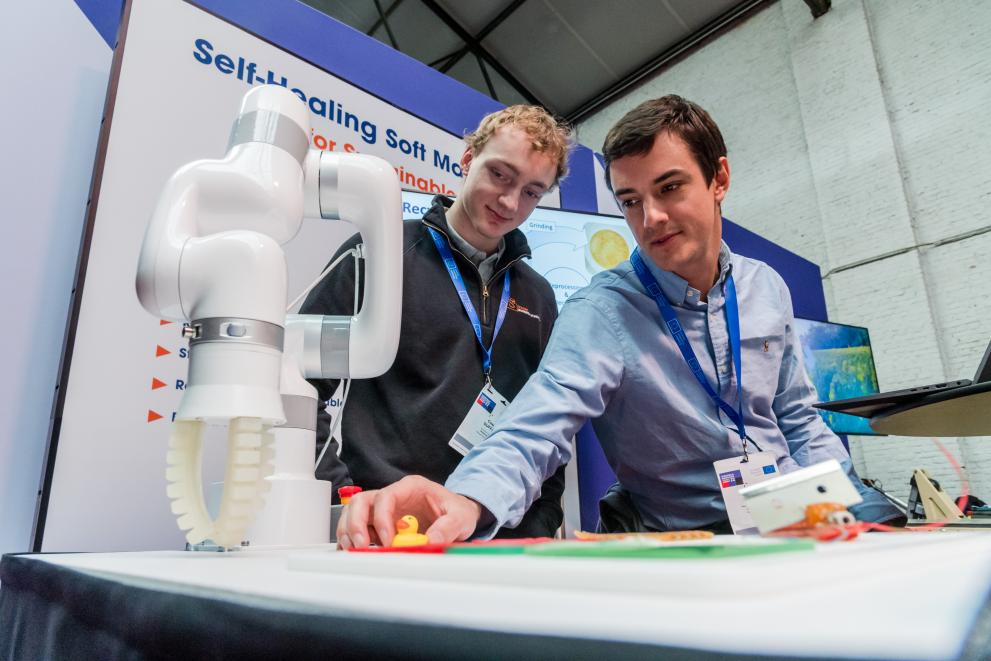
Ten projects sit under a challenge focused on embodied or physical AI, where models must perceive and act through machines rather than operate solely through text or digital interfaces. Proposed applications include logistics, industrial work, maritime environments, rescue operations, and autonomous laboratories.
Physical systems encounter failure modes that ordinary software can avoid. Sensors produce noisy data, mechanical components wear, objects move unpredictably, and a poor decision by a robot can damage equipment or injure somebody rather than merely return an incorrect answer.
The EIC consequently requires participating technologies to have progressed beyond an early concept. Physical-AI applicants were expected to have at least a prototype around technology readiness level four and to demonstrate access to testing infrastructure and interest from potential users.
That user requirement is significant because robotics projects can spend years improving technical performance without proving that a warehouse, factory, laboratory, or logistics operator wants the system badly enough to redesign work around it.
Under the stage-gated model, a project showing credible technical progress can move towards a second phase where development and testing happen in more realistic environments. Failure to hit the relevant milestones allows the programme to stop funding before considerably larger sums are committed.
Biomedical technology receives the same discipline
The other ten projects concentrate on New Approach Methodologies intended to replace, reduce, or refine animal use in biomedical research and testing. The selected portfolio includes approaches such as tumour-on-chip systems, computational methods, digital twins, and tools for assessing therapies.
Although these technologies appear far removed from robotics, they share similar commercialisation difficulties. Buyers need evidence that a method produces reliable results under realistic conditions, regulators may need confidence in new validation approaches, and developers often require specialised facilities before a product can generate substantial revenue.
Staged funding attempts to make those barriers visible earlier. Rather than assuming every technically interesting project should receive enough money to pursue its original plan indefinitely, the programme asks whether evidence is strengthening as development proceeds.
Milestones can themselves be badly designed, however. Research does not always follow a linear path, while an unexpected result can represent useful progress even when it fails to satisfy a target written months earlier. The EIC will therefore have to show that stage gates distinguish weak execution from genuine technical uncertainty rather than rewarding teams best able to optimise work around bureaucratic measures.
The ARPA influence reaches Brussels
The EIC explicitly describes Advanced Innovation Challenges as a more challenge-driven, stage-gated model, drawing from approaches associated with high-risk research agencies. The intention is to define a difficult technological outcome, fund competing routes towards it, and increase support when evidence justifies doing so.
Europe’s institutional environment makes direct comparison with US agencies imperfect. EU programmes work across member states, universities, startups, regulators, and procurement systems, while successful technology still enters a commercial market fragmented by national practice.
That means a strong funding mechanism can solve only part of the problem. A robot reaching the required readiness level still needs customers and integration partners, while a biomedical method may need regulatory acceptance before buyers can use it routinely.
The Commission’s broader policy programme is increasingly addressing those later stages as well, with new procurement and innovation legislation intended to help public authorities become more useful customers for developing technologies.
The 20 projects began work on 1 September, so meaningful evidence will come from what survives the first phase rather than from the large number of applications. A stage-gated programme demonstrates its value when it can stop weak projects as confidently as it expands strong ones.
If that discipline survives contact with European funding politics, Advanced Innovation Challenges could become more useful than another scheme whose success is measured primarily through money awarded. Deep technology is uncertain by definition, and public funding cannot remove that uncertainty, but it can decide whether the next tranche of capital follows evidence rather than inertia.


