Summary
- European orders for Fujitsu MONAKA servers will open in December, with initial shipments expected from April 2027.
- Fujitsu's Arm-based processor supports selected AI inference workloads without dedicated GPUs and can operate alongside accelerators for larger models.
- Manufacturer benchmarks and flexible cooling configurations position the platform as an alternative for organisations balancing application performance against infrastructure expenditure.
Fujitsu is bringing its latest processor architecture to European customers, targeting organisations seeking to introduce artificial intelligence applications without necessarily investing in dedicated accelerated computing infrastructure.
Its subsidiary, Fsas Technologies, will begin accepting European orders for Fujitsu MONAKA servers in December, with shipments starting from April 2027 according to the configuration selected.
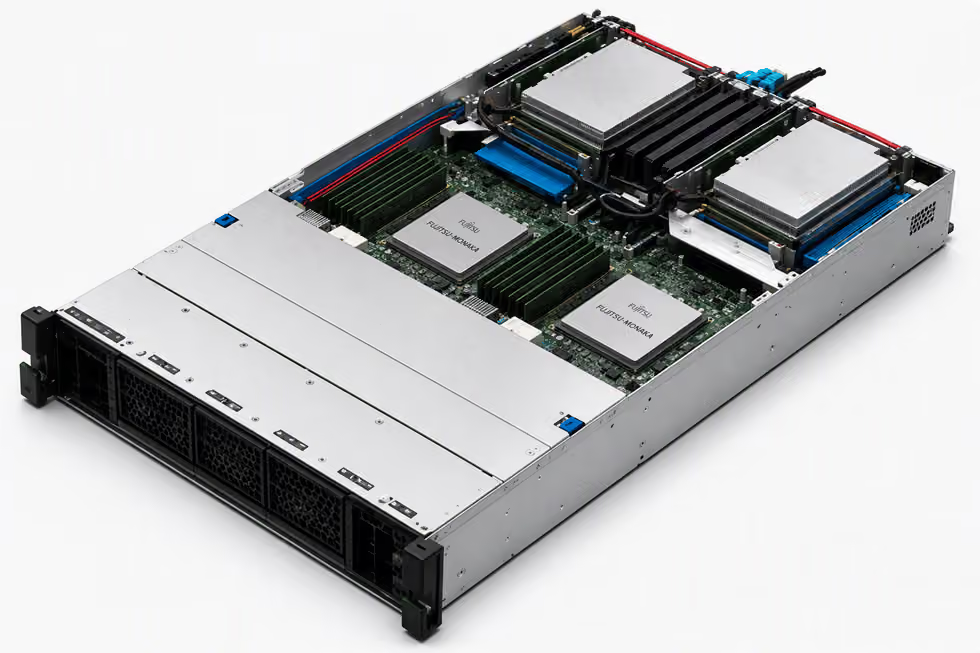
The servers incorporate Fujitsu’s MONAKA central processing unit (CPU), an Arm-based processor drawing on technology developed for the company’s supercomputing platforms.
While much of the investment in AI infrastructure has concentrated on graphics processing units (GPUs), Fujitsu is targeting applications for which general-purpose processors can provide sufficient computational performance and memory bandwidth.
Available configurations will include 1U and 2U rack-mounted servers, with options for air and liquid cooling. Under specified operating conditions, the air-cooled 1U configuration can operate at ambient temperatures of up to 40°C.
That flexibility could allow organisations to deploy selected AI workloads within facilities that were not originally designed to accommodate high-density accelerated computing equipment.
Matching processor architecture to inference requirements
The commercial requirements of AI infrastructure are changing as businesses move from developing and testing applications towards running them continuously within their operations.
While training advanced language models typically demands substantial parallel computing resources, the requirements of inference — using an existing model to generate responses — vary according to model size, application complexity, and the number of simultaneous users.
Organisations introducing internal document assistants, for example, may have considerably different performance requirements from businesses operating high-volume customer-facing AI services.
Fujitsu’s architecture addresses workloads for which memory throughput can be particularly important. Language model inference involves accessing stored model parameters repeatedly, making the speed at which information can move between memory and processing resources a significant determinant of performance.
The MONAKA processor operates at frequencies of up to 3.8GHz and supports DDR5 memory at transfer rates of up to 8,800MT/s. Fujitsu reports server memory bandwidth of 1,000GB/s.
Its manufacturer testing recorded inference performance of 307 tokens per second using OpenAI’s gpt-oss-20b model and 55.2 tokens per second using Gemma 4 31B, both at a batch size of two.
Those figures provide a more specific indication of the workloads Fujitsu is targeting than general comparisons between CPUs and GPUs. They do not, however, establish performance across different model architectures, levels of simultaneous usage, or enterprise software environments.
For larger models and more demanding applications, the servers can operate alongside GPUs and other accelerators. That gives customers the option of introducing additional specialised processing resources without adopting a single hardware configuration across every AI workload.
Infrastructure economics extend beyond processor performance
For data centre operators, the ability to accommodate new computing equipment within existing facilities can influence the economics of deploying AI services.
High-density accelerated systems may require substantial electrical capacity and specialised cooling infrastructure. Where existing facilities cannot accommodate those requirements, introducing new equipment can involve investment in electrical distribution, cooling systems, and physical infrastructure alongside the hardware itself.
A CPU-based deployment could reduce some of those requirements when it meets the performance demands of the intended applications.
Comparing the overall economics nevertheless requires operators to consider the cost of completing a defined workload, rather than simply comparing the power consumption of individual servers.
Equipment acquisition, electricity consumption, software compatibility, and the number of systems necessary to deliver acceptable application performance all contribute to the resulting cost.
The MONAKA platform supports Armv9 and enterprise Linux distributions, giving organisations access to an established software ecosystem. Customers will still need to establish whether individual applications, libraries, and management tools operate effectively on the architecture.
Diversifying technology procurement
Fujitsu’s European introduction also reflects demand for additional choices in the semiconductor and server markets, where organisations are examining their reliance on a limited number of infrastructure suppliers.
The company is emphasising the Japanese design, development, and manufacture of its server systems, alongside arrangements intended to improve visibility over component origins and production histories.
Such information can support procurement assessments concerning hardware provenance and supplier dependency, although manufacturing location alone does not determine the full extent of an organisation’s technological independence.
The regional launch includes local sales and technical support through Fsas Technologies, connecting European customers and distribution partners with Fujitsu’s development operations.
As set out in its global MONAKA launch, Fujitsu is targeting enterprise customers, research organisations, data centre operators, and high-performance computing applications.
With European ordering beginning next month and deliveries following in 2027, the commercial test will be how effectively customers can translate the platform’s hardware specifications into lower operating costs or additional computing capacity. Application-level benchmarking against existing infrastructure will be central to those purchasing decisions.