Summary
- Índico Capital Partners and Lince Capital co-led the financing, with existing investor ActiveCap also participating.
- Beyond Vision intends to expand industrial capacity and develop its beXStream drone operations platform.
- Reported plans to produce 500–800 drones monthly describe future capacity, not current output or confirmed orders.
Portuguese drone manufacturer Beyond Vision has secured more than €28 million to expand production and develop its autonomous systems, as investment in European unmanned aircraft increasingly demands manufacturing capacity alongside advanced software.
The financing was co-led by Índico Capital Partners and Lince Capital, with participation from existing investor ActiveCap. Confirmed on 22 October by legal adviser SRS Legal, the transaction is intended to strengthen the company’s industrial operations, accelerate artificial intelligence development and support international expansion.
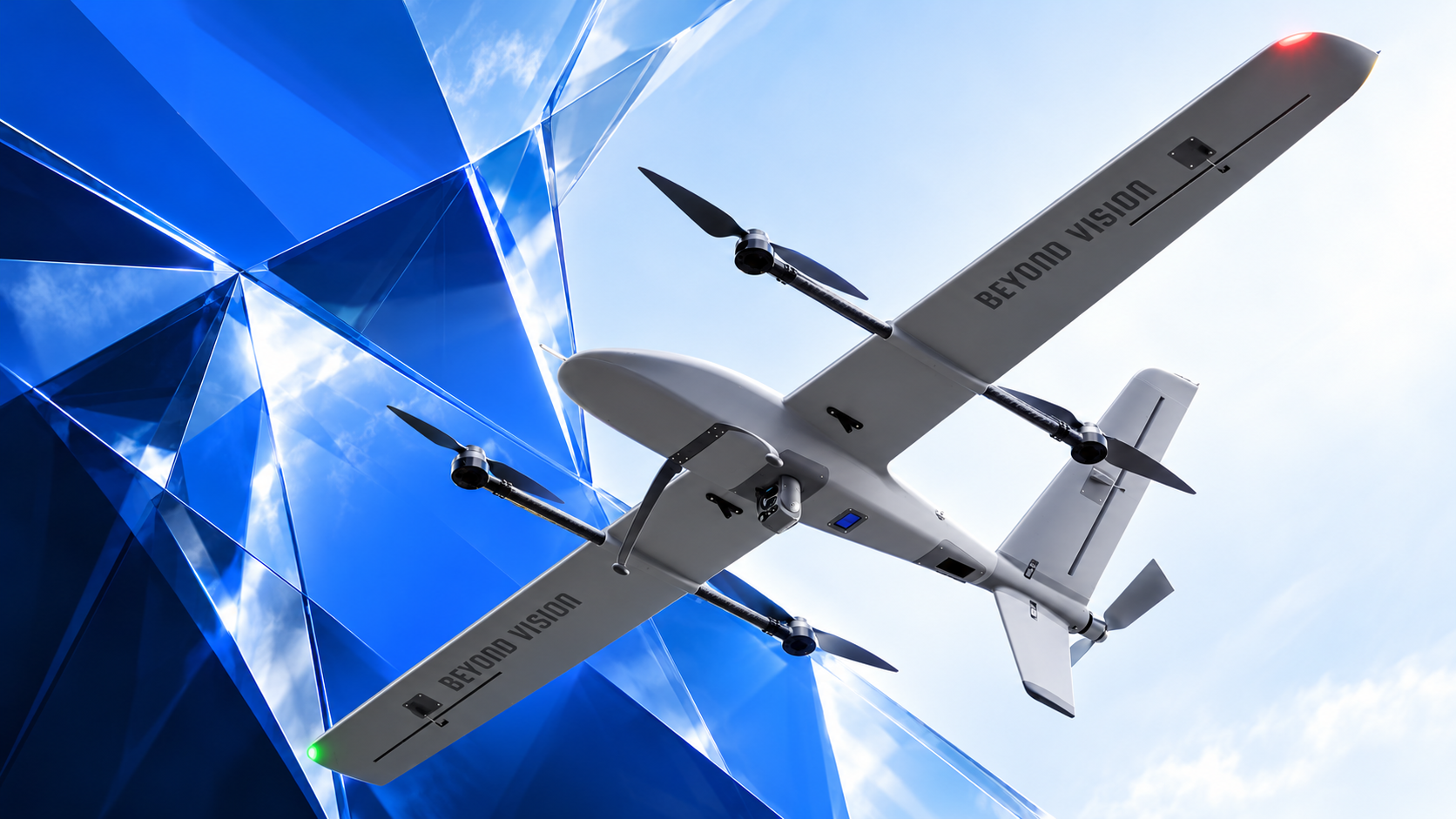
Founded in 2013, Beyond Vision is based in Alverca do Ribatejo, near Lisbon, where it develops unmanned aircraft and software for civilian, industrial, security and defence applications. Its products include multirotor drones, aircraft combining fixed-wing flight with vertical take-off and landing, and the beXStream platform for managing remote missions.
Contemporary aviation industry reporting indicates that the company plans to double the size of its Alverca production facility and target manufacturing capacity of approximately 500 to 800 drones per month. Those figures concern planned capability rather than an established output rate, and the announcement does not disclose an order book sufficient to support the proposed volume.
That distinction is commercially important. Increasing factory capacity can help a manufacturer deliver more aircraft, but revenue depends on demand, component availability, production quality and the ability to support equipment after delivery.
Production presents a different challenge from development
Unmanned aircraft require a combination of airframes, propulsion equipment, navigation systems, sensors, communications and flight control software. Producing larger numbers consistently involves coordinating those elements through repeatable manufacturing and testing processes.
Beyond Vision markets several aircraft types, including the BVQ418 quadcopter, BVQ825 octocopter and BVT516 fixed-wing vertical take-off and landing platform. Their characteristics differ because customers require different combinations of portability, payload capacity, endurance and operating flexibility.
Such variation complicates production planning. Components suitable for one aircraft may not be interchangeable with those required by another, while specialised sensors or communications equipment can create additional differences between customer configurations.
Manufacturers also need procedures for recording product changes, checking assembled systems and tracing components where technical faults are identified. Expansion can place pressure on those processes if output increases faster than the engineering and quality assurance resources available to support it.
Beyond Vision’s stated manufacturing target would therefore represent an increase in industrial capability only if the company can achieve the required production rate while maintaining suitable reliability, safety and customer support.
Current capacity, factory utilisation and independently audited production figures have not been disclosed through the October financing announcement. The reported target should not be used to calculate existing revenue or infer the value of contracts yet to be awarded.
Autonomy adds a software requirement
Beyond Vision develops beXStream, a platform intended to connect unmanned aircraft with remote operations and mission management. The system provides functions for planning, monitoring, executing and reviewing flights through a common interface.
For infrastructure operators, software can be as important as the aircraft itself. An inspection programme may involve repeated flights over different sites, with collected information requiring consistent identification, storage and review before engineers can act on the findings.
The same operational requirements arise when several aircraft participate in a coordinated mission. Operators need to understand the position, status and assigned tasks of each vehicle while ensuring the systems can respond appropriately if connectivity or navigation information changes.
Beyond Vision is developing capabilities for coordinating multiple autonomous vehicles, including applications involving collaborative systems. These functions require reliable communications, appropriate safety controls and clearly defined responsibility for decisions made during a mission.
The company describes its technology as AI-enabled, although that term covers different functions. Image processing may assist with identifying objects or conditions, while other algorithms can support planning, navigation and the adjustment of flight behaviour.
Each application needs its own performance evidence. A successful demonstration of remote flight control does not establish that an aircraft can perform an unrestricted autonomous mission, and coordination between several vehicles is not proof that the system can operate safely under every possible condition.
The October investment is intended to fund continued development, but the company has not published independent comparisons of its autonomy software against competing products or quantified the operational savings achieved across its customer base.
Civilian and defence markets require separate evidence
Beyond Vision supplies technology with civilian and military applications. Infrastructure inspection, emergency response and security monitoring can share some equipment requirements, although the environments in which the aircraft operate may be substantially different.
A utility company may prioritise repeatable inspections, reliable data capture and integration with maintenance records. Defence customers may require equipment that can operate under more demanding communications conditions and meet specific procurement, support and security requirements.
The company is registered as a NATO supplier. This registration establishes its standing within relevant supplier arrangements; it does not mean NATO has certified every aircraft or awarded a purchase contract covering the full product range.
The company’s products have also been used in military testing and exercises, according to its published material. Such activity provides experience in demanding applications without demonstrating that every product has completed qualification for operational deployment.
International sales can bring further obligations concerning export controls and the transfer of dual-use technology. Restrictions may depend on the technical characteristics, destination and intended use of the equipment or software concerned.
The financing is intended partly to extend Beyond Vision’s reach into additional markets, including the United States. Aviation industry reporting identifies American opportunities involving emergency response, but it does not establish completed expansion on the scale envisaged by the company.
Capital must support both factories and customers
Industrial expansion can consume substantial working capital before sales are completed. Manufacturers may need to order components, employ additional engineers, install production equipment and maintain inventories well before delivering finished aircraft.
Those costs sit alongside software development and the support required by customers operating equipment already in the field. Production growth also increases the importance of spare parts, technical documentation and procedures for resolving faults.
Investors backing dual-use technology must therefore consider whether the business can translate its products and engineering expertise into predictable manufacturing and commercial processes.
For Beyond Vision, the funding establishes greater financial support for those ambitions, but the company has not disclosed a valuation, audited revenue, profitability or the allocation of the financing between specific projects.
Its proposed Alverca expansion provides one measurable objective. Subsequent evidence can establish whether manufacturing capacity increases as planned, how many aircraft are delivered and which markets generate sustained orders.
Beyond Vision has established a portfolio of aircraft and operational software, supported by more than a decade of development. The investment gives it an opportunity to expand that business, with the commercial results dependent on production performance, customer adoption and the practical reliability of its autonomous technology.