Summary
- TUM and NEURA Robotics have opened the RoboGym at Munich Airport’s LabCampus, with 48 training cells and around 100 robots initially.
- The three-year research programme represents €17m in planned investment, including approximately €11m from NEURA.
- The facility will collect real-world interaction data and run simulations, while the new 4NE1 Gen 4 remains subject to industrial performance validation.
The Technical University of Munich and NEURA Robotics have opened a training centre with 48 robot training cells and approximately 100 machines, creating a facility where researchers and industrial partners can collect the physical interaction data required to develop more capable robotic systems.
The TUM RoboGym opened on 22 October at LabCampus, Munich Airport’s innovation district. It occupies more than 2,300 square metres and provides equipment for physical training, simulation and AI model development, with initial work concentrating on industrial manufacturing and internal logistics.
The Technical University of Munich (TUM) and NEURA Robotics established the centre through a collaboration initially planned to run for three years. When the project was announced in March, the partners put the investment at €17 million, including approximately €11 million from NEURA for robots and supporting infrastructure.
The opening also provided the setting for NEURA’s introduction of its 4NE1 Gen 4 humanoid. The company says the revised robot is lighter than its predecessor and incorporates changes intended to support more reliable movement and manipulation.
Although robotics research has advanced considerably, collecting useful training data remains an expensive part of developing machines that can handle unfamiliar physical tasks. Unlike text-based AI systems, which can be trained using extensive digital records, physical robots need examples of movement, contact and interaction with real objects.
Teaching robots through physical interaction
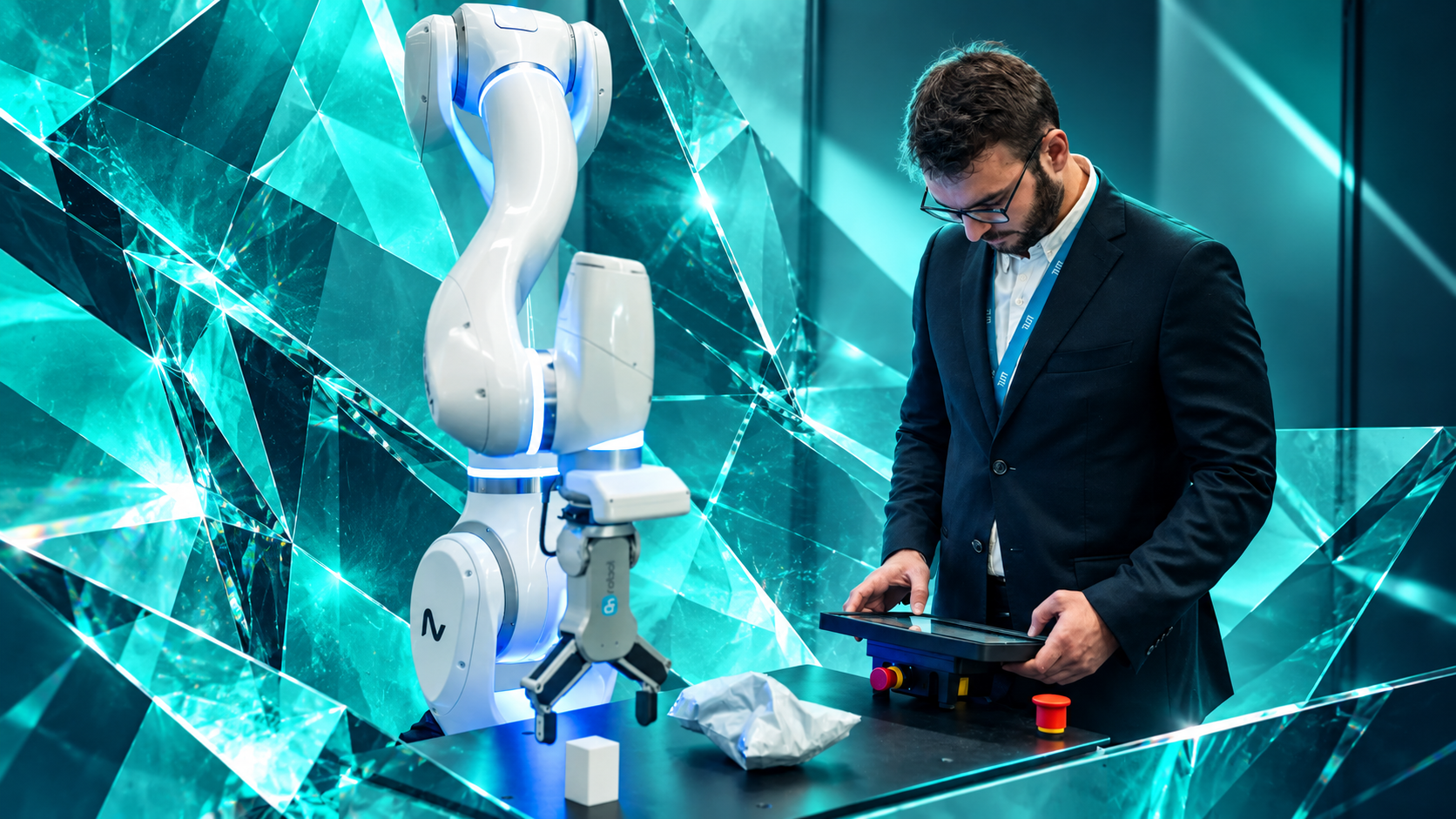
The RoboGym is designed to produce those examples systematically. Its training cells provide environments in which robots can practise tasks while sensors record their actions and the results.
According to TUM, approximately 100 humanoid and service robots will initially use the 48 cells. The facilities include robotic arms, mobile systems, motion-capture equipment and computing resources for AI model training and simulation.
Activities include assembling components, operating tools, folding boxes and handling objects. These tasks require machines to understand an object’s position, select an appropriate movement and adjust their behaviour when the physical result differs from what was expected.
A cardboard box, for example, may change shape when pressure is applied, while a rigid manufacturing component may require precise alignment before it can be assembled. A robot needs suitable sensing and control to manage those differences without damaging objects or creating unsafe movements.
Human demonstrations can provide examples of how a task should be performed. Researchers can then use information about movements, forces and outcomes to develop models intended to reproduce or adapt those skills.
Simulation extends the process by allowing teams to examine many variations without requiring a physical robot to perform every attempt. However, an action learned in a virtual environment may behave differently when executed on actual machinery, where friction, tolerances and sensor inaccuracies influence the result.
Physical trials remain necessary to establish whether a model can cope with those differences. The combination of demonstrations, simulated examples and repeated testing is intended to improve the reliability of learned skills.
TUM says information generated through the RoboGym will be collected in a curated cloud data lake for use in developing physical AI models. Such a resource can help researchers examine which behaviours transfer between tasks and which remain dependent on a particular machine or environment.
Industrial problems supply the training work
Companies can bring specific processes into the RoboGym, allowing researchers to investigate tasks drawn from manufacturing, logistics and other practical settings. External research institutions and universities can also seek access, rather than the facilities being reserved exclusively for NEURA’s product development.
This arrangement may help businesses assess whether a proposed robotic application is technically feasible before committing to equipment for production use. A process that appears suitable for automation may still prove difficult because of variable materials, limited working space or the need to operate near people.
At the centre, researchers can adjust tasks and gather information about failures without interrupting an operating factory. Such work can identify whether a robot needs better sensing, different equipment or changes to the surrounding process.
Commercial deployment would require further evidence. A successful laboratory demonstration does not establish that a machine can work reliably across a full production shift, maintain suitable cycle times or operate economically without frequent human assistance.
Those considerations become particularly important for humanoid robots, which are intended to perform varied tasks rather than one tightly defined movement. The versatility of the design creates engineering demands involving balance, manipulation, sensing and safe physical contact.
The university’s neighbouring KI-Fabrik facility supports related research into robotic capabilities, including work with stationary dual-arm systems. Together, the facilities provide opportunities to investigate specific manipulation tasks and how the resulting techniques could be used by different machines.
A new humanoid joins the programme
NEURA introduced the 4NE1 Gen 4 alongside the opening, describing the revised model as designed with future series production in mind.
The company says the new version is approximately 20% lighter than its predecessor, with a slimmer design, revised motion control and improved physical handling capabilities. It operates using Neuron AI, NEURA’s foundation model approach for physical robotics.
The manufacturer has been developing AI models that combine different forms of sensor information to support robotic actions. Techopia previously examined NEURA’s work on touch, hearing and memory, which provides technical background to the newly introduced hardware.
The October development is distinct because it combines the new robot with a physical training facility intended to produce data and test skills. NEURA says the model is already operating in training environments, but it has not published independently audited figures establishing its reliability, production cost or economic performance across industrial deployments.
The company also intends to develop a wider international network of training centres, with Munich serving as the first location. Additional facilities would require investment, appropriate research partnerships and equipment capable of supporting the intended programmes.
The ability to transfer skills between different robot platforms is another research objective. Robots may use different arms, joints, hands and sensors, which means that a movement learned on one machine cannot necessarily be reproduced directly by another.
Researchers must distinguish the general features of a task from those dictated by the physical design of the robot performing it. A shared training dataset can assist with that investigation, but the results still need to be tested on each relevant class of equipment.
Research infrastructure faces a commercial test
The €17 million programme provides a dedicated environment for collecting information that can be difficult for individual businesses to obtain. Its industrial value will depend on whether the resulting models can perform useful tasks beyond the conditions in which they were trained.
For manufacturers and logistics operators, the relevant measures include task completion rates, error frequency, cycle time, maintenance demands and the amount of human supervision required. Improvements in isolated demonstrations are less informative than reliable operation over extended periods.
Sharing training resources may reduce some of the duplication involved when different organisations investigate similar robotic capabilities. It also creates questions about data access, commercial confidentiality and ownership of results developed through collaborative projects.
TUM has not published a complete set of commercial arrangements governing every external participant. Companies will need to determine how their process information and resulting research can be used before contributing sensitive operational material.
The RoboGym’s opening establishes a substantial research facility and a more structured source of physical training data. Over the initial three-year programme, its performance can be assessed through the skills developed, evidence from industrial trials and the extent to which participating businesses translate research results into operating systems.