

Summary
- Deutsche Telekom is preparing an application for an EU AI Gigafactory and says it is willing to invest around €1 billion if the framework is right.
- Europe plans a new tier of AI infrastructure substantially larger than the AI Factories already being built around supercomputing centres.
- Telekom says its existing Munich Industrial AI Cloud is largely booked, giving the proposed expansion an early demand signal rather than relying solely on policy ambition.
Deutsche Telekom is preparing an application for one of Europe’s planned AI Gigafactories and says it could commit around €1 billion, putting one of the continent’s largest infrastructure operators behind an attempt to close Europe’s shortage of large-scale AI compute.
Chief executive Tim Höttges disclosed the plan at DIGITAL X, while T-Systems subsequently said the investment would depend on suitable framework conditions. No project has yet been awarded, but Telekom’s interest brings a substantial potential private investor into a programme whose viability depends on commercial operators putting capital alongside European and national funding.
The EU intends Gigafactories to sit above the AI Factories already being developed around European supercomputing centres, providing substantially greater accelerator capacity for training, fine-tuning, and running large AI systems. The policy is partly about technological sovereignty, although its success will ultimately depend on whether European organisations have enough demand to support facilities whose economics require sustained use rather than occasional access.
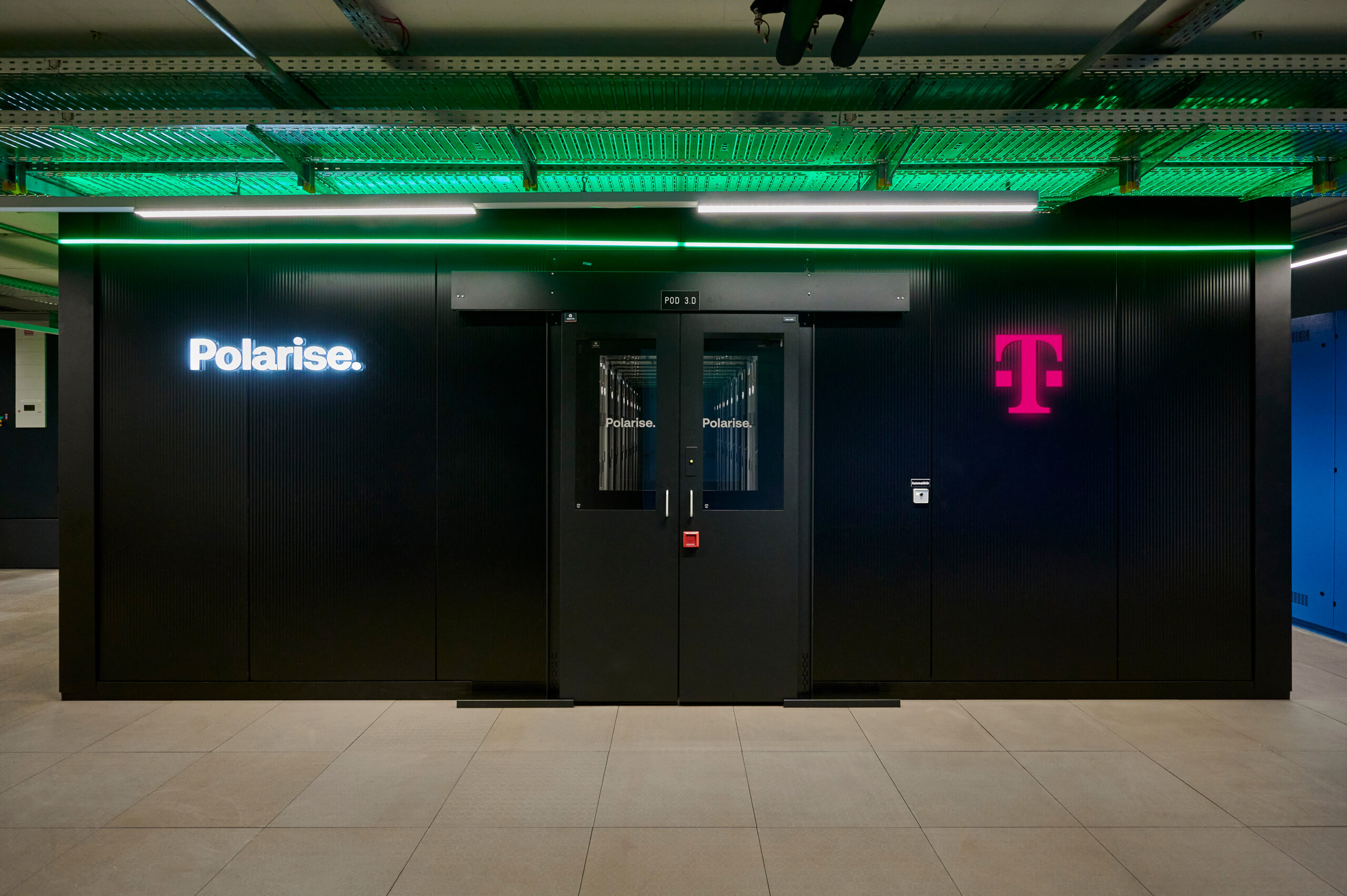
Telekom has an early reference point in Munich, where its Industrial AI Cloud combines accelerated computing with connectivity, security, cloud services, and enterprise technology. T-Systems says that system is now largely booked, a development Techopia examined in August as available capacity began tightening.
Actual utilisation provides a stronger basis for further investment than forecasts of future GPU demand alone. Large computing clusters have substantial fixed costs across hardware, buildings, electricity, cooling, networking, maintenance, and financing, making customer demand central to whether sovereign infrastructure becomes a durable market or an expensive strategic reserve.
Höttges said Telekom was working intensively on the tender and application, adding: “It should not fail due to lack of funding.” The remark is especially relevant because the Gigafactory model is intended to combine public support with much larger private commitments rather than treating advanced AI compute as wholly state-funded infrastructure.
Compute policy meets commercial demand
Europe’s shortage of AI capacity is not simply a question of processor numbers. Large systems require high-capacity networking, storage, electricity, cooling, security, and software capable of making the hardware usable by customers, while advanced accelerators themselves still come through supply chains dominated by companies outside Europe.
A European-controlled facility can therefore improve choice over hosting, governance, and contractual control without creating technological independence from global chipmakers. The more practical sovereignty test is whether European organisations can obtain enough compute on terms that meet their legal, commercial, and security requirements without being locked into a very small group of external infrastructure providers.
Telekom is pitching the opportunity around industrial demand rather than frontier-model development alone. T-Systems points towards manufacturing, robotics, predictive maintenance, pharmaceuticals, healthcare, public services, cybersecurity, and European language models, all of which give the infrastructure a broader potential customer base than companies attempting to build the largest general-purpose models.
That focus is commercially important because the facilities need workloads that persist after the current AI investment cycle changes. Europe already has strong industrial companies with proprietary engineering, manufacturing, healthcare, and scientific data, but those organisations still need a reason to move workloads onto a new compute platform rather than use existing hyperscale cloud services.
Integration will therefore matter almost as much as processing power. A manufacturer may have valuable training data distributed across factories, engineering systems, private cloud environments, and older enterprise applications, while healthcare and public-sector organisations face additional constraints around sensitive information and procurement.
Telecom operators can make a broader infrastructure offer because they already sell connectivity, cloud services, security, and managed technology around computing capacity. That does not guarantee competitive economics, but it creates a route for Gigafactory resources to be connected with customers’ existing systems rather than sold as isolated accelerator time.
Energy remains another constraint. AI campuses compete for large, dependable electricity connections at a time when European grids are already accommodating renewable generation, electrification, industrial demand, and conventional data-centre growth. A project can secure processors and financing yet still be delayed by power, construction, or network capacity.
Those conditions explain why the Gigafactory programme is structured around consortia rather than simply ordering machines for existing public supercomputers. Successful bidders will need to assemble capital, infrastructure, energy, hardware, software, and enough commercial demand to operate very large systems over several years.
The public-policy challenge is to avoid building capacity that is strategically attractive but commercially underused. Startups, researchers, industrial companies, and public organisations do not all purchase compute in the same way, while publicly supported infrastructure may also be expected to provide access to organisations that would struggle to secure equivalent resources commercially.
Telekom’s Munich utilisation suggests at least some European demand is real, although moving from a largely booked AI Factory to a facility measured on a much larger scale remains a significant jump. A €1 billion commitment would also cover only part of the investment required for a major Gigafactory consortium.
Europe’s AI infrastructure debate is consequently moving into a more demanding phase. The policy objective of greater control over compute is well established; the next test is whether operators can build facilities at the required scale, connect enough paying customers to them, and keep highly expensive hardware productively occupied after the initial political enthusiasm has passed.


