

Summary
- Isar Aerospace’s Spectrum rocket reached orbit from Norway on its second flight and deployed customer payloads, becoming the first privately developed rocket to reach orbit from continental Europe.
- The mission arrives as Europe tries to widen launch capacity beyond Ariane 6 and Vega-C while satellite demand and security requirements increase pressure for independent access to orbit.
- Isar still has to turn one orbital success into repeatable launch cadence, but European public programmes are increasingly treating commercial launch providers as strategic infrastructure.
Isar Aerospace has put its Spectrum rocket into orbit from northern Norway and deployed customer payloads on only its second flight, giving Europe a new commercial launch option as governments and satellite operators look for more capacity and less dependence on a narrow group of providers.
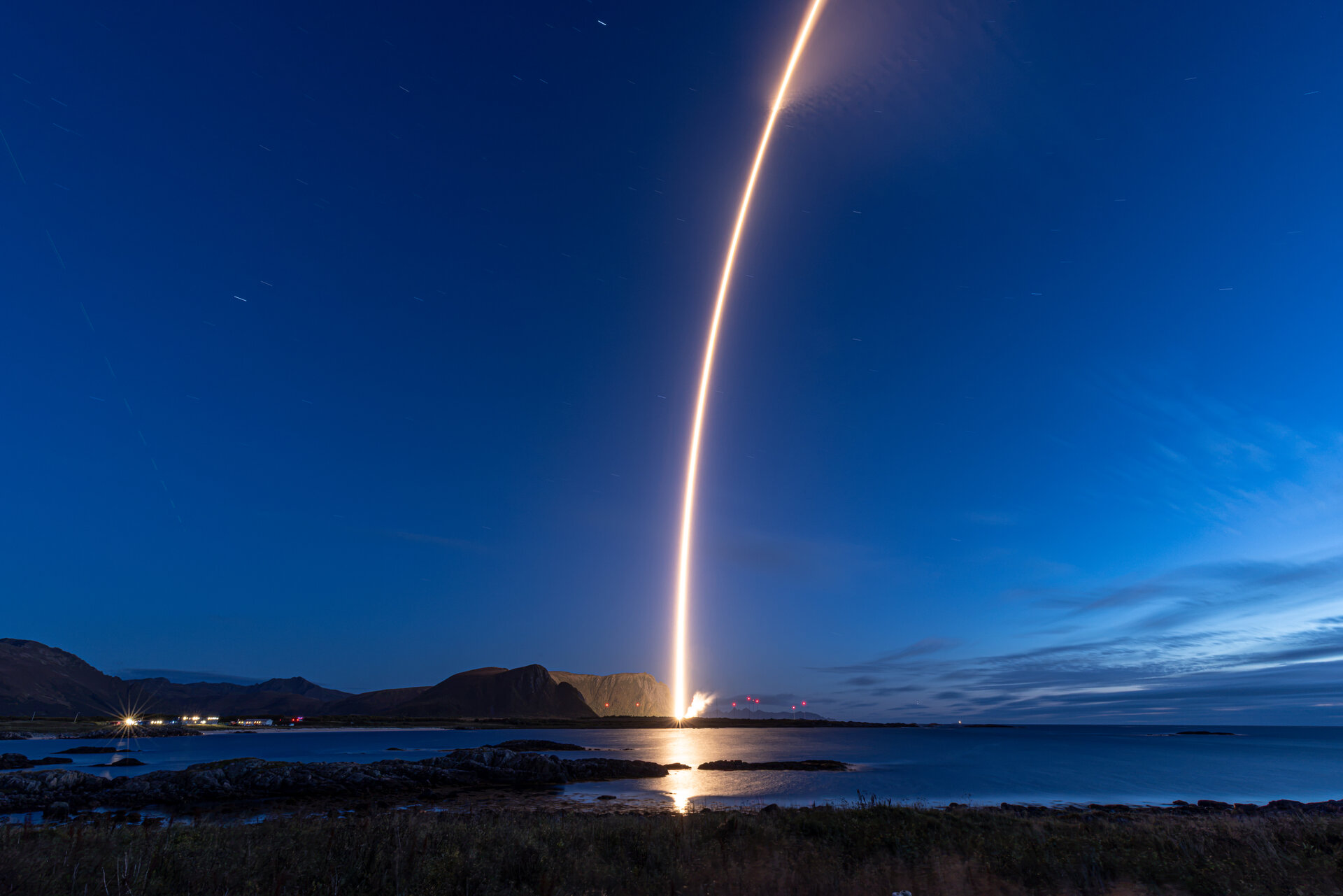
The two-stage Spectrum lifted off from Andøya Spaceport at 22:12 CEST on 5 September and reached orbit before deploying satellites and an experimental payload. The European Commission described it as the first privately developed rocket to reach orbit from continental Europe, while the European Space Agency said the flight made Isar the first provider to meet a central orbital milestone under its European Launcher Challenge.
Spectrum stands 28 metres tall and is designed to carry payloads of up to 1,000kg to low Earth orbit. Its second mission carried CubeSats and an experiment selected through European and German programmes, while the flight itself served as an operational qualification campaign intended to generate data for further industrialisation of the launch system.
The achievement follows Spectrum’s first test flight in March 2025, when the rocket cleared the pad but failed shortly afterwards. Moving from that result to an orbital mission matters commercially because launch customers ultimately buy reliability and schedule certainty rather than engineering milestones, and Europe is trying to create enough demand and institutional support for several domestic launch providers to move from development into regular service.
Europe needs more than one successful flight
European access to space has improved since Ariane 6 entered service and Vega-C returned to operation, although the market is already facing another capacity question. ESA has been considering higher launch rates as satellite deployment demand rises towards the end of the decade, while ArianeGroup is examining whether production and supply chains can support a greater number of Ariane 6 missions.
That pressure gives smaller launch systems a clearer commercial role. Large rockets remain essential for heavy satellites and constellation deployments, but institutional, scientific, defence, Earth-observation, and commercial operators also need more flexible routes to orbit, particularly where payloads cannot wait indefinitely for space on a larger shared mission.
Isar chief executive and co-founder Daniel Metzler said after the flight that “Launch continues to be the largest bottleneck for the global space industry”, arguing that Spectrum adds an alternative for institutional and commercial customers. The claim will now be tested by cadence: one orbital success validates important parts of the vehicle, but an economically useful launch provider has to manufacture rockets repeatedly, secure payloads, maintain launch infrastructure, and demonstrate that successful missions can become routine.
Public policy is increasingly being designed around that transition rather than leaving new launch companies to cross it alone. Isar signed an ESA contract under the European Launcher Challenge in August with approximately €200 million in programme commitments, while the company has also received support through ESA’s Boost! programme and previously won a €10 million European Innovation Council prize for low-cost space launch.
Launch capacity becomes industrial policy
The Commission now describes autonomous, resilient, and competitive access to space as infrastructure supporting navigation, telecommunications, Earth observation, economic activity, and security. Its proposed European Competitiveness Fund for 2028 to 2034 includes measures around launch demand, joint procurement, technology development, and ground infrastructure, effectively treating the ability to reach orbit as an industrial capability Europe cannot assume the global market will always provide on acceptable terms.
The experience of recent years explains that shift. Europe endured a period in which Ariane 6 was delayed, Vega-C was grounded after a failure, and access to Russian launch services disappeared after the invasion of Ukraine, leaving some European missions dependent on US providers. SpaceX remains the dominant commercial launch company globally, and that concentration has made launch sovereignty part of a broader European debate about technological dependencies.
Isar is one of several companies expected to introduce more competition into that market, while ESA’s European Launcher Challenge is explicitly designed to buy services from newly developed commercial systems rather than treating launcher development only as a traditional institutional programme. The agency argues that more supply should make European access to space more robust and, over time, increase pressure on providers to compete on price and service.
A sizeable gap remains between that policy objective and a mature commercial market. Rocket production is capital-intensive, launch sites have finite capacity, propulsion supply chains can constrain cadence, and customers will scrutinise reliability over multiple missions before treating a newcomer as equivalent to an established provider. Isar raised €270 million in June to expand production and its launch network, illustrating both the opportunity and the amount of capital required to pursue it.
Spectrum has nevertheless crossed the threshold separating a prospective launch provider from one that has actually delivered hardware to orbit. Europe’s next test is whether Isar and its emerging peers can convert public backing, industrial investment, and successful demonstration flights into a sufficiently frequent service that satellite operators gain genuine choice rather than another launcher that flies occasionally.


