

Summary
- Valencia-based iPronics has raised $125 million in Series B funding, taking total funding to $177 million.
- Its programmable optical switches are designed to reconfigure connections between AI compute resources while reducing networking power and complexity.
- The round reflects AI infrastructure investment moving from processors towards the networking, power, cooling, and optical systems surrounding them.
Investment in artificial intelligence infrastructure is spreading beyond the processors that dominate industry spending, with Spanish photonics company iPronics raising $125 million to expand programmable optical switching for increasingly large AI data centres.
The Series B round was co-led by Maverick Silicon and Light Street Capital, with Nvidia participating alongside Bosch Ventures, the European Innovation Council Fund, Amadeus Capital Partners, and Criteria Venture Tech. It takes total funding for the Valencia company to $177 million and will support commercial deployment and expansion.
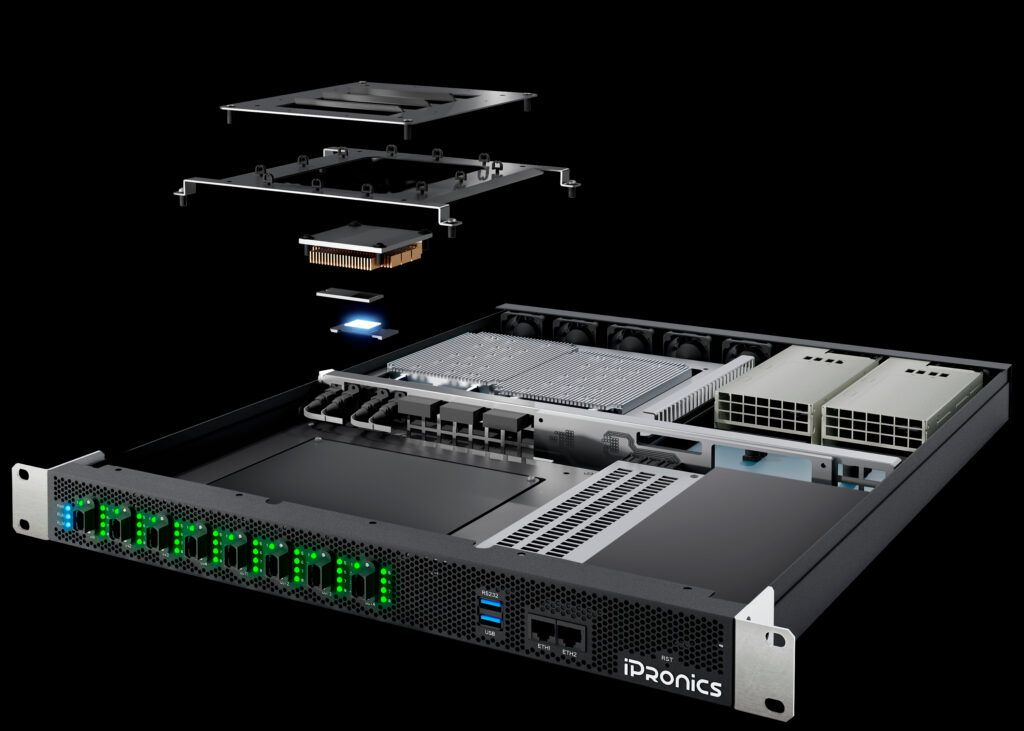
iPronics builds optical circuit switches using silicon photonics, targeting the connections that move data between processors and racks inside AI infrastructure. Its rack-mounted iPronics ONE system provides a programmable optical layer that can alter connectivity as training and inference workloads change rather than relying entirely on a fixed network topology.
The financing arrives as the physical bottleneck around AI systems broadens. Adding accelerators increases available compute, but it also raises demand for networking bandwidth, electricity, cooling, memory, and the ability to move large volumes of data without consuming an excessive share of the power budget. GPU utilisation increasingly depends on whether the network can keep those processors supplied with data.
AI spending reaches the network
Copper remains deeply embedded in data centre infrastructure, although its electrical and physical constraints become harder to manage as bandwidth and distance requirements rise. Optical links can carry more data over longer distances with lower transmission losses, which has already made photonics an important part of large computing networks.
The emerging contest concerns how far optical technology moves inside the cluster and how much switching can be performed without repeatedly converting signals between light and electricity. iPronics argues that programmable optical circuit switching can provide a more dynamic layer, connecting compute resources as requirements change and reducing some of the networking overhead associated with larger clusters.
The company combines optical switching with control software, telemetry, and APIs, allowing infrastructure operators to treat connectivity as a configurable resource rather than fixed cabling. Whether that model gains broad adoption will depend on reliability, interoperability, operational simplicity, and cost across facilities that cannot tolerate network instability.
iPronics is not alone in targeting the constraint. European photonics developers are already pursuing AI’s networking bottleneck, while semiconductor materials suppliers are reporting stronger demand for wafers used in optical components. Photonics is becoming part of the wider AI infrastructure build rather than a specialist market at the edge of it.
Nvidia’s participation adds another dimension. The chipmaker benefits when surrounding infrastructure lets customers deploy larger clusters and keep accelerators productively occupied, giving it a commercial interest in technologies that remove constraints around its core hardware. Its investments across networking and optical supply chains reflect the dependence of processor sales on the rest of the data centre keeping pace.
Europe holds part of the photonics stack
Founded in 2019 as a spinout from the Universitat Politècnica de València, iPronics retains its engineering base in Spain while expanding commercially in the United States, where it has opened an office in Santa Clara. The structure is familiar across European deep technology: intellectual property and research remain rooted in Europe while hyperscale customers and a large pool of growth capital sit across the Atlantic.
The European Innovation Council Fund’s participation gives the financing an additional policy dimension. Brussels is investing in AI factories, supercomputing, semiconductor capacity, and proposed AI gigafactories as it tries to expand regional computing capacity and reduce strategic dependence on infrastructure controlled elsewhere.
Those ambitions require more than access to processors. Networking, energy systems, storage, cooling, and optical components form part of the same physical stack, and Europe already holds significant positions in photonics research, semiconductor manufacturing equipment, speciality materials, and optical communications.
Commercialising those strengths has often proved harder than developing the underlying technology. A $125 million growth round gives iPronics more room to move from demonstration and early deployment towards the manufacturing, support, and customer engineering demands of production data centres.
Infrastructure buyers will remain cautious about technologies inserted into critical network paths, while hyperscalers can develop their own designs or work with larger networking suppliers. Programmable optical switching therefore has to show advantages under continuous operation, not merely in laboratory demonstrations or carefully controlled trials.
The round nevertheless shows where another layer of AI infrastructure competition is forming. Once processors become sufficiently numerous and expensive, the ability to connect them efficiently determines how much useful computing work the system can deliver. Networking is consequently moving towards the same strategic territory as power availability and cooling.
For iPronics, the new capital buys the chance to prove that programmable optics can become routine infrastructure rather than a specialist tool. Across the wider market, spending is already spreading through the data centre supply chain, and the companies moving data between chips are beginning to attract capital once concentrated almost entirely on the chips themselves.


