

Summary
- The Commission has cleared joint control of a Spanish data-centre venture by ACS, Telefónica, Santander, and SETT.
- Spain has authorised €719m of SETT investment alongside another €300m contribution linked to EuroHPC.
- Europe's sovereign-compute ambitions are becoming questions of infrastructure ownership, finance, power, and construction as well as AI research.
The European Commission has cleared a Spanish data-centre joint venture involving ACS, Telefónica, Banco Santander, and state-backed investment body SETT, removing a competition hurdle from Spain’s attempt to build one of Europe’s large-scale AI computing hubs.
Sociedad Gigafactoría Española de Inteligencia Artificial is intended to construct and operate data-centre infrastructure. Brussels reviewed the transaction under its simplified merger procedure and concluded that it would not create competition concerns because of the limited market positions resulting from the deal in Spanish third-party colocation.
The corporate structure forms one part of a substantially larger infrastructure programme. Spain authorised SETT to invest €719m in the public-private consortium in June, while a separate €300m contribution to the EuroHPC Joint Undertaking is intended to support participation in European AI gigafactory infrastructure.
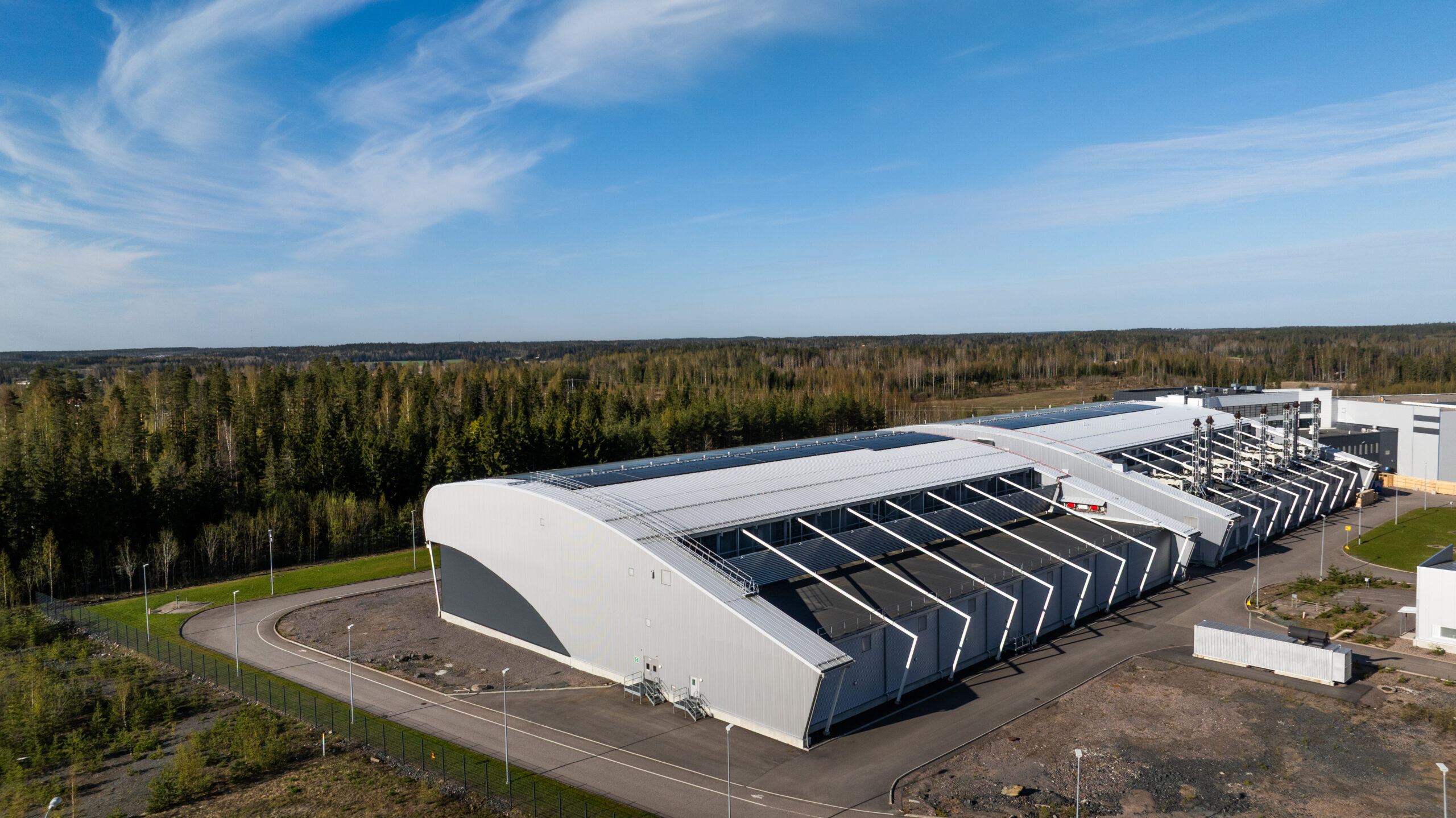
The proposed Spanish project is expected to mobilise roughly €5bn and involves locations in Móra la Nova, Tarragona, and San Fernando de Henares, Madrid. Its partners bring together construction, telecommunications infrastructure, finance, and public capital rather than the model-development expertise normally associated with headline AI companies.
Compute policy turns into infrastructure ownership
That combination illustrates the next phase of Europe’s AI strategy. Governments can announce sovereign-compute ambitions comparatively quickly, but delivering them requires land, electricity, cooling, fibre, construction capability, financing, specialised hardware, operating expertise, and customers prepared to pay for the resulting capacity.
The Commission’s merger notification describes ACS AI Infrastructure Development as a business created to promote, design, build, lease, market, operate, and maintain data centres and related IT infrastructure. Telefónica contributes connectivity and digital-infrastructure expertise, Santander financial capacity, while SETT exists specifically to invest public money in strategic technology.
Rather than leaving AI infrastructure entirely to hyperscale cloud providers, the consortium gives the Spanish state a place alongside large domestic corporate groups. That does not make the computing stack wholly sovereign because processors, networking equipment, and software may still come from global suppliers, but it gives Spain more influence over where capacity is built and how the physical assets are financed.
The government has presented the proposal as part of its attempt to host one of the European Union’s planned AI gigafactories, which are intended to provide computing capacity large enough to develop and operate advanced models. EuroHPC has become the institutional mechanism through which much of Europe’s public supercomputing investment is coordinated.
Spain’s €300m contribution to EuroHPC therefore sits alongside direct investment in the domestic consortium, creating two forms of state participation: support for the European programme and ownership exposure to the company capable of constructing the facilities.
The economics extend beyond processors
The cost of an AI gigafactory is not confined to accelerators. A large facility can require power connections measured in hundreds of megawatts, extensive cooling, high-capacity fibre, backup systems, land, permitting, and construction before the computing equipment is installed.
Europe’s effort to build more domestic AI capacity is consequently becoming an industrial and infrastructure programme as much as a software policy. Construction groups, utilities, telecoms companies, equipment suppliers, banks, and public investment institutions influence how much compute can actually be deployed.
Spain has advantages in that contest, including significant renewable-energy resources and experience attracting digital-infrastructure projects, although plentiful generation does not automatically create a grid connection at the place and time a data centre requires it.
Large AI facilities can encounter the same planning, transmission, and local-infrastructure constraints affecting projects elsewhere in Europe, while rapid changes in accelerator density and power consumption make long-term design assumptions harder to fix.
The consortium can distribute some of those risks, but public investment also raises difficult questions. AI hardware evolves rapidly, data-centre assets have long payback periods, and demand forecasts are being made while model architectures and computing economics remain unsettled.
A facility designed around today’s assumptions about accelerator density, electricity demand, and model training may need to accommodate different hardware within a few years. Operators therefore require flexibility while still securing enough long-term demand to justify billions of euros of capital expenditure.
The Commission’s merger decision is a comparatively modest regulatory step in that programme, but it formalises an important part of the ownership structure. Spain is assembling construction capacity, telecommunications expertise, finance, and state investment around the physical foundations of AI rather than waiting for a single domestic model developer to fund them.
Whether the project ultimately becomes part of Europe’s gigafactory network will depend on much more than merger clearance. Power, procurement, hardware supply, utilisation, and the ability of European developers to turn subsidised computing capacity into useful services will determine whether the infrastructure produces more than an impressive capital-spending figure.


