

Summary
- TfL has granted private hire vehicle licences to Wayve’s autonomous vehicles ahead of supervised passenger journeys planned for later this summer.
- The licences do not authorise a fully driverless commercial service, which still requires approval through Britain’s Automated Passenger Services regime.
- London will test how autonomous ride-hailing fits with road safety, congestion policy, employment, accessibility, and local transport regulation.
London-based Wayve and Uber have cleared another regulatory step towards carrying passengers in autonomous vehicles after Transport for London granted private hire vehicle licences to cars that will be used for supervised rides later this summer.
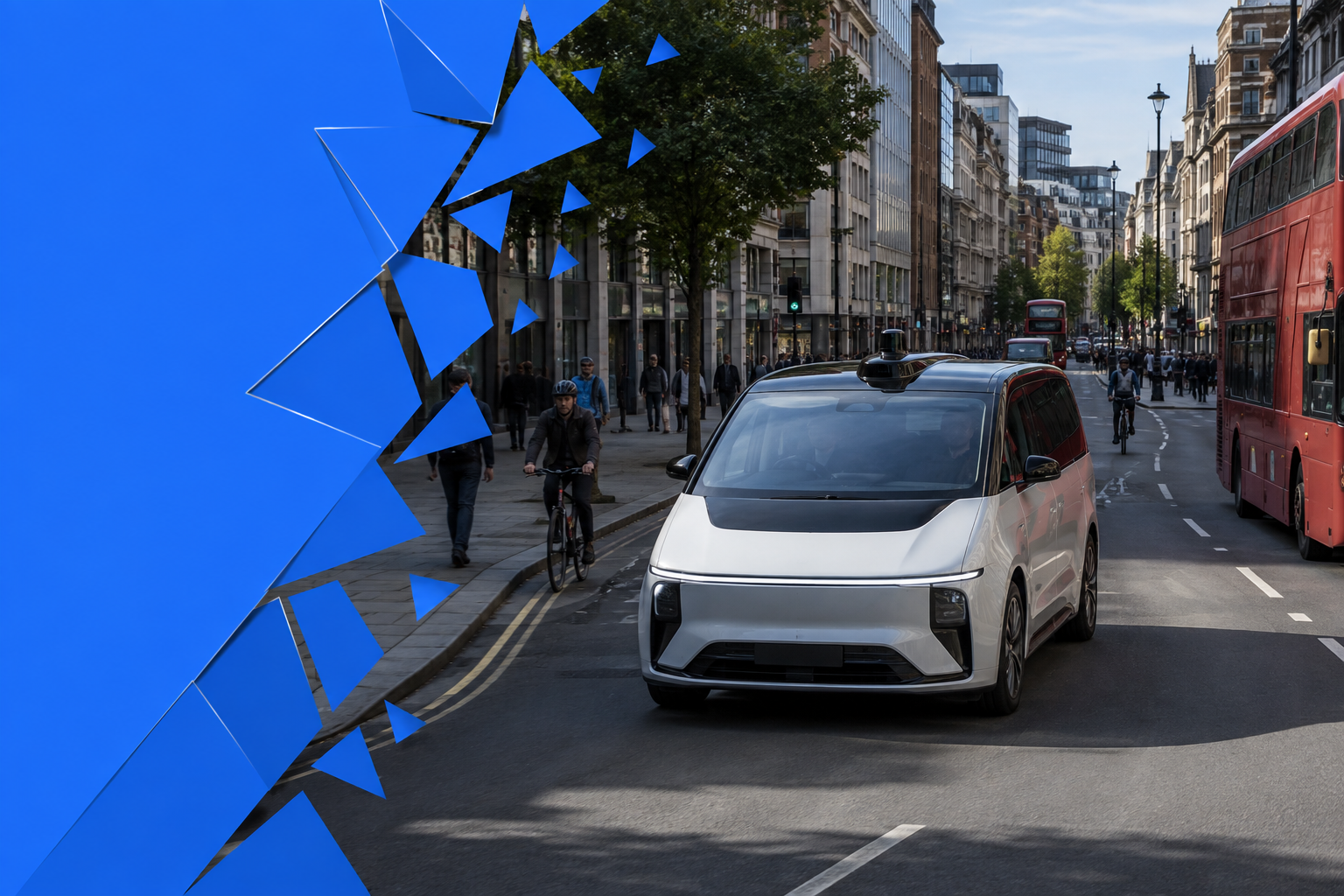
The approval allows Wayve’s vehicles to operate within London’s existing private hire framework for the early service, which will retain a safety operator. Uber says selected people who have registered an interest will be able to take rides as the companies test passenger operations and prepare for a broader commercial launch.
More than 100,000 people have signed up to register interest, according to the companies. TfL’s licensing decision does not, however, amount to final approval for unrestricted driverless taxi operations because autonomous passenger services are being brought under a separate national permitting regime created by the Automated Vehicles Act 2024.
The Driver and Vehicle Standards Agency can issue Automated Passenger Services permits in England, while an application covering London requires TfL’s consent. Wayve and Uber therefore face overlapping regulatory requirements: the vehicles and supervised service can progress through existing private hire rules, while removing the human safety operator requires approval through the dedicated autonomous-services framework.
Deployment moves beyond technology trials
The licensing decision takes Wayve closer to the point where its autonomous-driving system has to function as part of an operating transport service rather than principally as a technology demonstration. Passenger pickup, fleet management, insurance, accessibility, incident handling, local licensing, customer support, and interaction with the wider road network all become part of the deployment problem once real journeys are offered.
Wayve has spent much of the past decade developing an end-to-end machine-learning approach that differs from autonomous systems built around extensive hand-coded rules and highly detailed maps. Its AI Driver uses data from cameras and other sensors to produce driving decisions, while the company argues that a learned system can generalise across different vehicles and cities with less market-specific engineering.
The technology is already moving towards production deployment with manufacturers, as Wayve expands its AI-driving model beyond research fleets. Its agreement with Uber provides a route into ride-hailing services without requiring the UK company to build an entire consumer transport platform alongside the driving system.
Uber participated in Wayve’s $1.2 billion Series D earlier this year and committed additional milestone-based funding for robotaxi deployment. The companies have said London will be their first market before expansion to more than 10 international locations, with Uber expected to own and operate vehicles carrying Wayve’s autonomous-driving software.
Regulation is consequently becoming as important as model performance. Britain opened applications in May for its automated passenger-services pilot scheme, allowing operators to seek permission for taxi-, bus-, and private hire-style services as the government implements the legal framework ahead of broader automated-vehicle rules expected in 2027.
The permitting architecture gives local authorities an explicit role rather than treating autonomous driving solely as a vehicle-safety question. In London, DVSA cannot issue an Automated Passenger Services permit without TfL’s consent, leaving the transport authority able to consider how a proposed operation fits the city rather than assessing only whether the underlying vehicle can drive itself.
That wider remit already includes road safety, congestion, cybersecurity, employment in the taxi and private hire sectors, accessibility, and the effect autonomous fleets could have on the Mayor’s objective of moving more journeys towards walking, cycling, and public transport.
Public enthusiasm also cannot be inferred from the number of people on a waiting list. A YouGov survey commissioned by the London Assembly Transport Committee in June found 42% of Londoners opposed the introduction of autonomous passenger vehicles, compared with 29% who supported them, while only 29% said they were likely to use one.
Respondents were particularly concerned about unexpected situations, road danger, and technical failures. Only 17% said they trusted the companies involved a great deal or a fair amount to collect and analyse personal data, adding information governance to the more familiar questions around physical safety.
Those concerns give supervised passenger operation a practical role even though it falls short of full autonomy. It exposes the technology to ordinary service conditions while retaining a human fallback, allowing operators and regulators to collect evidence about how vehicles interact with passengers, traffic, roads, and other transport users before the safety operator is removed.
London also provides a demanding commercial test of Wayve’s central technical claim. The company argues that machine-learning-based driving can generalise more efficiently than autonomy systems heavily dependent on pre-mapped routes and market-specific rules, and the capital’s dense roads, cyclists, pedestrians, buses, changing street layouts, and irregular traffic leave little room for that proposition to remain theoretical.
A viable service will still require more than demonstrating that the car can navigate those conditions. Autonomous ride-hailing has to combine acceptable safety, predictable availability, regulatory compliance, sensible unit economics, and enough public confidence for customers to use it without the novelty value attached to an early trial.
The private hire licences therefore mark a genuine deployment step without settling the larger regulatory question. Wayve and Uber can move ahead with supervised passenger journeys, but Britain’s autonomous-passenger permit remains the dividing line between a trial carrying customers with a human safety operator and the driverless service the companies ultimately intend to run.


