

Summary
- Bleckmann has invested in two humanoid robots for distribution operations in Britain and the Netherlands.
- Initial deployment will prioritise training and operational experience rather than immediate productivity improvements.
- The programme complements existing investments in automated storage, retrieval, packing, and robotic picking.
Fashion and lifestyle logistics specialist Bleckmann is preparing to introduce humanoid robots into its British and Dutch distribution operations, extending an automation programme in which it has already invested more than $600m.
Two machines will arrive at selected distribution centres over the coming weeks, although Bleckmann intends to concentrate initially on training, understanding their operational limitations, and developing ways for employees and robots to work alongside one another rather than pursuing immediate efficiency gains.
The machines can interpret spoken instructions and translate them into physical movements, while cameras, LiDAR, and three-dimensional simultaneous localisation and mapping technology help them navigate their surroundings. Potential applications include retrieving orders and moving products between locations within a warehouse.
Unlike conventional automated picking stations or storage systems, humanoid robots are designed around the physical dimensions and movement patterns of people. Their introduction follows a decision by Bleckmann three years ago to increase investment in complex warehouse automation, an approach that has subsequently produced highly automated distribution facilities across its network.
Flexibility within existing warehouses
Automation equipment installed within distribution centres is frequently optimised around a particular activity. Automated storage and retrieval systems can move large quantities of inventory efficiently, while robotic picking arms can repeatedly perform handling operations without requiring the mobility or physical versatility of a warehouse employee.
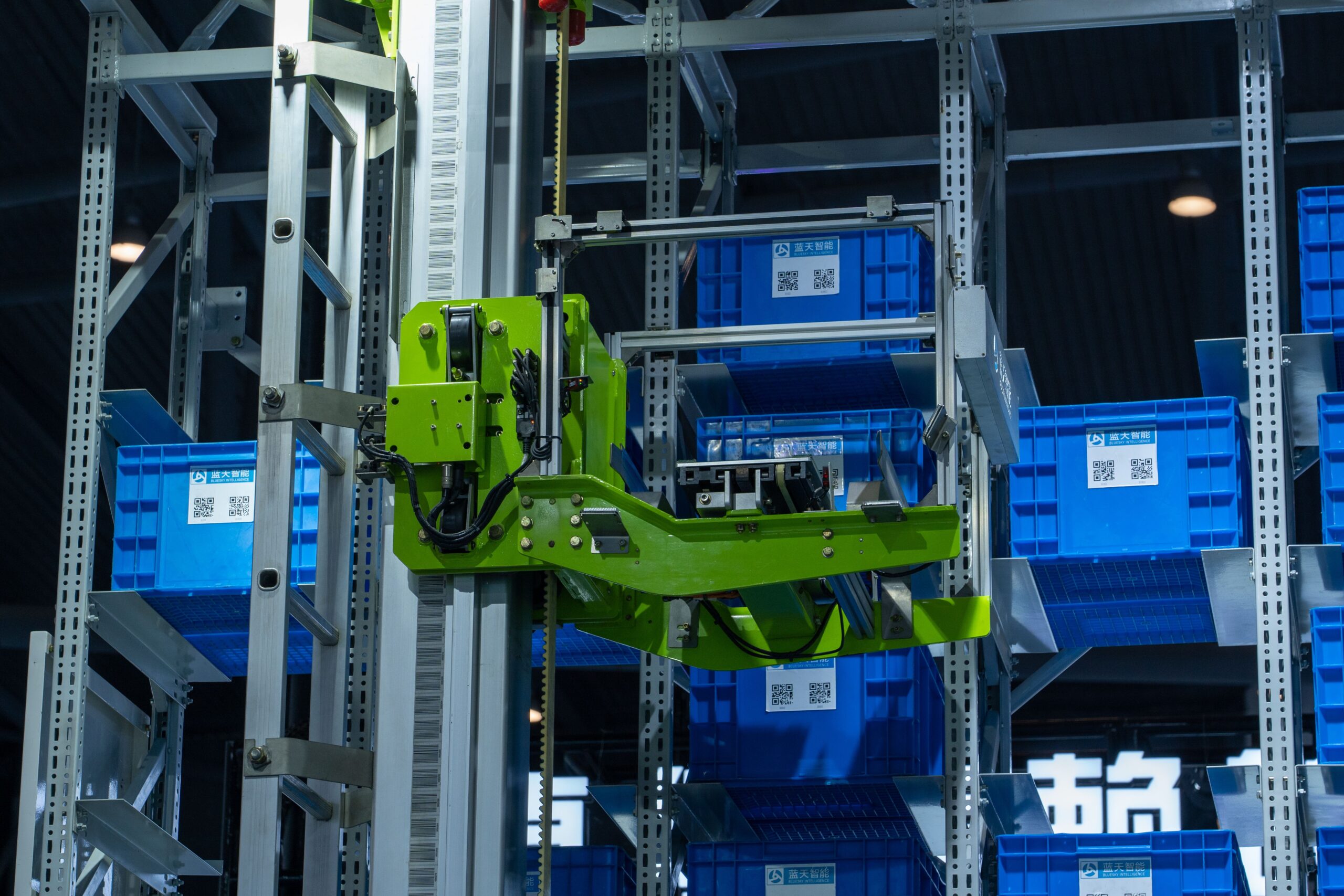
Bleckmann has already introduced AutoStore technology at its Almelo and Roosendaal facilities in the Netherlands, connecting automated storage with other stages of order fulfilment. Last week, it also announced a pilot involving a robotic picking arm at its Bergen op Zoom site.
Those investments address identifiable operational processes, whereas humanoid robotics offers the possibility of distributing automation across activities that have historically been difficult to serve with dedicated machinery.
Fashion logistics presents a particularly varied environment in which to assess that proposition. Distribution centres handle garments, footwear, accessories, and other products with differing dimensions and packaging characteristics, while seasonal purchasing patterns can produce considerable fluctuations in order volumes.
Although specialised machinery can be configured around predictable workloads, installing dedicated equipment for activities that occur intermittently or change frequently may be commercially difficult to justify. A robot capable of moving between those activities could extend automation into parts of a warehouse where a permanent installation would offer limited returns.
The flexibility comes with additional engineering demands. Bleckmann acknowledges that humanoid systems require longer training and implementation periods than some other forms of automation, although their potential range of activities is considerably broader.
Comparing performance with established automation
Once the machines enter operational use, Bleckmann will need to develop a more detailed understanding of their performance across individual activities. A robot that can successfully retrieve an item under controlled conditions may encounter difficulties when products are positioned differently, packaging becomes damaged, or other equipment obstructs its intended movements.
Warehouse management software adds another dimension to that assessment. Distribution operations depend on accurate information about inventory positions, customer orders, and the sequence in which activities must be completed. Assigning work to a humanoid machine requires coordination with those systems so that its actions contribute to the wider fulfilment process.
Employees will also need reliable ways to intervene when a machine encounters something outside its training or operational permissions. The time required to resolve exceptions will influence whether automation releases employee capacity or creates additional supervisory work elsewhere.
Assessing the technology through task completion rates alone would consequently provide an incomplete picture of its commercial value. Equipment availability, maintenance, energy consumption, training expenditure, and the effect of interruptions on surrounding activities all contribute to the cost of operating a robotic system.
That calculation becomes particularly important when comparing humanoids with established warehouse equipment. A specialised picking arm may achieve considerably higher throughput within its designated workstation, but a mobile robot could potentially undertake additional activities during periods when demand for picking is lower.
Building operational experience before expansion
Bleckmann’s initial investment in two machines will allow it to explore those differences without immediately committing to a large robotic fleet. The company has emphasised that employees will remain central to its operations, with the technology intended to assist with repetitive and physically demanding work.
Shared working environments will require appropriate safety assessments, particularly where employees, mobile equipment, and automated systems operate in close proximity. Reliable obstacle detection is one part of that work, alongside procedures governing supervision, intervention, and the allocation of individual activities.
Having already committed substantial resources to conventional warehouse automation, Bleckmann can assess humanoid robotics against technologies with established operating histories within its own facilities. The company has not yet disclosed productivity figures or projected financial returns for the machines. Its initial deployment will provide evidence about where their physical versatility offers advantages over the more specialised equipment already serving its distribution network.


