

Summary
- Maestro provides a central management layer for service providers operating multiple Scality ARTESCA installations across customer locations.
- Individual deployments connect out to Maestro rather than requiring inbound VPN access, while fleet-level capacity data can support consumption-based billing.
- The product targets a managed-service constraint: infrastructure revenue scales poorly when monitoring, updating, and accounting effort grows almost site by site.
Backup-as-a-service providers can add customers faster than they add operations staff only when the underlying infrastructure behaves like a fleet rather than a collection of separately administered storage systems, which is the scaling problem Scality is addressing with a new management layer for ARTESCA.
Scality has made Maestro 1.1 generally available for cloud and managed service providers operating object-storage deployments across multiple customer sites. Instead of administrators signing into each ARTESCA environment separately, Maestro provides central monitoring, software and firmware management, capacity reporting, and estate-wide operational visibility.
The product was announced initially in France earlier this month before the UK release distributed on 9 September, so its useful significance lies less in the precise launch date than in the operating model it targets. Backup infrastructure may sit physically inside dozens or hundreds of customer environments even while one service provider remains responsible for keeping it healthy, updated, secure, and correctly billed.
As deployments multiply, seemingly small administrative tasks become a scaling constraint. Separate logins, individual VPN access, manual update cycles, health checks, and monthly capacity reconciliation can absorb engineering time almost in proportion to customer growth, undermining the economies a managed service is intended to create.
Central management changes the labour curve
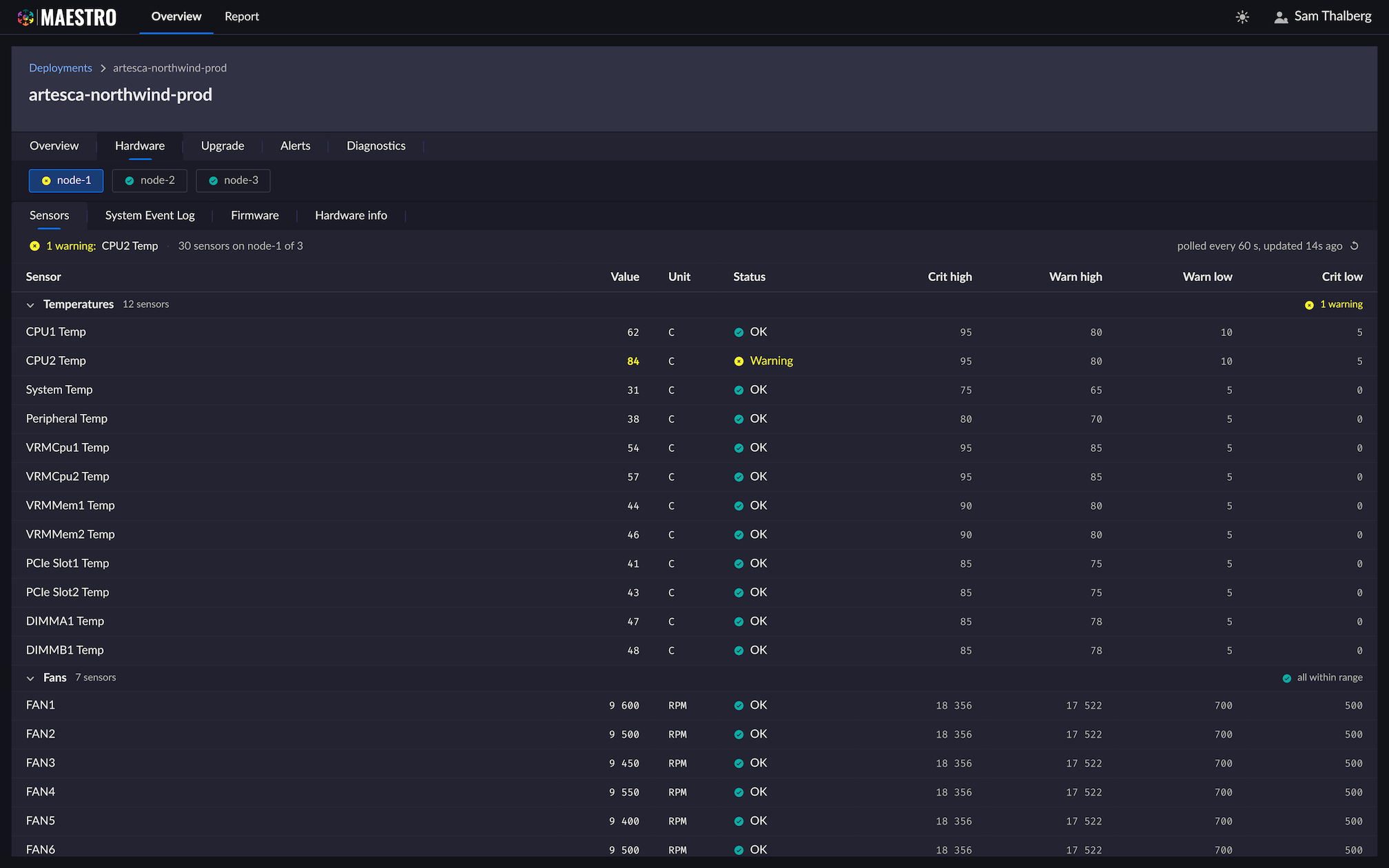
Maestro sits above individual ARTESCA installations and gives service-provider teams a fleet-level view of health and alerts. Administrators can also coordinate ARTESCA software upgrades and server firmware updates rather than working through every customer deployment independently.
Capacity information is particularly relevant to backup-as-a-service because commercial arrangements are often consumption based. Where customers pay according to storage use, gathering utilisation manually across a growing estate turns billing into another infrastructure-management workload, so Maestro aggregates that information for use in pay-as-you-go processes.
Autodata, which operates several ARTESCA deployments across customer sites in the UK and Ireland, is already using Maestro within its backup-as-a-service operation. Dominic McLoughlin, chief executive of Autodata, said: “Software updates that consume hours of staff time can now be monitored centrally, and we can grow the fleet without adding operational headcount.”
The customer example provides a clearer commercial test than the familiar promise of a single management console. Managed-service margins depend on revenue increasing faster than the labour required for each new environment; if every installation creates another set of manual maintenance and billing processes, the offering begins to resemble bespoke outsourcing regardless of how standardised the underlying storage product may be.
Fleet management attempts to break that relationship. Comparable patterns already exist in endpoint management, cloud infrastructure, networking, and other managed technologies, where administrators increasingly work through policies and groups rather than connecting separately to every system.
Remote access becomes an architecture decision
Scality has designed Maestro so individual ARTESCA deployments establish outbound connections to the management platform. Maestro does not initiate a connection into the customer environment, removing the requirement for a service provider to maintain a VPN tunnel to every installation purely for management.
That choice addresses a practical deployment problem because customer networks carry their own firewall policies, security reviews, and change procedures. Requiring inbound management connectivity can make each new installation partly dependent on the customer’s networking team, whereas an outbound approach resembles the architecture used by many centrally managed cloud and endpoint products.
Removing individual VPNs does not eliminate security considerations around the central platform. A management system with administrative reach across multiple customer environments becomes important infrastructure in its own right, placing greater weight on authentication, privileges, audit records, update integrity, availability, and isolation between tenants.
Operational efficiency and concentration risk consequently move together. A manually managed estate is expensive, although its separation limits the reach of some mistakes; a central platform can make hundreds of systems easier to operate while increasing the importance of securing the system through which those operations are controlled.
Maestro currently runs as an on-premises deployment, allowing providers to operate the management layer themselves. Scality plans a SaaS version later, which would shift some of that operational responsibility towards the vendor.
BaaS remains an infrastructure business
Backup has moved steadily from a product organisations purchase towards a function service providers operate, particularly as ransomware recovery requirements and expanding data volumes make maintaining separate specialist infrastructure less attractive for businesses without dedicated teams.
The service model does not make the physical work disappear. Storage capacity still has to be monitored, software and firmware updated, failures addressed, consumption measured, and individual customer environments supported when their behaviour diverges from the rest of the estate.
Object storage provides a useful foundation for large backup repositories because it can accommodate substantial unstructured datasets and support interfaces familiar to backup applications, but Maestro remains a management layer specifically for Scality ARTESCA rather than a neutral orchestration platform spanning competing storage vendors.
Service providers therefore face a trade-off. Standardising more of the estate on one platform increases the value of central fleet management, while customers seeking heterogeneous infrastructure will still need additional operational tooling around it.
The more revealing evidence will arrive as providers move from dozens of installations towards the hundreds Scality has designed Maestro to manage. If monitoring, updating, billing data, and remote administration remain central while the infrastructure estate multiplies, backup-as-a-service gains more of the operating leverage associated with cloud services.
Storage capacity can be purchased predictably; engineering attention cannot. Maestro is an attempt to stop those two requirements growing at the same rate.


