

Summary
- Scaleway has announced an AI supercomputer in Sweden using AMD Instinct MI355X GPUs and the ROCm software platform.
- Bull, Giga Computing, HPE Networking, VAST Data and Motul will contribute infrastructure and integration capabilities.
- The project forms part of a wider European expansion that includes Nvidia capacity in Copenhagen and additional cloud zones planned for 2027.
French cloud provider Scaleway is expanding its AI infrastructure into Sweden with a supercomputer based on AMD’s Instinct MI355X processors, offering European businesses another hardware option for training and operating AI models as demand for computing capacity increases.
Announced at Scaleway’s ai-PULSE conference in Paris on 13 October, the project represents the company’s first supercomputer deployment outside France. Scaleway describes it as Europe’s first commercial AI supercomputer built around AMD technology, although that European-first designation is a company claim and the announcement does not establish that customers are already using the facility.
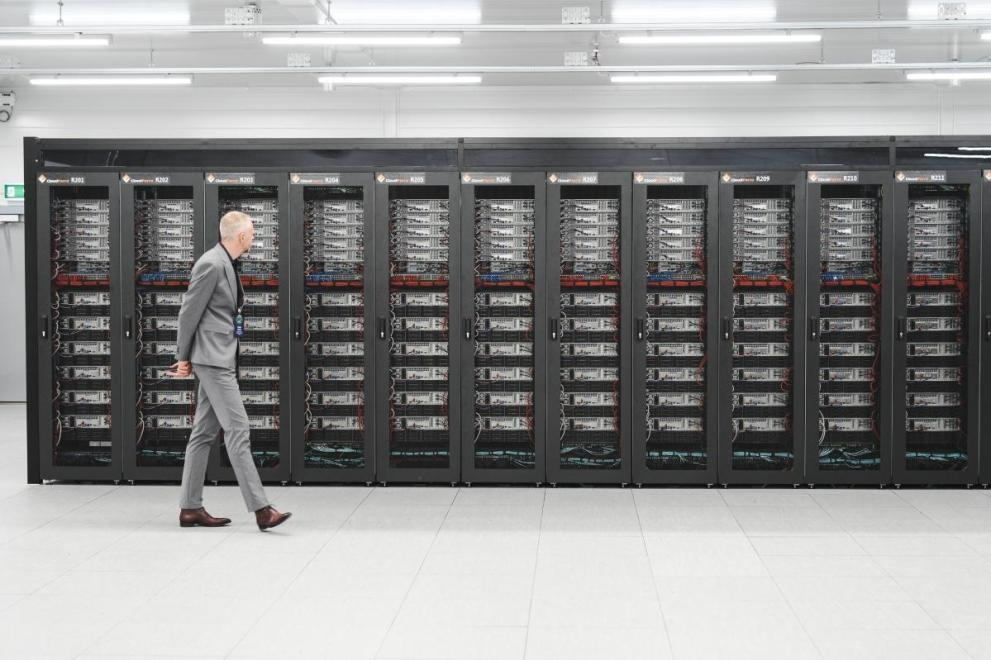
The installation will combine AMD GPUs with the company’s ROCm software platform, supported by a group of infrastructure suppliers responsible for integrating servers, networking, data storage and cooling. Scaleway has not disclosed the final number of processors in the Swedish system, its construction cost or a confirmed date when the proposed capacity will become commercially available.
With advanced AI computing currently dominated by Nvidia hardware and its CUDA software ecosystem, the Swedish project would allow more developers to evaluate an alternative processor architecture within a European cloud environment. Whether that option proves commercially attractive will depend on the software supported, the performance achieved on actual workloads and the price of using the infrastructure.
AMD offers an alternative computing architecture
The AMD Instinct MI355X is designed for demanding AI and high-performance computing applications, including model training and inference. Its capabilities must be considered alongside the software used to distribute calculations between processors, manage memory and transfer data during intensive workloads.
ROCm provides an open software platform intended to support development on AMD accelerators, with compatibility across widely used machine learning frameworks. This potentially gives developers another route to running AI applications without adopting Nvidia’s CUDA environment as their only target.
However, software portability depends on the individual application and its supporting libraries. Code developed for Nvidia hardware may require adjustments or additional testing before it runs efficiently on AMD processors, particularly where developers have relied on specialised operations, vendor-specific optimisations or tools with uneven support across platforms.
The workload also influences the value of an alternative architecture. Training a large model places considerable demands on processor memory and communication between accelerators, while inference applications may be more sensitive to response times, request volumes and the cost of keeping a model available for users.
For organisations weighing different services, a comparison based only on the specifications of individual GPUs would consequently be incomplete. The costs of transferring software, maintaining different development environments and optimising applications may influence the total expense of operating AI systems as much as the price of computing time.
Scaleway’s announcement does not include independent performance benchmarks or customer pricing for the new Swedish infrastructure. The claimed benefits of architectural choice are therefore supported by the planned configuration, while its practical competitiveness remains to be established through deployment and operation.
Building a system around the processors
The company has assembled several technology partners to deliver the installation. Bull will integrate and deploy the cluster, taking responsibility for equipment installation, racks, cooling integration and subsequent hardware maintenance.
Giga Computing is supplying the servers, while HPE Networking will provide Ethernet connectivity between the systems. These components must support rapid communication among processors, particularly when AI training jobs distribute large volumes of calculation across multiple machines.
VAST Data is contributing the data platform used to supply information to computing workloads. Storage performance is important because processors can remain underused when data cannot be delivered or retrieved quickly enough, reducing the economic value of hardware that is expensive to purchase and operate.
Motul will supply liquid cooling fluid designed for the thermal demands of high-density computing infrastructure. Removing heat from equipment is a substantial operating requirement for advanced AI installations, although the effectiveness of an individual cooling design depends on the complete system and its operating conditions.
These components create interdependent engineering requirements. Increasing the number of accelerators may raise theoretical computing capacity without producing an equivalent improvement in usable performance if networking, storage or cooling cannot accommodate the additional demand.
Scaleway says the completed system is intended to support both training and inference for startups and established businesses. The announcement does not identify committed customers for the Swedish supercomputer or disclose contractual arrangements for accessing the new capacity.
Operational reliability will also depend on the ability to maintain and replace specialised equipment. Large computing installations can include thousands of individual components, making fault detection, maintenance access and the availability of replacement parts important to keeping the wider platform productive.
European hosting and international dependencies
Sweden was selected partly because of its technology sector and electricity mix, according to Scaleway. The project builds on the company’s existing relationship with Swedish telecommunications operator Tele2, which has identified demand among local customers for European cloud and AI services.
The country’s relatively low-carbon electricity generation may offer environmental advantages over locations dependent on more carbon-intensive power. However, the announcement does not provide measured electricity consumption, verified emissions estimates or a power usage effectiveness figure for the completed system.
Neither the location nor the proposed cooling technology can establish the project’s total environmental impact before its actual operating conditions are known. The manufacturing of the equipment, utilisation of the computing capacity and infrastructure required to supply electricity all contribute to a fuller assessment.
Alongside Sweden, Scaleway is developing another GPU installation in Copenhagen using Nvidia HGX B300 systems. The Danish project is intended to provide several thousand GPUs, according to the company’s wider European expansion announcement, giving customers access to a different hardware and software environment.
During 2027, Scaleway also plans to open three additional cloud availability zones in Stockholm and three in Frankfurt. These are separate elements of its infrastructure expansion, which also includes further services and computing technologies across its existing European operations.
The choice to offer both AMD and Nvidia architectures illustrates a practical approach to European technological independence. Operating infrastructure through a European provider can give customers more options over data location, contractual arrangements and the jurisdiction in which services are delivered, even while the underlying hardware comes from international suppliers.
Such arrangements do not eliminate all external dependencies. Advanced processors, server components and software frameworks remain part of a global supply chain, and customers may still encounter technical or commercial restrictions when moving workloads between different architectures or cloud providers.
Europe’s broader investment in AI computing raises similar questions about the relationship between announced capacity and delivered infrastructure. Techopia recently examined Sesterce’s proposed Finnish AI campus, where the scale of the ambition remains dependent on construction, electrical infrastructure and subsequent commercial demand.
Scaleway’s Swedish project is more specific about its planned technology stack and integration partners, although the total installed capacity and commercial availability have yet to be disclosed. Once the facility becomes operational, customers will be able to assess whether the AMD configuration offers meaningful advantages in performance, portability and cost for the workloads they need to run.


