Summary
- Ocean Infinity Solutions has been selected as the Royal Navy's commercial mission partner for Atlantic Net, under an initial £90m investment framework.
- The planned network will combine underwater sensing, autonomous platforms, communications and AI-assisted analysis to support anti-submarine surveillance.
- Initial operational capability is intended for 2027, with almost 200 skilled jobs expected to be supported through the programme and its supply chain.
The Royal Navy is developing an autonomous surveillance network beneath the North Atlantic, combining underwater sensors, uncrewed maritime systems and artificial intelligence to improve the detection of submarines and activity around critical infrastructure.
The programme, known as Atlantic Net, will be developed with British maritime technology company Ocean Infinity Solutions, which has been selected as the Navy’s commercial mission partner. A framework announced on 10 November opens the way for an initial £90m investment, with the government intending to make the capability operational from 2027.
Defence Minister Luke Pollard outlined the plans at the International Sea Power Conference in Oslo, where the Royal Navy presented Atlantic Net as the first operational element of its wider Atlantic Bastion programme.
The investment is expected to support almost 200 skilled jobs and associated supply chain activity. The precise systems included in the initial deployment, their locations and the division of responsibilities between contractors have not all been publicly specified.
Persistent sensing changes undersea surveillance
Traditional anti-submarine operations depend on a combination of warships, submarines, maritime patrol aircraft and specialist sensors. These assets can investigate activity across considerable distances, but they cannot maintain continuous coverage of every strategically important area.
Atlantic Net is intended to increase surveillance persistence by connecting autonomous and uncrewed systems with underwater sensing equipment, communications infrastructure and data analysis capabilities.
Its initial focus includes the Greenland–Iceland–UK gap, a strategically important area linking northern waters with the wider Atlantic. The region has long been relevant to the movements of submarines travelling between operating areas, making the ability to detect and track underwater activity a continuing priority for NATO forces.
A distributed network could gather information from several locations over extended periods, providing naval operators with a broader view of activity than individual platforms can maintain alone.
However, underwater monitoring presents considerable technical difficulties. Sound propagates differently depending on water temperature, depth and other environmental conditions, while commercial shipping and natural activity generate signals that must be distinguished from objects of security interest.
Autonomous sensors can help collect information, but the resulting data still requires interpretation. A system capable of detecting unusual acoustic activity must also establish whether the signal is relevant and how confidently it can be associated with a particular source.
The Royal Navy plans to use AI to assist that analysis, helping operators process information and identify activity requiring further investigation. Its effectiveness will depend on the quality of the sensor network, the available data and the reliability of the analysis under different operating conditions.
Connecting autonomous systems with naval forces
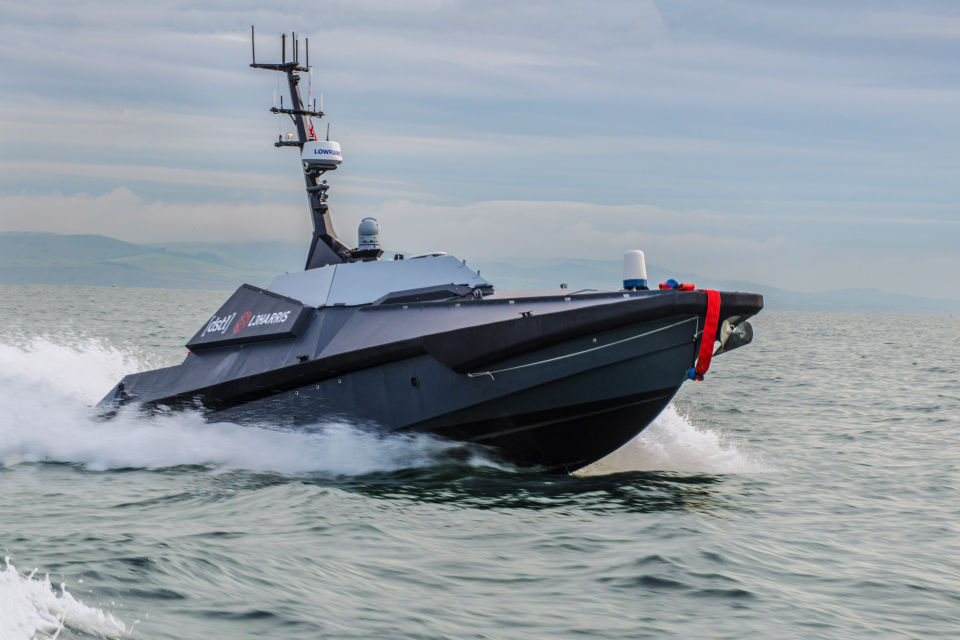
The intended architecture combines underwater and surface platforms, remote operations and a common information service directed by the Royal Navy. Ocean Infinity will work with specialist partners to bring the individual components together.
The service is designed to provide earlier warning to anti-submarine warfare ships and Astute-class submarines. Crewed naval assets would remain responsible for operations requiring their specialist capabilities, while the wider surveillance network could help identify where those resources are needed.
Integrating these systems requires secure communications and methods for combining information collected by equipment with different technical characteristics. Data arriving from fixed sensors, mobile autonomous platforms and crewed vessels must be associated with locations and times before operators can assess the wider picture.
Underwater communications create additional constraints because the high-capacity wireless methods used on land do not operate in the same way beneath the sea. Autonomous systems may therefore need to store information, communicate through intermediary platforms or operate with periods of limited connectivity.
Such constraints affect how quickly information can reach decision-makers. A sensor may collect useful data without being able to transmit it immediately, meaning the architecture must account for delays and intermittent connections.
Remote operation also depends on maintaining control over the systems themselves. Equipment deployed across large maritime areas needs robust procedures for navigation, maintenance, recovery and response when communications are interrupted.
These requirements make the programme more complex than purchasing a collection of autonomous vehicles. Its operational value will depend on how reliably the complete network functions over time and how effectively its information supports naval decisions.
Undersea infrastructure extends the security requirement
The North Atlantic contains communications cables and energy infrastructure connecting the UK with European and international networks. Damage to those systems can affect businesses, communications services and other essential activities.
Monitoring an underwater cable presents a different challenge from protecting a facility on land. Routes can extend across vast distances, while surface conditions and underwater geography limit the ability to observe every section continuously.
The government has linked Atlantic Net to concerns about Russian submarine activity and the security of strategically important underwater infrastructure. Those concerns form part of its wider defence assessment, but they do not establish responsibility for every unexplained incident involving a cable or pipeline.
A distributed surveillance service could improve awareness of activity near important routes, particularly where sensors are capable of collecting information over extended periods. Whether that provides effective warning will depend on the locations monitored, the performance of the equipment and the ability to interpret relevant signals.
Surveillance also serves a different function from physical protection or repair. Identifying suspicious activity may support a response, but it does not prevent every possible failure or remove the need for infrastructure operators to maintain resilience and recovery arrangements.
Commercial robotics enters sustained naval operations
Ocean Infinity has developed maritime robotics and remote operations capabilities through offshore survey and inspection work. Its commercial activities involve collecting information in challenging marine environments, providing experience relevant to the operation of autonomous systems at sea.
The company will now apply those capabilities to a military programme involving different security requirements and operational responsibilities.
Commercial survey systems and naval surveillance equipment share requirements involving sensing, positioning, communications and reliable operation. Military applications may additionally require protection against deliberate interference, secure information handling and compatibility with established command systems.
Ocean Infinity’s selection does not establish that its existing commercial vessel fleet will be deployed unchanged for Atlantic Net. Specific equipment and deployment arrangements will be determined through the programme’s development and integration work.
The initial framework also differs from confirmation that the full £90m has already been spent. It establishes the basis for investment and delivery, with the operational capability and associated industrial activity to follow.
Atlantic Bastion links national and allied capability
Atlantic Net forms part of Atlantic Bastion, the Royal Navy’s plan to combine crewed platforms with autonomous systems and supporting digital infrastructure.
The wider approach is intended to strengthen maritime security alongside NATO and Joint Expeditionary Force partners, reflecting the cross-border nature of undersea infrastructure and submarine operations.
International cooperation will depend partly on the ability to share relevant information securely and interpret it consistently across different naval systems. Equipment and software developed for one force must support operational coordination without compromising sensitive information or creating unacceptable delays.
The government expects Atlantic Net to begin operating in 2027. Before then, its developers must integrate the necessary sensing, communications, control and analysis capabilities into a service suitable for sustained maritime operations.
The next measurable milestones will be the introduction of operational equipment, demonstration of reliable surveillance coverage and confirmation that the resulting information can be used by the naval platforms responsible for responding to underwater threats.