Summary
- AHEAD has opened a 53,000-square-foot Reading facility for building, configuring, testing, and staging AI, HPC, and edge infrastructure.
- The site supports its European expansion alongside the acquisition of Netherlands-based Prolimax and additional cross-border logistics capability.
- The facility targets an overlooked deployment bottleneck: validating expensive rack-scale systems before hardware reaches a customer’s production data centre.
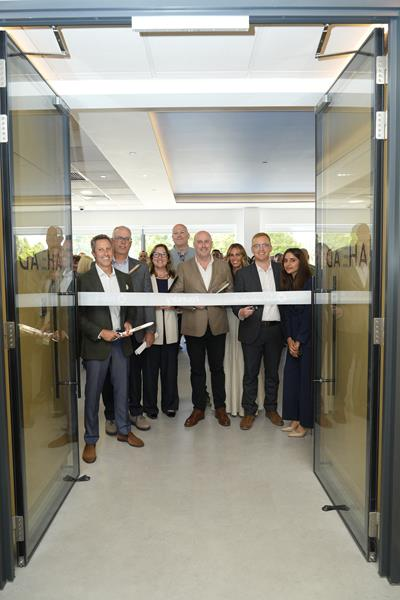
US technology services company AHEAD has opened a 53,000-square-foot facility in Reading for assembling, configuring, testing, and staging AI, high-performance computing, and edge infrastructure before equipment reaches customers’ production environments.
The Foundry at Winnersh Triangle gives AHEAD a European production centre for rack-scale systems as the company expands further into the region. The site combines warehouse and office capacity and follows the acquisition of Netherlands-based Prolimax, which added supplier relationships, logistics capability, and operating infrastructure inside the European Union.
AHEAD describes its Foundry model as a way to industrialise the work between hardware procurement and deployment. Servers, accelerators, networking, storage, cabling, firmware, and supporting components can be brought together as complete systems, subjected to testing and burn-in, recorded in lifecycle-management software, and prepared for shipment as a validated rack rather than a collection of separate boxes.
That intermediary work has become more consequential as AI infrastructure grows denser and more expensive. A cluster can contain high-value accelerators whose performance depends on networking, storage, power, cooling, firmware, and software behaving correctly together, so discovering a configuration problem only after the hardware reaches a data centre can leave substantial capital idle.
AI infrastructure creates an integration market
Pre-integration shifts some risk into a controlled environment where engineers can test a repeatable design before deployment teams arrive on site. The process is not unique to AI, although accelerated computing increases the cost of mistakes because a problem affecting networking or rack configuration can prevent a large amount of expensive compute from reaching production.
AHEAD couples the physical build process with its Hatch lifecycle-management platform, which tracks assets, sites, and shipments. That attempts to preserve the relationship between what was assembled in the integration centre and what eventually operates in each customer location, rather than allowing serial numbers, component changes, and shipment information to fragment across spreadsheets and supplier systems.
Asset records become more important when infrastructure moves across several countries or operates in regulated environments. Organisations may need to establish where a system is located, when hardware changed, which firmware was installed, who handled the equipment, and whether a replacement component altered the validated configuration.
The resulting market sits between equipment manufacturing and the data-centre floor. AHEAD does not manufacture the processors or networking equipment and the Foundry does not remove the need for final on-site commissioning, but it packages the integration work into a repeatable industrial process before the equipment reaches the environment where downtime becomes expensive.
European deployment adds logistical friction
Regional production also reduces some of the administrative complexity around moving infrastructure across borders. The Prolimax acquisition gives AHEAD additional EU supplier and logistics capability, while the Reading site provides a physical base for UK and European projects that would otherwise rely more heavily on integration work performed elsewhere.
Cross-border hardware deployment can involve customs, tax, warranties, replacement components, asset ownership, and contractual responsibility alongside the technical build. Those issues are rarely central to discussions about AI capacity, although they can determine how quickly infrastructure actually becomes available to the teams waiting to use it.
The same applies to local data-centre conditions. A rack validated in Reading still has to operate against the destination site’s power, cooling, network, security, and software environment, so pre-integration reduces one category of deployment risk without removing the need for site engineering.
Enterprises are meanwhile becoming more selective about where AI workloads run. Public cloud remains appropriate for many applications, while cost, latency, data control, resilience, and regulatory requirements are pushing other workloads towards private data centres, colocation sites, sovereign infrastructure, or edge locations.
That creates a more distributed physical estate at the same time as the systems being deployed become harder to integrate. A standardised build process is therefore partly an attempt to prevent each location from becoming a bespoke engineering project, particularly for organisations rolling out similar AI infrastructure across several markets.
AHEAD’s Reading facility shows where spending is accumulating beyond chips and data-centre capacity. The AI build-out is creating demand for businesses that configure, validate, transport, document, and maintain complex infrastructure between the manufacturer and the workload that eventually consumes it.
Those services will receive less attention than new accelerators or hyperscale campuses, but their performance can determine when either becomes productive. A rack of expensive hardware that cannot be commissioned reliably is still stranded capital, regardless of how impressive its theoretical compute capacity looks on a specification sheet.