

Summary
- Philips will combine imaging, robotics, AI, and steerable catheter technology under an ARPA-H award worth up to $33.7m.
- Johns Hopkins University will work on autonomous device navigation, while Boston University develops catheter technology.
- Clinical validation, regulation, hospital integration, cyber resilience, and human oversight stand between the research programme and routine treatment.
Dutch health-technology group Philips has secured up to $33.7 million in US government research funding to develop robotic systems capable of undertaking progressively more of a specialist stroke procedure, bringing autonomous technology into a clinical setting where treatment delays can determine whether a patient recovers or suffers severe disability. The project combines image-guided therapy, artificial intelligence, robotic device control, and new catheter technology rather than building an isolated surgical robot from scratch.
The award comes from the US Advanced Research Projects Agency for Health under its Autonomous Interventions and Robotics programme. Philips will work with Johns Hopkins University and Boston University on technologies intended to automate parts of mechanical thrombectomy, in which clinicians navigate instruments through blood vessels to remove a clot obstructing blood flow to the brain.
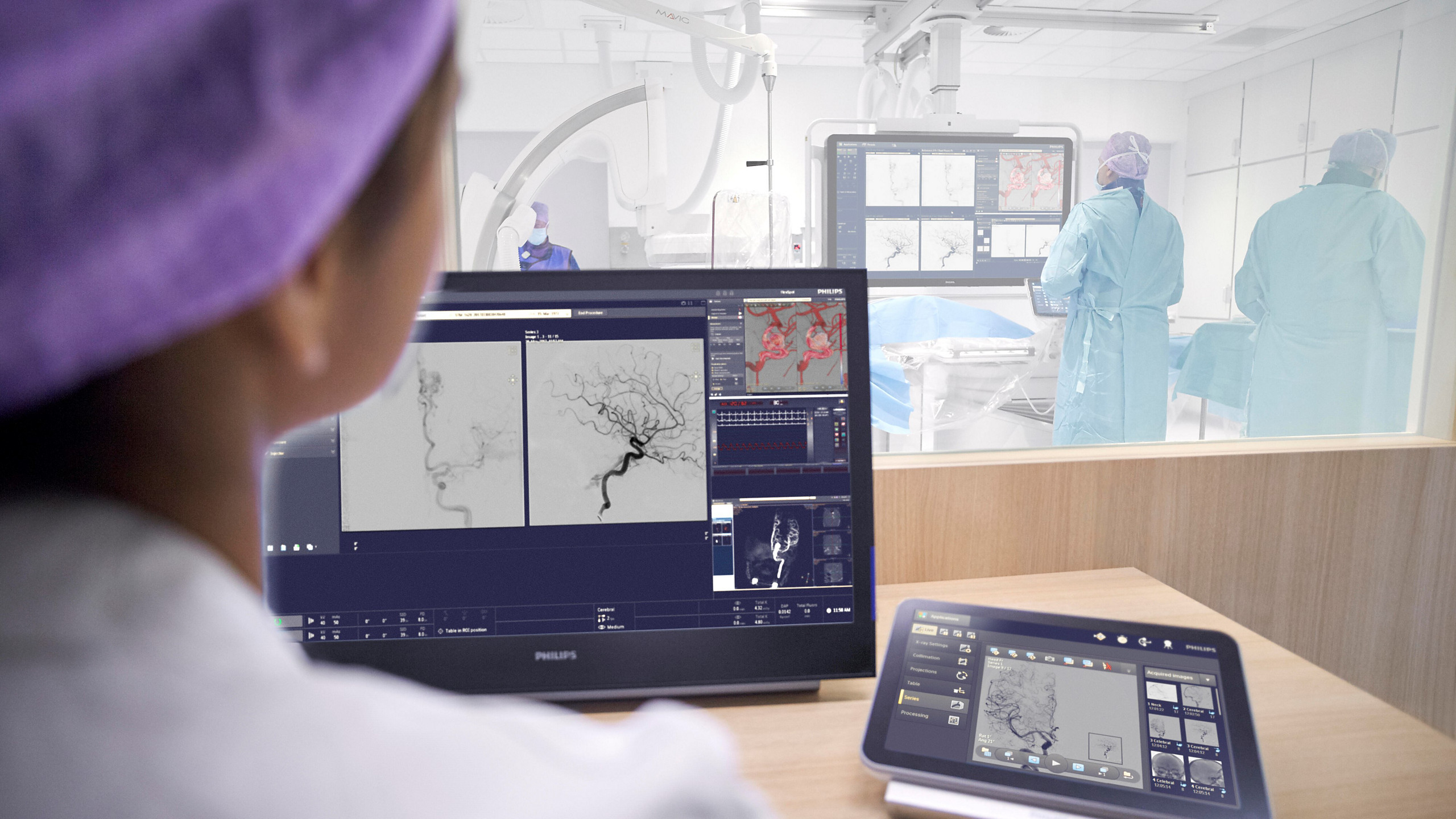
Johns Hopkins researchers will focus on autonomous device navigation, while Boston University will develop steerable catheter technology. Philips intends to combine those capabilities with its existing Azurion image-guided therapy infrastructure, allowing the programme to test how imaging, robotics, and AI automation can work inside a clinical platform already designed for interventional procedures.
The distinction between automation and autonomy remains substantial. Philips describes the programme as a route towards increasingly automated and potentially remote procedures under expert oversight, while ARPA-H’s broader goal is to explore whether robotic systems can make specialist interventions available in hospitals that lack clinicians able to perform them on site.
Specialist availability is part of the constraint
Mechanical thrombectomy provides a demanding test because access depends on both expensive equipment and scarce clinical expertise. ARPA-H says only a minority of eligible US stroke patients currently receive the procedure, while much of the population lives too far from a capable hospital for rapid intervention.
The figures describe the American system funding the project, but the engineering problem is not uniquely American. Sophisticated interventional procedures tend to concentrate in specialist centres because hospitals need clinicians with highly specific skills, suitable imaging equipment, trained teams, and services able to respond quickly when an emergency occurs.
Automation offers one possible way of separating parts of that expertise from the clinician’s physical location. If a robotic system can reliably perform routine navigation and device handling, a specialist could potentially supervise more work remotely or concentrate personal intervention on the parts of a procedure requiring clinical judgement.
That model depends on considerably more than laboratory accuracy. Network reliability, imaging quality, robotic fail-safes, equipment maintenance, cyber security, sterility, and procedures for immediate manual intervention would all become part of the safety case. Hospitals would also need clear responsibility when software, robotic equipment, a remote specialist, and a local clinical team participate in the same treatment.
Automation is entering an existing platform
Philips’ decision to build around Azurion is commercially important because hospital technology usually enters practice through existing clinical workflows rather than as a detached technical demonstration. Image-guided interventions already depend on specialist rooms, equipment, and operating procedures, so integrating robotic capabilities into a familiar platform could prove more practical than requiring an entirely new treatment environment.
The programme still has several stages to clear before that becomes a product proposition. ARPA-H describes the Philips project, called A-RISE, as combining image-guided infrastructure with imitation-learning algorithms and a multi-channel fluid-driven steerable catheter, with mechanical thrombectomy providing the initial clinical challenge.
Philips is one of several organisations funded under the wider AIR programme. Other awards cover different robotic systems, magnetic approaches, and simulation and validation infrastructure, allowing the agency to test competing technical routes rather than committing to a single architecture.
That structure underlines the experimental status of the work. Public research funding does not establish that autonomous stroke treatment is clinically effective, economically viable, or ready for regulatory approval, while any eventual European deployment would face its own medical-device assessment, procurement processes, clinical validation, and health-system requirements.
Even supervised automation could alter the economics of interventional medicine if it reduced the extent to which every procedure depended on a specialist being physically beside the patient. Hospitals could potentially extend advanced treatment to more locations, while technology suppliers would move further from selling individual imaging systems towards integrated stacks combining software, robotics, instruments, and workflow automation.
Such integration can also deepen dependence on a smaller number of suppliers. When imaging, robotic controls, AI models, and interventional devices operate as one system, interoperability and lifecycle support become procurement questions alongside clinical performance, particularly when software updates may change equipment expected to remain in service for years.
The ARPA-H programme should therefore be read as a substantial attempt to automate one of medicine’s more technically demanding workflows rather than evidence that autonomous stroke procedures are close to routine deployment. The decisive evidence will come from whether the system can navigate safely across varied anatomy, perform consistently under clinical conditions, and preserve effective expert control when a procedure departs from the patterns on which its automation was developed.


