

Summary
- Surplus heat from atNorth’s DEN02 data-centre campus in Ølgod will supply a neighbouring greenhouse development operated by Selected Group.
- The first greenhouse phase is expected in the third quarter of 2028 and is designed to expand alongside the data-centre campus.
- The project creates a nearby heat customer, addressing one of the practical barriers to making data-centre heat recovery useful.
atNorth will supply surplus heat from its planned DEN02 data-centre campus in western Denmark to a neighbouring greenhouse, connecting two energy-intensive industries in a project that will test whether rapidly expanding digital infrastructure can support useful local heat demand rather than simply adding another load to the electricity system.
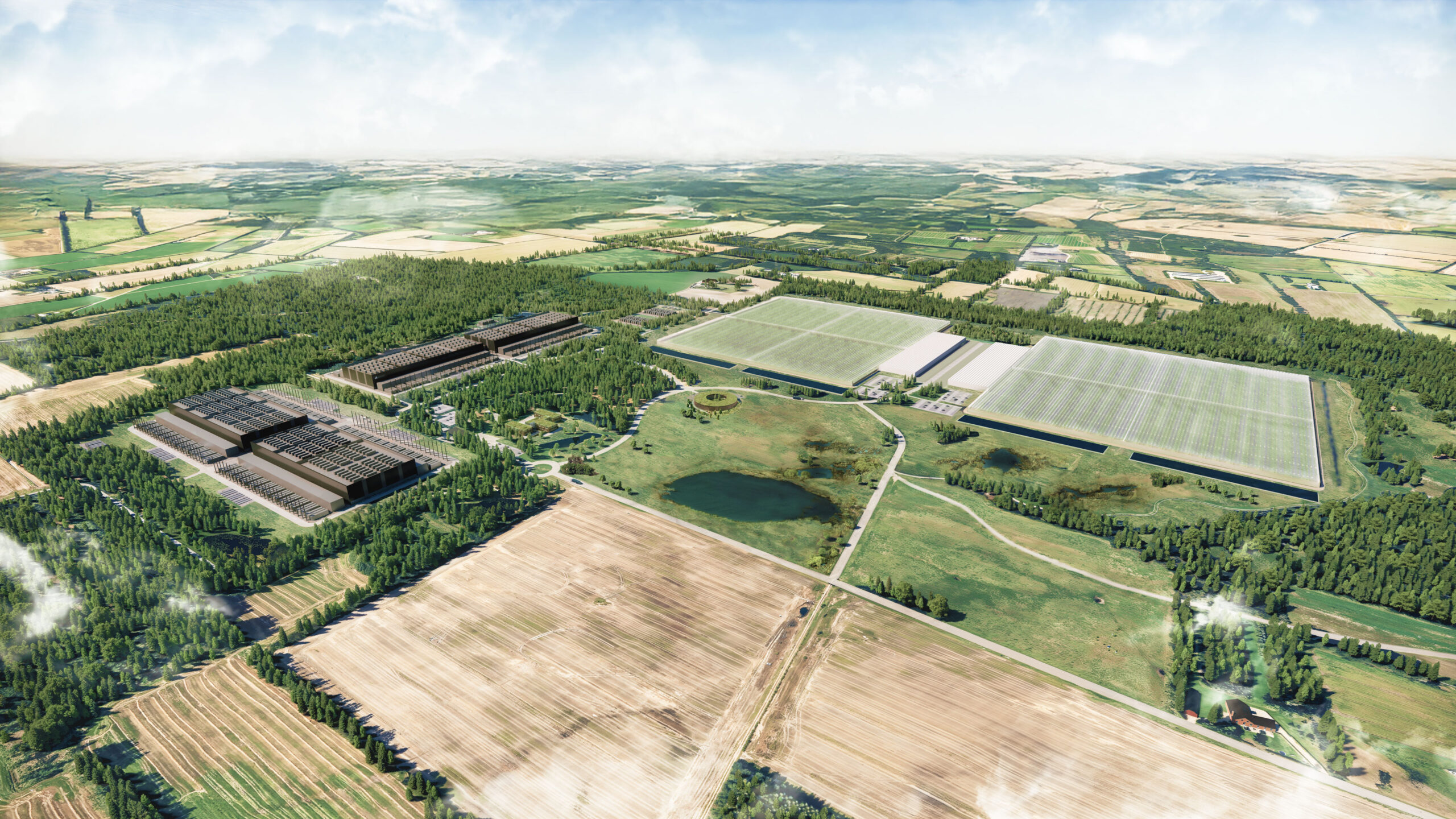
The Nordic data-centre operator has agreed a heat-reuse partnership with Selected Group, which develops and operates infrastructure projects including large-scale greenhouses. The agricultural facilities will sit beside DEN02 in Ølgod, with the first phase expected to be completed in the third quarter of 2028.
Selected Group intends to use recovered heat for year-round food production, while the greenhouse development is designed to increase alongside the data-centre campus. DEN02 itself is planned with an initial capacity of 250MW and scope for several hundred additional megawatts, making the presence of nearby heat customers more important if the site reaches its proposed scale.
Data centres turn a large share of the electricity consumed by computing equipment into heat, but describing that energy as reusable is easier than finding somewhere useful to send it. Heat has to be captured at an appropriate temperature, transported over an economically sensible distance, and matched with customers whose demand aligns closely enough with the operating profile of the computing facility.
A greenhouse solves part of the matching problem
Locating the greenhouse beside DEN02 removes one obvious obstacle by minimising the distance between the source and user. It also creates demand that can continue through colder periods when greenhouse heating requirements are highest, although the detailed engineering design and final heat volumes have not been disclosed.
The partners say the project is intended to reduce dependence on fossil-heated greenhouse production while supporting more Danish-grown fruit and vegetables. Controlled production can extend the domestic growing season if the energy economics work, particularly in a climate where conventional winter cultivation is limited.
Selected Group already has experience with a related model in Sweden, where it operates a 20-hectare greenhouse at Frövi using existing energy resources. The Danish project therefore combines a data-centre operator seeking an outlet for surplus heat with an infrastructure investor that already treats industrial heat as a commercial input rather than a demonstration project.
The arrangement is also more tangible than carbon accounting alone. Energy-efficiency measures can reduce the electricity required for each unit of computing, but a rapidly expanding campus can still increase total consumption. Finding a productive customer for heat that would otherwise be rejected into the surrounding environment does not cancel that demand, although it can improve how the energy is used after entering the site.
Heat reuse depends on local infrastructure
atNorth has been developing several approaches elsewhere in the Nordic region, including district-heating and other local heat-recovery projects. The pattern illustrates why reuse is inherently local: a data centre can serve customers across Europe, but its thermal output needs a nearby consumer to make pipes, pumping, heat exchangers, and other supporting infrastructure economic.
The rise of higher-density AI and high-performance computing adds another consideration because cooling systems are changing alongside chip power requirements. DEN02 is being designed to support direct liquid cooling, which can remove heat from processors more efficiently than conventional air systems and may create different opportunities for recovering it.
Large reuse projects still depend on timing. A greenhouse built before a data-centre campus reaches sufficient utilisation could lack its intended energy supply, while computing infrastructure that arrives first may operate for years without the neighbouring customer being ready. atNorth and Selected Group say the greenhouse will scale in tandem with DEN02, an approach intended to keep the two investments aligned.
Compute expansion becomes a planning question
The Danish project demonstrates how data-centre development extends beyond decisions about electricity and network connectivity. A very large campus affects land use, local construction, grid capacity, heat networks, employment, and surrounding industrial activity, giving municipalities reason to consider what else can be built around the infrastructure.
Heat recovery can improve that local proposition, although operators still need to be judged on delivered systems rather than planned circular-economy benefits. DEN02 remains under development and the greenhouse’s first phase is nearly two years away, leaving construction, final engineering, commercial production, and actual heat flows to be demonstrated.
If DEN02 expands beyond its initial 250MW, its thermal output could become a substantial local resource, provided there are enough economically viable customers able to use it. One greenhouse is unlikely to absorb everything from a campus of that scale, but the project establishes one route by which digital infrastructure can connect with the surrounding energy economy.
As European computing demand drives further data-centre construction into Nordic markets, sites will increasingly be judged not only on how efficiently they consume electricity but on how well they fit into local power and heat systems. In Ølgod, the proposed greenhouse gives that test a physical destination.


