

Summary
- The Commission proposes replacing three procurement directives with one directly applicable regulation covering public contracts and concessions.
- Public buyers would gain more room to negotiate and consider quality, resilience, cybersecurity, innovation, and security alongside price.
- European-preference provisions would give procurement a more explicit role in industrial policy while remaining subject to international obligations.
The European Commission wants the EU’s enormous public procurement market to do more than obtain goods and services at the lowest compliant price, proposing a single rulebook that would give public authorities greater scope to consider industrial resilience, cybersecurity, innovation, quality, and European supply.
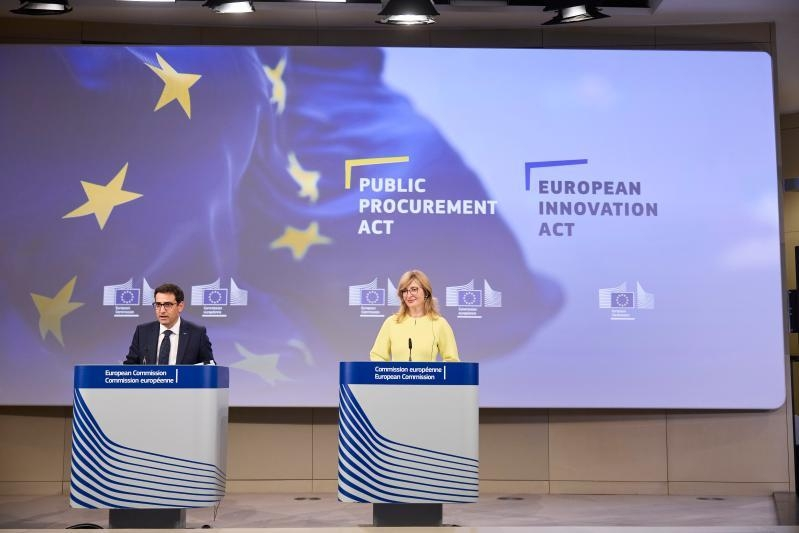
The Public Procurement Act proposed on 9 September would replace three directives covering general procurement, utilities, and concessions with one directly applicable regulation. Public authorities across the EU spend about €2.5 trillion a year through procurement — roughly 15% of EU GDP — so changes to the rules reach deep into markets including technology, energy, transport, healthcare, construction, and public services.
Brussels also wants to reduce the number of principal procedures, make negotiation easier in appropriate tenders, and connect national purchasing systems through a more integrated digital environment. Suppliers would, in principle, spend less time reproducing information already held elsewhere, while public buyers would have more flexibility to consult markets before committing themselves to specifications.
Although simplification occupies much of the proposal, its more substantial economic effect could come from changing what authorities are expected to value. Procurement would become a clearer instrument for reducing strategic dependencies and supporting European industrial capability rather than operating primarily as an administrative process built around equal access and price competition.
Price loses some of its dominance
Technology procurement has frequently exposed the limits of specifications written before buyers fully understand what a market can provide. Cloud systems, cybersecurity services, artificial intelligence, and developing infrastructure technologies can change quickly enough that a rigid tender may lock an authority into assumptions made months before bids are assessed.
The Commission’s proposal therefore gives greater weight to a best price-quality approach and broader strategic considerations, while allowing buyers more room to negotiate. That could make tenders more workable where reliability, interoperability, security, support, or long-term resilience carry costs that are not visible in the initial purchase price.
Cybersecurity illustrates the difficulty. A cheaper technology contract can still create expensive dependencies if its supplier becomes difficult to replace, if updates depend on infrastructure controlled in another jurisdiction, or if sensitive information is exposed to laws and ownership structures that concern the contracting authority. Similar questions arise across energy equipment, communications networks, cloud services, and other strategically significant purchases.
Brussels also proposes a framework through which European preference could be applied in specified circumstances. The measure is not a blanket instruction to exclude foreign companies, and existing international procurement commitments would continue to matter, but public authorities could place more weight on European content and reciprocal market access where strategic dependence or unfair access becomes an issue.
That will be among the more contentious parts of the legislation because public procurement has traditionally combined competition policy with an expectation of open markets. Giving industrial strategy a larger role creates room for governments to support domestic capacity, although it can also reduce competition or raise costs if preference criteria become a substitute for supplier performance.
Digital simplification still needs implementation
A common regulation should remove some variation created when directives are transposed into national law, yet legal harmonisation will not automatically produce a seamless procurement market. National platforms, identity systems, data formats, contracting practices, and administrative processes still need to work together if a supplier is genuinely to tender across borders without rebuilding the same documentation repeatedly.
The Commission intends a more connected digital procurement marketplace to address part of that fragmentation. In technology markets, where small suppliers can struggle with the cost of navigating multiple national systems, lower administrative overhead could widen participation, particularly if qualification information can be reused rather than resubmitted to each authority.
Smaller businesses will nevertheless continue to face requirements around financial standing, security, insurance, service continuity, and previous public-sector experience. Simplifying a tender form does not remove the institutional preference for suppliers that can demonstrate they will still be operating throughout a multi-year contract.
The proposal consequently intersects with Europe’s wider effort to turn public demand into a market for emerging technology. Germany has already experimented with routes that connect prototype development more directly with government procurement, reflecting concern that European research programmes can produce promising technologies without producing customers.
The European Innovation Act proposed alongside the procurement reform takes that argument further by creating a specific framework for research and development purchasing. Taken together, the two measures would give public bodies more ways to act as early customers while using ordinary procurement spending to support strategic capacity.
Greater discretion, however, also creates a governance burden. When buyers can negotiate more freely or give strategic considerations more weight, suppliers need predictable rules for how those judgements are made, while contracting authorities need sufficient expertise to defend decisions against challenge.
The proposed regulation must now pass through the European Parliament and Council, where provisions covering preference, quality weighting, and market access are likely to attract extensive negotiation. What emerges may therefore differ materially from the Commission text.
Even before those negotiations begin, the direction has shifted. Procurement worth roughly €2.5 trillion a year is being treated not simply as government purchasing machinery but as part of Europe’s response to industrial competition, technological dependence, and economic security. Whether the reform strengthens European suppliers without weakening competition will depend on the detail that survives the legislative process and, eventually, on the purchasing decisions made under it.


