Summary
- Infineon and LS Electric have signed an MoU to collaborate on high efficiency DC power infrastructure.
- The work will focus on power conversion systems, solid state transformers, and solid state circuit breakers.
- AI infrastructure demand is pushing datacentre engineering beyond compute hardware into power delivery, grid interfaces, and energy efficiency.
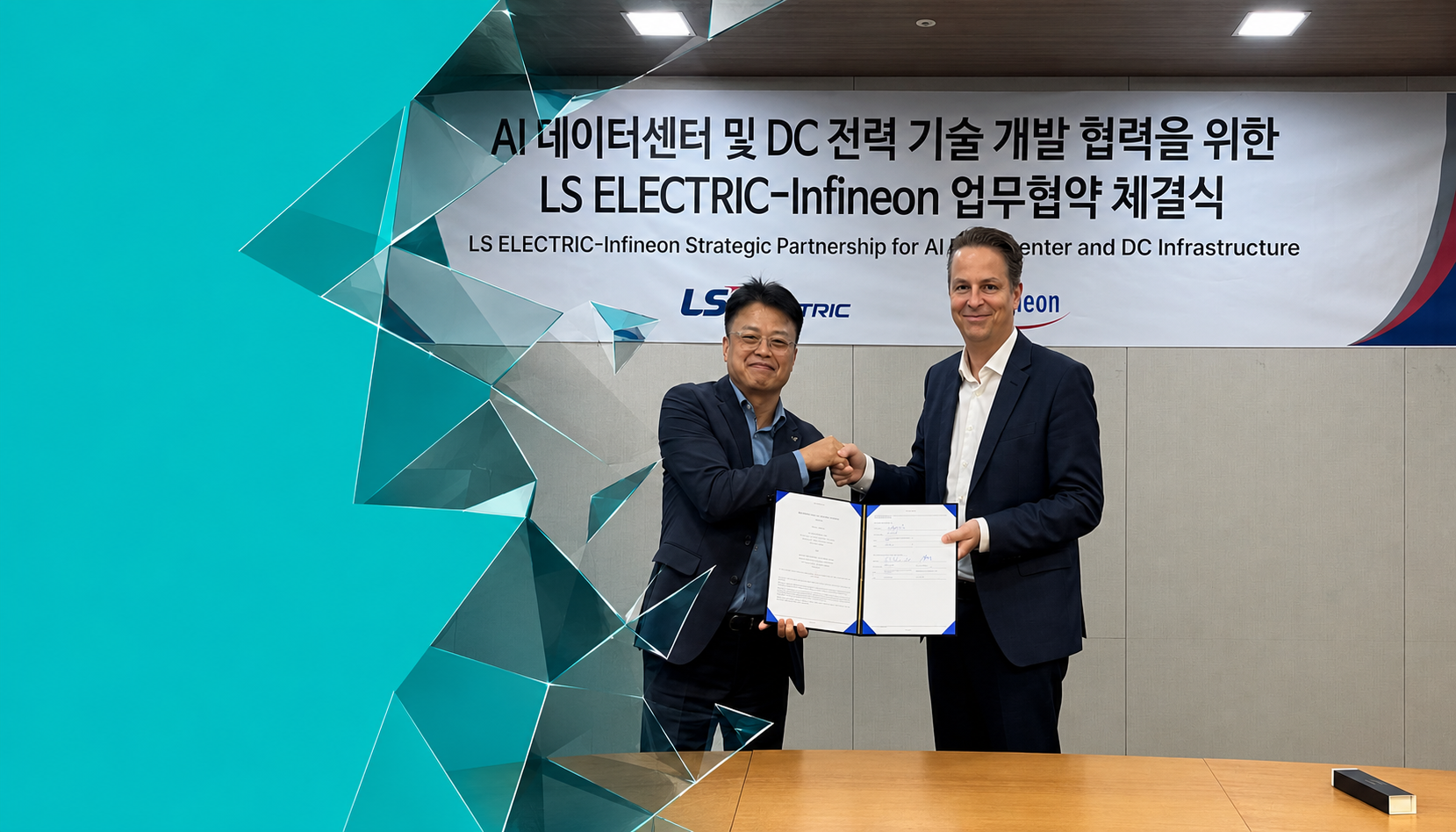
Infineon Technologies and LS Electric have signed a memorandum of understanding to develop high efficiency direct current power infrastructure for AI datacentres and next generation power grids.
The collaboration will focus on power conversion systems for energy storage, solid state transformers, and solid state circuit breakers. Infineon will bring power semiconductor technology into the work, while LS Electric contributes electrical equipment and grid systems expertise.
The agreement is more than a routine supplier partnership because AI datacentres are changing the assumptions that have governed facility power design. As GPU clusters become denser, the limiting factor is not only how many accelerators operators can buy, but how reliably and efficiently electricity can move from the grid to racks that draw far more power than conventional enterprise workloads.
Traditional datacentre power architectures rely heavily on alternating current distribution, with repeated conversion stages before electricity reaches servers and chips that ultimately consume direct current. Each conversion creates losses, heat, complexity, and equipment requirements. In high density AI environments, those inefficiencies become more expensive because power demand rises sharply and thermal management becomes harder.
That is why power electronics are moving towards the centre of the AI infrastructure debate. Solid state transformers and DC distribution systems could reduce equipment size and improve efficiency, while giving operators more flexible ways to integrate energy storage and manage demanding loads. Those benefits will only become commercially meaningful if the systems also prove reliable, maintainable, safe, and interoperable across facilities built from equipment supplied by multiple vendors.
Infineon’s role is commercially significant because the German chipmaker has been increasing its exposure to AI datacentre power demand. The company is not competing in the GPU market that dominates public discussion of AI hardware, but AI infrastructure is creating demand across the surrounding electrical stack. Power conversion, voltage regulation, circuit protection, energy storage interfaces, and grid integration are all becoming part of the economics of compute.
Europe may also have an industrial opening in this layer of the market. Much of the attention around AI hardware goes to US accelerator companies and hyperscale cloud providers, while European suppliers have deeper strengths in power electronics, electrical engineering, industrial automation, and grid technology. As AI buildouts collide with energy constraints, those capabilities could become more valuable than the current software centric debate suggests.
The deployment challenge remains substantial. Datacentre operators are cautious about electrical infrastructure because downtime is commercially damaging and customer workloads are increasingly mission critical. New DC architectures may offer efficiency advantages, but they must also clear a conservative engineering bar. Safety, standards, parts availability, maintenance skills, insurance, and operational monitoring will influence adoption alongside headline efficiency gains.
Grid operators will have their own stake in how these systems develop. Large AI campuses can behave like industrial loads, and their connection requirements may force upgrades to substations, transmission capacity, and local distribution networks. If DC infrastructure improves facility level efficiency or makes energy storage integration easier, it could reduce some pressure. If AI demand continues to grow faster than grid capacity, efficiency improvements will soften rather than settle the planning problem.
The Infineon and LS Electric agreement shows where the next layer of competition is forming. Datacentres are becoming power systems with computing attached, and suppliers able to improve the movement of electricity through that stack may become as important to AI deployment as the companies selling processors or cloud capacity.