

Summary
- ABB will support Ferrari Hypersail with DC system integration, energy management, storage, power distribution, and marine electrical expertise.
- The 100-foot yacht combines 48V and 800 VDC systems in a self-sufficient microgrid designed to operate for weeks under severe offshore conditions.
- ABB intends to apply lessons from the project to industrial power systems including data centres, renewable infrastructure, shipping, and microgrids.
ABB is taking an 800-volt direct-current architecture into the open ocean through a technology partnership with Ferrari Hypersail, using a renewable-powered racing yacht as an unusually severe test environment for electrical systems increasingly relevant to data centres, renewable energy, shipping, and industrial microgrids.
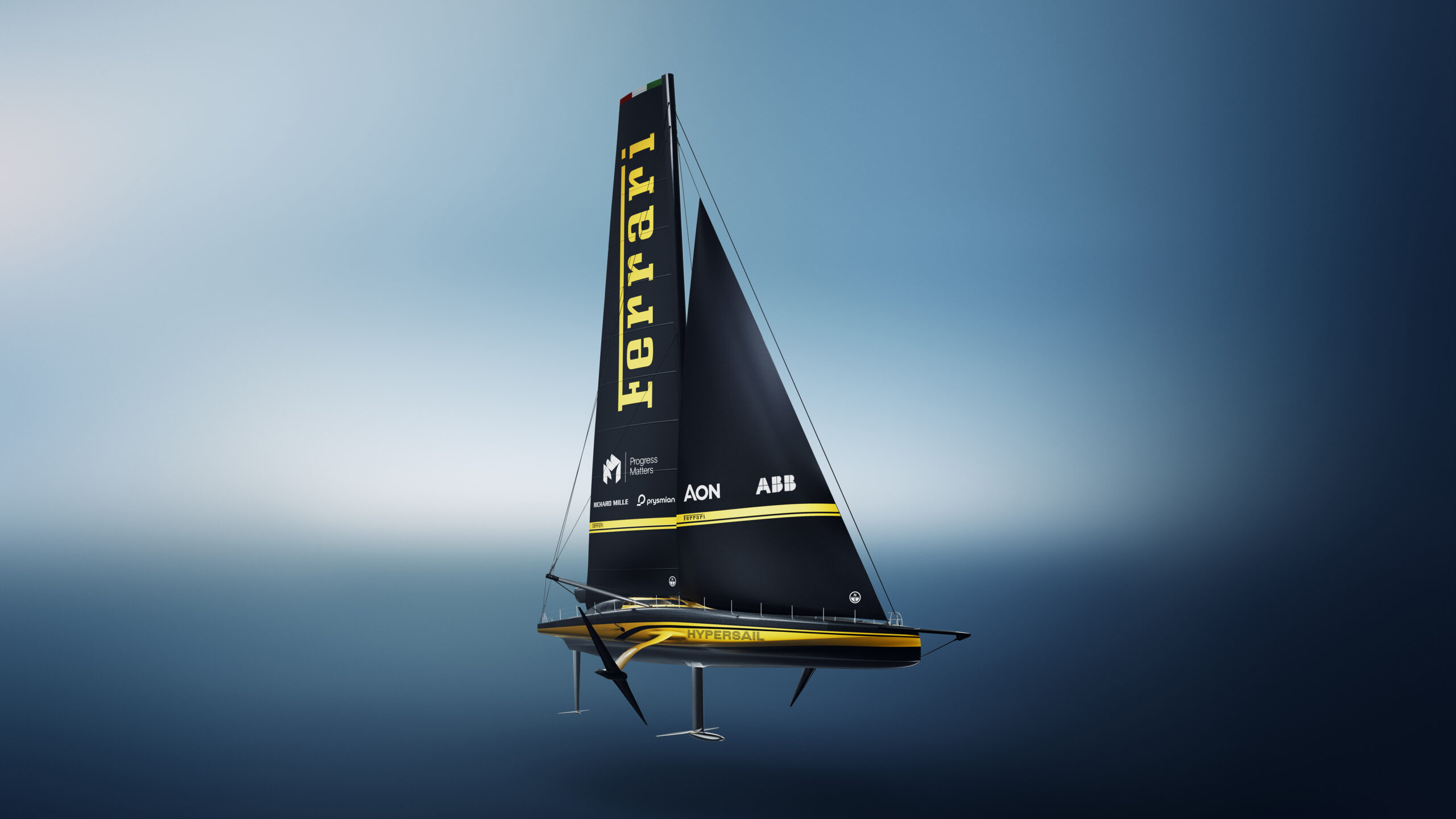
The Swiss engineering group has become Electrification Partner to Ferrari Hypersail, a 100-foot ocean-going full-foiling monohull designed to operate for weeks without an external electricity supply. ABB will contribute expertise in DC system integration, energy management, storage, power distribution, monitoring, and marine electrical systems, while the vessel itself will combine 48V and 800 VDC electrical architectures.
Although the Ferrari name gives the project an obvious sporting profile, the engineering problem is closer to a mobile industrial microgrid. The yacht has to generate, store, distribute, and continuously manage electricity for navigation, foil controls, safety equipment, electronics, and propulsion while dealing with cold, salt spray, pressure, violent movement, and tight limits on weight and available space.
ABB says the project draws on more than 25 years of work in DC technology and a portfolio of more than 700 related patents. Ferrari Hypersail will provide a live operating environment in which renewable generation, storage, and electrical loads have to remain balanced without access to a conventional grid or routine shore-based intervention.
A microgrid with nowhere to hide
Most industrial microgrids have some degree of redundancy available through the wider electricity system, backup generation, maintenance access, or the possibility of reducing non-essential loads. A vessel crossing an ocean has fewer options, particularly when systems connected to its electrical architecture control navigation, stability, and safety as well as performance.
That makes the yacht a potentially useful engineering environment for DC systems. Solar generation and batteries operate in direct current, while a growing range of electronic loads ultimately consume DC power, even though conventional electricity networks and much industrial equipment are organised around alternating current. Each conversion between AC and DC introduces equipment, weight, heat, and electrical losses, giving engineers an incentive to remove unnecessary conversion stages where the wider architecture permits it.
ABB says Ferrari Hypersail’s design will distribute power through a dual-voltage DC microgrid, with the 800 VDC system handling higher-power requirements and 48V supporting other onboard equipment. Its technology page describes the architecture as removing power-conversion steps to improve efficiency and resilience, although the practical outcome will depend on how the complete system performs once the vessel is operating under sustained load at sea.
The conditions add another layer of relevance. Marine systems have to withstand corrosion, vibration, temperature changes, moisture, mechanical stress, and highly variable power demand, while renewable generation can fluctuate with weather and operating conditions. Power electronics therefore have to do more than achieve a favourable laboratory efficiency figure: they must control energy flows predictably while the system is being physically stressed.
Enrico Voltolini, Project Leader of Ferrari Hypersail, said: “Hypersail runs entirely on renewable energy.” He added that the vessel must remain self-sufficient for weeks in hostile ocean environments, making reliable electrification an operational requirement rather than an ancillary part of the design.
800 VDC is moving beyond specialist applications
ABB’s interest extends well beyond marine engineering because high-voltage DC distribution is attracting attention wherever large electrical loads sit close to batteries, renewable generation, or power electronics. Data centres are one example: AI infrastructure is increasing rack-level power requirements, while operators are looking for ways to reduce conversion losses and simplify the path between incoming electricity, energy storage, and computing equipment.
ABB already links its 800 VDC work to next-generation AI data centres, including collaboration with Nvidia on power architectures intended for high-density computing. Renewable generation creates a related engineering problem because solar arrays and batteries naturally produce or store DC electricity, while industrial microgrids increasingly combine those assets with changing loads that need to be controlled in real time.
The commercial question is therefore not whether an ocean-racing yacht itself represents a large new market, but whether extreme conditions produce useful lessons about component design, control, fault handling, energy management, and system resilience. Technology developed for motorsport and aerospace has long migrated into industrial applications when engineering constraints expose weaknesses more quickly than ordinary operation would.
There are limits to the comparison. A yacht is not a data centre, and equipment optimised for low weight and extreme marine performance will not map directly onto a fixed industrial facility where cost, maintainability, standardisation, and regulatory requirements differ. ABB is using the project as an engineering demonstrator rather than presenting Ferrari Hypersail as a scaled-down template for industrial infrastructure.
The overlap is nevertheless tangible because both environments depend on managing generation, storage, and high-power loads as one coordinated electrical system. If Ferrari Hypersail’s architecture remains stable while supplying critical systems for weeks at sea, the useful output will be the engineering evidence produced around how high-voltage DC systems behave when resilience, efficiency, and continuous autonomous operation all have to be delivered at once.


