

Summary
- Cambridge Aerospace has raised $300 million at a $3.4 billion valuation, taking total funding beyond $630 million.
- The UK company is expanding production around its Skyhammer and Starhammer interceptor programmes and developing in-house solid rocket motors.
- Its manufacturing strategy reflects a wider defence-market constraint: governments need lower-cost systems, but new suppliers still have to prove they can produce them reliably and repeatedly.
British air-defence company Cambridge Aerospace has raised $300 million at a $3.4 billion valuation, directing another large pool of private capital towards the industrial task of producing missile and drone interceptors at substantially greater volume.
The Series C was led by DFJ Growth, with participation from investors including Lux Capital, Accel, Lakestar, Never Lift, Ora Global, and Elad Gil. Cambridge Aerospace has raised more than $630 million since its formation in 2024 and employs around 250 people, mostly in the UK, alongside operations elsewhere in Europe and overseas.
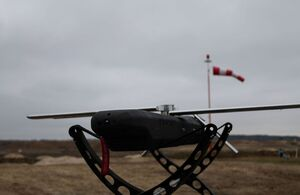
The funding is intended to expand manufacturing around two principal systems. Skyhammer is already in production as a lower-cost interceptor for drones and other airborne threats, while Starhammer is being developed for higher-speed targets and is expected to reach the market next year.
Demand is not hypothetical. Cambridge Aerospace has secured Ministry of Defence business around Skyhammer, giving the young company an early route from venture-backed development into government procurement. Its larger challenge now lies in converting prototype speed and investor capital into production that can meet the reliability, quantity, and delivery expectations attached to operational defence systems.
Manufacturing becomes part of the technology
Cambridge Aerospace is attempting to own more of that production problem rather than hand difficult components to an established supply chain. It uses additive manufacturing and AI within its industrial processes and is developing its own Nightstar solid rocket motors, reducing dependence on suppliers operating in a market where motor capacity has become a significant bottleneck.
The company is also building manufacturing capacity in Norfolk, with ambitions to supply its own programmes and eventually other customers. That vertical integration changes the character of the business because success depends on factories, materials, quality control, skilled labour, test infrastructure, and production yield alongside missile design.
Cambridge Aerospace is targeting production of 2,500 Skyhammer units a month by next spring, an aggressive ramp for a business founded only two years ago. Achieving it would require a manufacturing cadence closer to high-volume industrial production than the small-batch cycles associated with many conventional missile programmes.
The target also illustrates why defence technology is attracting growth capital that would once have been more closely associated with software. Governments are trying to rebuild stockpiles and production capacity, while comparatively cheap drones have exposed a mismatch between the cost of attack and the cost of interception.
Lower prices do not remove defence constraints
An inexpensive one-way drone can impose disruption far beyond its purchase price, yet a conventional air-defence response may rely on missiles that are expensive, slow to manufacture, or scarce. Lower-cost interceptors offer another layer in which the defensive response is less economically disproportionate, particularly when threats arrive in volume.
That logic does not make the engineering easier. An interceptor still has to operate reliably under demanding physical conditions, integrate with sensing and command systems, survive electronic interference, meet safety requirements, and perform consistently when failure carries consequences far beyond an unsatisfied commercial customer.
Government procurement also introduces certification, export controls, logistics, training, maintenance, and integration work that a venture-backed company cannot compress in the same way it might shorten a software release cycle. Faster industrial methods can reduce some bottlenecks, but defence customers ultimately buy repeatable performance rather than development velocity.
Cambridge Aerospace has already crossed an important threshold by securing Ministry of Defence demand, while its latest round gives it enough capital to invest in the factories and component production needed to fulfil larger programmes. The risk shifts accordingly from whether investors will fund the technology towards whether the business can manufacture it at the promised cost and volume.
That distinction is becoming central across European defence technology. Startups have attracted substantial investment by arguing that software-led engineering, additive manufacturing, and greater vertical integration can shorten development cycles, but the current market increasingly tests those claims through procurement and production rather than demonstrations.
Factories also consume venture capital differently from SaaS businesses. Equipment, materials, inventory, quality systems, facilities, and working capital absorb cash before a finished interceptor is delivered, leaving investors exposed to government purchasing cycles and industrial execution as well as technical risk.
Cambridge Aerospace’s $3.4 billion valuation reflects expectations about a defence market expanding quickly, but valuation is the least operational part of the story. With in-house rocket motors, a Norfolk production footprint, and a target measured in thousands of interceptors each month, the company is now making an industrial claim that can be tested on a production line.


