Summary
- ProLogium says contractors have begun coordinated site and electrical infrastructure work for its planned Dunkirk battery gigafactory.
- The first phase is designed for 4 GWh of annual capacity, with the wider site potentially expanding to 44 GWh.
- Mass production remains scheduled for the end of 2028, leaving execution, localisation, skills, and industrial ramp-up as the main tests ahead.
ProLogium says construction work on its Dunkirk battery gigafactory is moving from preparation into coordinated site execution, with grid connection, electrical infrastructure, supplier qualification, and workforce development advancing around a project intended to anchor the Taiwanese battery developer’s European manufacturing base.
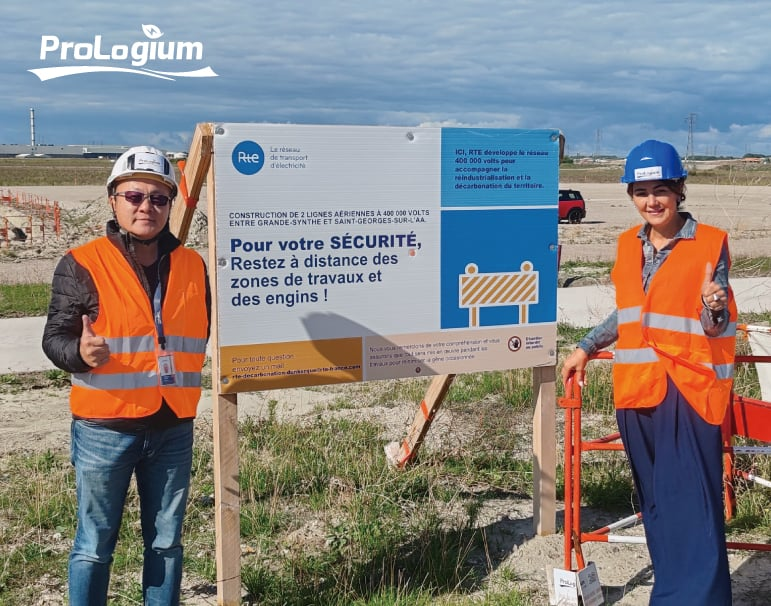
Contractors are working across site access, fencing, platform preparation, and electrical infrastructure, while French distribution network operator Enedis is carrying out the grid connection. ProLogium expects the construction site to receive power in early October, a relatively mundane milestone that marks a shift from planning towards the physical infrastructure required to build the factory.
The plant is designed to begin with annual production capacity of 4 GWh before potentially expanding to as much as 44 GWh. ProLogium says phase-one construction began during 2026 and continues to target mass production by the end of 2028.
Those dates leave a considerable industrial programme between an energised building site and commercial battery output. Battery factories require specialised clean and dry environments, tightly controlled manufacturing processes, qualified material suppliers, trained workers, and stable production yields before headline capacity becomes usable output.
Europe’s battery challenge moves into execution
Dunkirk has become one of Europe’s more concentrated battery and electric-vehicle industrial clusters, drawing manufacturers and suppliers partly because of access to port infrastructure, energy, transport links, and the existing industrial base in northern France. ProLogium is trying to place its next-generation battery technology inside that ecosystem rather than ship cells into Europe from Asia indefinitely.
The company’s planned facility includes a bespoke cleanroom and dry-room design for advanced battery manufacturing and is targeting BREEAM certification. ProLogium is also qualifying local and European suppliers while adapting technology and engineering processes for production in France.
Localisation will determine how much of the project’s industrial value remains in Europe. A battery plant can assemble cells domestically while continuing to depend heavily on imported specialist materials, equipment, intellectual property, and upstream processing, so European policymakers have increasingly looked beyond the location of the factory building when discussing resilience.
ProLogium describes Dunkirk as part of a wider European system linking research, intellectual property, manufacturing, suppliers, and skills. The company already operates an overseas research and development centre in Paris-Saclay, while its first gigafactory is in Taoyuan, Taiwan.
Its French factory is intended for a newer generation of inorganic lithium ceramic battery technology, which the company says can support a more diversified supply chain. As with other next-generation battery technologies, however, the industrial question is not simply whether laboratory or pilot cells perform well but whether the manufacturing process can reach automotive volumes with consistent quality and commercially viable costs.
Gigafactories depend on more than capital
Europe’s battery-manufacturing push has shown how difficult that transition can be. Large plants require billions of euros in capital, substantial power connections, reliable equipment, and long-term customer demand, while delays in construction or production ramp-up can consume cash long before a factory reaches efficient utilisation.
ProLogium’s current update is therefore more useful as an execution marker than as proof that industrial risk has been solved. Site preparation, grid connection, and contractor coordination show that the project is advancing physically, but the more demanding steps of installing manufacturing equipment, commissioning production lines, qualifying cells, and scaling yield remain ahead.
Workforce development is another constraint because advanced battery manufacturing creates demand for technicians and engineers whose skills overlap with other industrial projects in the region. ProLogium says it is working with schools, universities, and training centres in Hauts-de-France as part of preparations for long-term operations.
That local skills pipeline matters because Dunkirk is not attracting one factory in isolation. Multiple large industrial investments compete for construction labour, electrical capacity, engineering expertise, maintenance technicians, logistics infrastructure, and suppliers, giving the region the benefits of clustering while also increasing pressure on the same resources.
The planned 44 GWh end-state also needs to be distinguished from the initial 4 GWh phase. Gigafactory announcements often use ultimate site capacity as shorthand for the scale of an investment, although expansion generally depends on earlier phases reaching technical and commercial milestones first.
For ProLogium, the timetable now runs towards an end-of-2028 production target, which means the next two years will move the project from civil engineering into industrial commissioning. Supplier qualification and technology localisation will have to advance alongside the building because a functioning European battery plant depends on the manufacturing system around it rather than the shell alone.