

Summary
- Pasqal and LG CNS have signed a three-year agreement around hybrid AI and neutral-atom quantum computing.
- Work will include integration and management of quantum resources within LG CNS data-centre environments.
- Neither company has published customer deployments or benchmarks showing an economic advantage for quantum-assisted AI workloads.
Quantum computing is beginning to encounter the same integration problem that shaped earlier generations of enterprise infrastructure: specialised hardware becomes commercially useful only when ordinary software and data-centre systems can invoke it without requiring every customer to become an expert in the underlying machine.
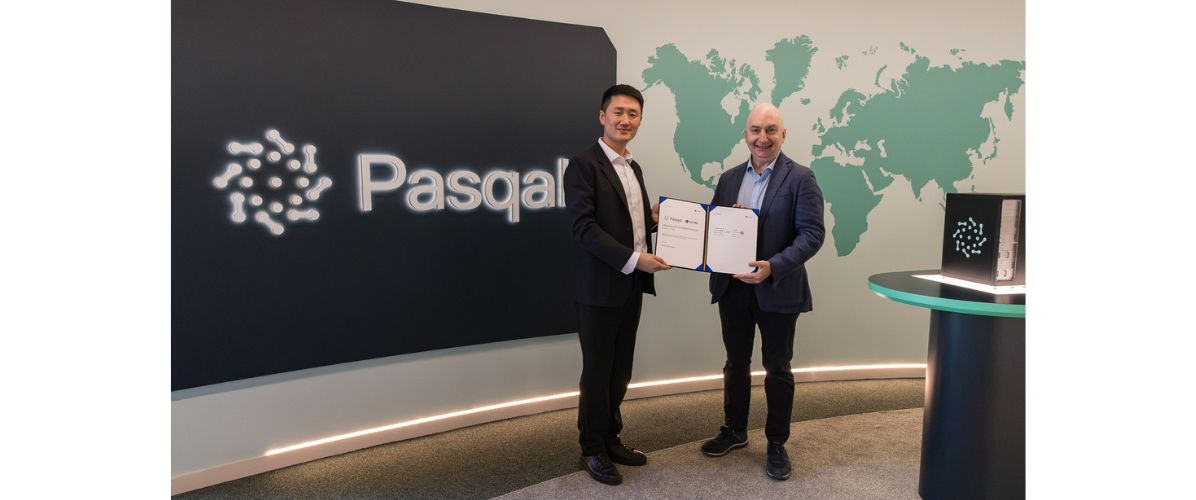
French quantum company Pasqal has signed a three-year agreement with LG CNS to develop hybrid platforms combining neutral-atom quantum processors with AI and data-centre infrastructure.
The 10 September agreement covers integration with LG CNS environments and the operational management of quantum resources inside data centres. The companies also plan to pursue commercial opportunities together in South Korea and elsewhere.
No customer deployment, pricing, performance benchmark, or production timetable has been disclosed, so the announcement does not show that quantum computing has already created an advantage for ordinary AI workloads. Instead, it addresses the infrastructure required to find out.
Quantum will coexist with conventional compute
Commercial quantum computers are unlikely to replace CPUs and GPUs across general workloads. Their potential lies in narrower classes of calculation where quantum algorithms may eventually outperform conventional methods, which means useful systems will need to move individual tasks between several forms of compute.
Pasqal uses neutral atoms manipulated with lasers to represent quantum information, an architecture different from the superconducting processors pursued by several rivals. Yet whichever physical approach succeeds still needs scheduling, networking, software interfaces, security, monitoring, and operational support around the processor.
That makes LG CNS a relevant partner because its expertise lies in enterprise systems and data-centre operations rather than quantum physics. Integrating a specialist machine into existing infrastructure requires the software and processes to decide when a calculation should use it, how information reaches the device, and what happens when the result returns.
The history of GPUs provides a useful, if imperfect, comparison. Graphics processors became foundational AI infrastructure not only because the hardware improved but because software frameworks, cloud services, and orchestration layers made them accessible to developers who did not need to understand every detail of the chip.
Quantum systems remain much less mature, although they face a similar abstraction requirement if they are to move outside specialist research environments.
AI data centres provide a large but uncertain market
The partnership is framed around AI infrastructure partly because data centres are consuming rapidly increasing amounts of specialised compute. Operators are already mixing GPUs, CPUs, accelerators, high-speed networks, and storage architectures as they try to balance performance, energy use, and cost.
Quantum processors could eventually become another component of that heterogeneous environment, although the phrase “quantum AI data centre” risks implying a broader capability than either company has demonstrated.
Many proposed quantum applications concern optimisation, simulation, chemistry, materials, or other mathematically specialised problems. There is not yet public evidence from Pasqal and LG CNS showing that routine large-language-model training or inference would gain an economic advantage simply by adding a quantum processor.
The more credible near-term route is hybrid. Conventional machines handle most activity, while a specialised problem is sent to a quantum resource only when there is evidence that doing so improves speed, accuracy, or cost.
Building that integration before large-scale quantum advantage arrives can still make sense because customers need operational infrastructure ready when useful workloads emerge. The risk is building a sophisticated management layer around hardware that remains too expensive or too limited to justify production use.
Commercialisation depends on boring engineering
Quantum announcements often concentrate on qubit counts or scientific milestones, while enterprise customers eventually have to ask more prosaic questions about uptime, security, failure handling, support, workload queues, and data movement.
Those operational details determine whether a specialised processor can become part of an ordinary data-centre estate rather than remaining an instrument booked by researchers.
Pasqal is simultaneously working to increase the scale of its neutral-atom systems, while its partnership with LG CNS develops the surrounding architecture. The two strands have to progress together: a powerful processor without usable integration remains difficult to commercialise, while perfect orchestration around weak hardware has no compelling workload.
The South Korean relationship also demonstrates how a French deep-tech company can pursue European strategic capacity while building international markets. Quantum hardware requires substantial investment, and European suppliers will need customers outside their home region if research strength is to develop into a durable industry.
The three-year agreement gives Pasqal and LG CNS time to build the operational plumbing while the hardware matures. By the end of that period, however, the commercial question should be easier to state: whether a customer can invoke a quantum resource from an ordinary workflow and obtain enough measurable advantage to justify the additional complexity.
Until that evidence exists, the partnership is best understood as infrastructure preparation rather than a quantum breakthrough. That may sound less dramatic, but data-centre history suggests that making exotic hardware boring enough to operate can be one of the most important steps towards making it useful.


