Summary
- London-based CloudNC has raised $20 million to expand CAM Assist and develop additional AI products for precision manufacturers.
- CAM Assist is used by more than 1,000 machine shops, while Quote Agent moves the company into job assessment and estimating.
- Extending AI from machine programming into quoting tests whether manufacturing software can improve both shop-floor productivity and the commercial workflow before production starts.
CloudNC built its first manufacturing AI product around one of the most specialised tasks inside a machine shop, while its next expansion reaches several steps earlier into the process where manufacturers decide whether a job can be made, how long it will take, and what price they should quote.
CloudNC has raised $20 million in new capital led by Nimble Ventures, with participation from Calculus Venture Capital, Entrepreneur First, and Lockheed Martin’s LM Ventures. The London-headquartered company plans to expand adoption of CAM Assist and develop additional products including Quote Agent, an AI system for assessing machining enquiries and producing estimates.
CAM Assist applies AI to computer-aided manufacturing programming, the stage where a machinist turns a digital part design into strategies and toolpaths telling a CNC machine how to cut it. CloudNC says the product is now used by more than 1,000 machine shops worldwide.
Moving into quoting brings the company closer to the commercial front end of manufacturing. Before metal reaches a cutting tool, a manufacturer has to assess whether the requested part is practical, determine processes and materials, estimate machining and setup time, consider available capacity, and put a price on the work quickly enough to compete for it.
Automation moves from the machine into sales
An inaccurate estimate creates problems in either direction. Quote too high and a manufacturer can lose profitable work; quote too low and it can win an order whose real production requirements consume the expected margin. Experienced estimators consequently carry knowledge spanning machinery, tooling, materials, tolerances, setup, and historical job performance.
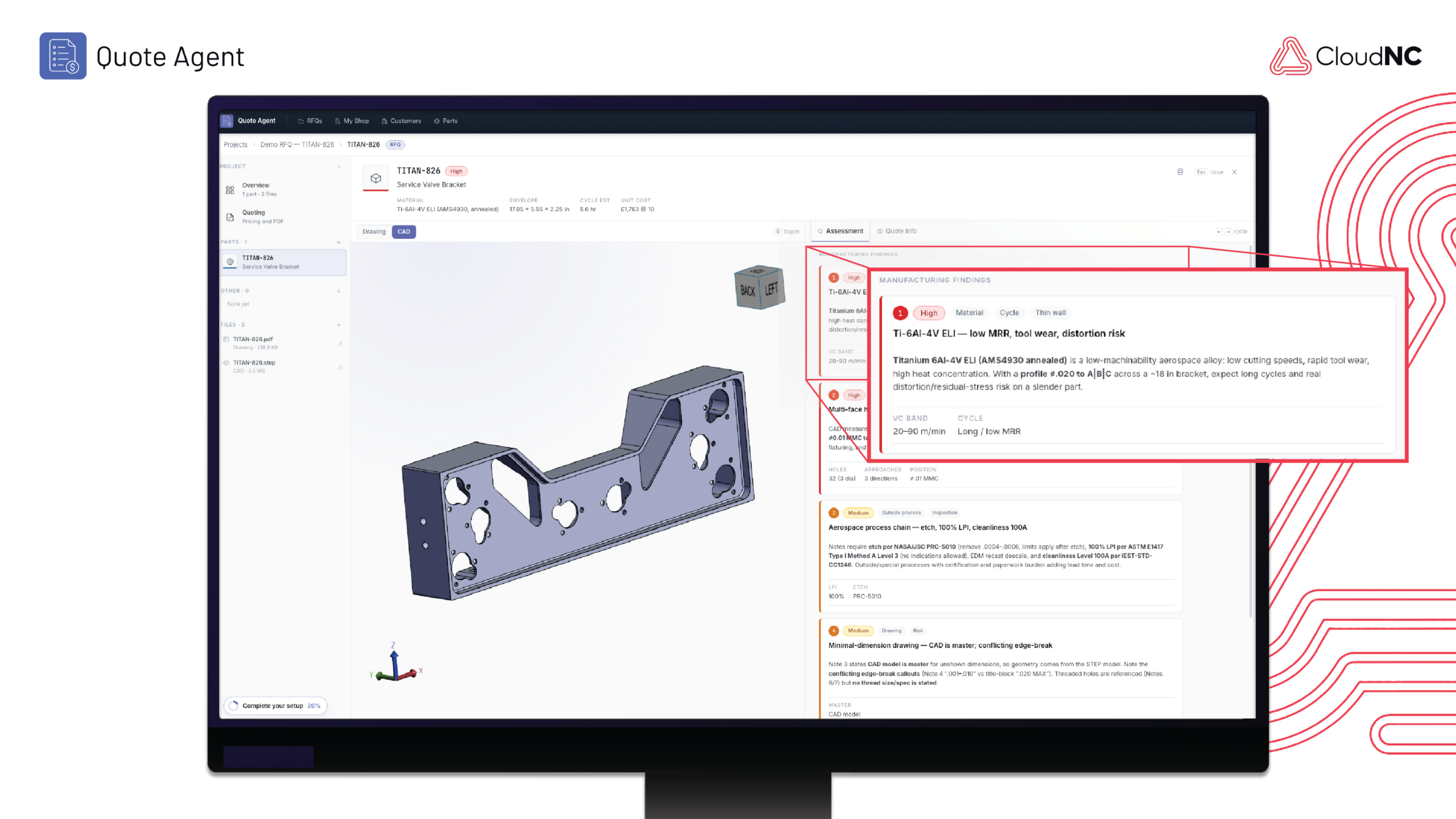
CloudNC says Quote Agent will use AI to analyse parts, drawings, manufacturability, and other information involved in requests for quotation while retaining expert judgement. A public product interface is already live, although the company describes broader availability as coming later in 2026.
The model extends the approach taken with CAM Assist. Rather than removing a machinist from the process, the software generates strategies and operations that a programmer can inspect and adjust before the resulting toolpaths reach production.
CloudNC markets CAM Assist as capable of automating a substantial share of programming work, although individual time-saving figures remain company and customer claims rather than independent industry benchmarks. A more concrete adoption signal comes from its integration with established environments including Mastercam, Autodesk Fusion, Siemens NX, GibbsCAM, and SolidCAM.
Those integrations reflect the economics of industrial software. Machine shops have existing tools, trained staff, post-processors, libraries, customer requirements, and machinery with long useful lives, making an AI product easier to adopt when it improves an installed workflow rather than demanding wholesale replacement.
Skills shortages strengthen the productivity case
British manufacturers continue to report difficulty recruiting technical workers, while industry and government skills work increasingly treats AI as one factor reshaping roles across advanced manufacturing. That does not make automation a substitute for machinists, whose work requires judgement around machines, materials, tools, fixtures, tolerances, and the physical consequences of a bad decision.
A more credible productivity case is therefore to reduce repetitive programming and estimation work consuming the time of people who already possess that expertise. Where experienced staff can supervise more jobs rather than manually constructing every toolpath or quotation, constrained skills become less of a ceiling on throughput.
CloudNC has an unusual perspective on that problem because it operates a factory in Chelmsford alongside its software business. The company uses its technology in a manufacturing environment serving sectors including aerospace, energy, nuclear, defence, and automotive work, giving developers exposure to production constraints rather than relying entirely on synthetic examples.
Quoting nevertheless introduces a different type of risk from CAM programming. A proposed toolpath can be inspected before a machine begins cutting, while an inaccurate quotation may create a commercial problem that becomes apparent only after the business has committed to the job.
Useful estimates also depend on more than geometry. Machine capabilities, materials, cycle-time assumptions, labour, capacity, customer requirements, and commercial rules all influence price, bringing familiar enterprise-AI problems around data quality and integration into a setting where errors have direct physical and financial consequences.
Vertical AI expands along the workflow
CloudNC’s movement from CAM programming towards quoting demonstrates how specialist AI suppliers can widen once they establish a foothold in a technically difficult process. Solving one domain-specific problem provides customer relationships, operational data, and expertise that can support adjacent products.
The company is also working towards FedRAMP certification in the United States, potentially widening use in government and defence manufacturing environments where security and data handling carry additional requirements. Lockheed Martin’s investment arm participating in the new round adds another connection to those markets.
Funding does not establish whether the expansion will succeed. The more useful measures will be whether machine shops use Quote Agent during routine commercial work, how closely estimates track the eventual cost of completed jobs, and whether time saved in programming and estimating produces greater throughput rather than simply another software subscription.
With CAM Assist already used across more than 1,000 shops, CloudNC has moved beyond an industrial AI demonstration. Its next test is whether the same manufacturing knowledge can automate a larger portion of the process running from an incoming customer drawing to a finished component that was priced correctly in the first place.