

Summary
- Strolll has secured approximately £4.3 million of Innovate UK backing across a reported innovation loan and an officially recorded Growth Catalyst Investor Partnerships award.
- The projects cover AI assisted validation of neuromotor assessments and augmented reality rehabilitation for acute, bed-bound patients.
- The funding targets a persistent healthtech bottleneck: generating evidence and fitting digital rehabilitation into clinical workflows rather than stopping at promising pilots.
Innovate UK is backing Stafford-based neurorehabilitation company Strolll with approximately £4.3 million across two projects intended to expand augmented reality therapy and speed the validation of digital neurological assessments.
Contemporaneous reporting puts the package at a £3.6 million innovation loan alongside a £699,075 Growth Catalyst Investor Partnerships award recorded in the government’s subsidy database. The smaller award is independently confirmed in the official record, while the £3.6 million loan figure has not been located in a standalone UKRI award notice and should therefore remain attributed rather than treated as separately verified.
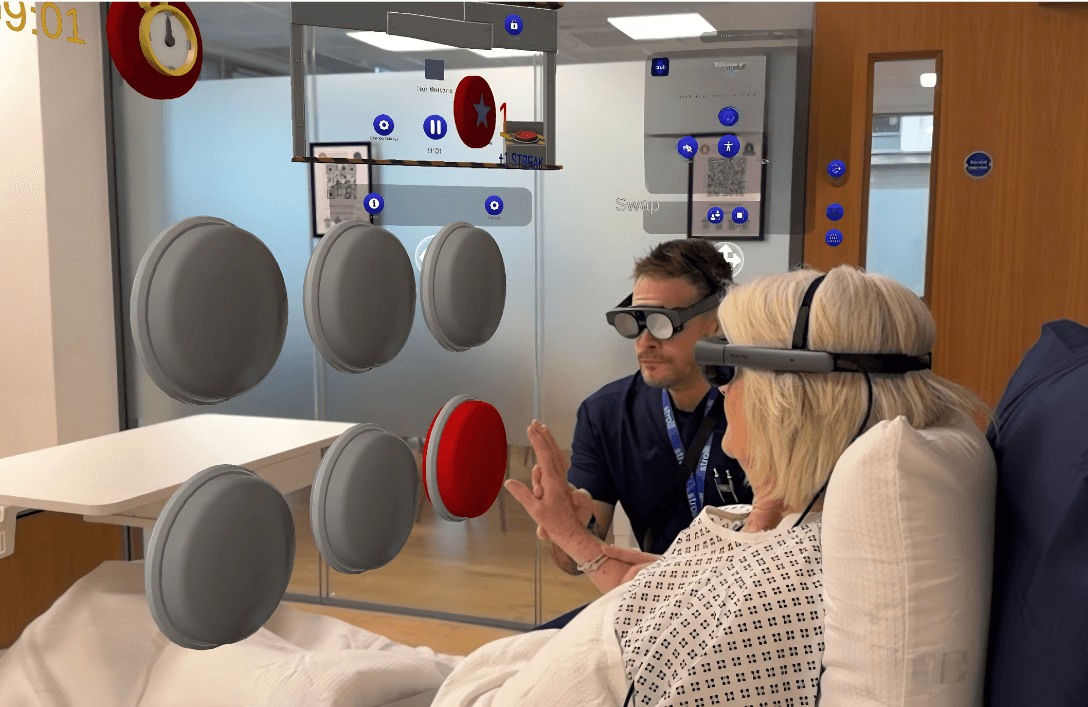
Strolll’s existing platform uses augmented reality glasses to place visual cues, exercises, and rehabilitation tasks into a patient’s real surroundings rather than replacing the environment with virtual reality. The company targets neurological conditions where movement, balance, gait, and repeated therapy are important, including Parkinson’s disease and stroke rehabilitation.
The new projects extend beyond commercial expansion of that platform. One, StrolllAssessment, is intended to combine artificial intelligence with a biomechanics laboratory so that digital neuromotor assessments can be validated more quickly, while StrolllAcute is designed to bring augmented reality rehabilitation to bed-bound patients earlier in hospital care.
Clinical validation is part of the product
Digital health companies frequently encounter a gap between showing that technology works in a controlled study and proving that hospitals can depend on it routinely. Assessment tools carry a particularly demanding evidence burden because clinicians need to know that an automated measurement corresponds closely enough with established methods to influence monitoring or treatment.
Reporting around the funding says the larger innovation loan will support a biomechanics laboratory at Strolll’s Stafford site where automated clinical assessments can be compared with reference measurements. The objective is to make validation more repeatable across several digital measures rather than rebuilding the process around each individual assessment.
Artificial intelligence can accelerate analysis of movement data, but it does not remove the clinical evidence requirement. An algorithm measuring gait, balance, or motor function has to perform across different patients, conditions, body types, devices, and clinical environments, while clinicians need to understand when a measurement falls outside its dependable range.
Validation infrastructure can consequently become a commercial asset in its own right. A company able to test new digital assessments repeatedly may shorten development cycles, although regulators, researchers, and healthcare customers will still decide what level of evidence is sufficient for each intended medical use.
Augmented reality moves towards acute care
The second project moves Strolll’s approach into an earlier stage of rehabilitation. StrolllAcute is aimed at bed-bound patients, where conventional mobility therapy can be limited by a patient’s condition, staff availability, equipment, and the practical difficulty of beginning meaningful activity in an acute ward.
Strolll argues that augmented reality can keep the physical environment visible while adding therapeutic cues and tasks, distinguishing its system from fully immersive virtual reality. Its current platform supports exercises in clinical and home environments and is intended to increase engagement and rehabilitation intensity without removing interaction with therapists.
The broader evidence base remains under development. A randomised controlled trial funded through the National Institute for Health and Care Research is examining Strolll’s Reality DTx technology in Parkinson’s rehabilitation, while other clinical and academic projects are studying augmented reality approaches for neurological recovery. Health Innovation East says a £2.4 million NIHR-funded trial began in 2025, giving the technology a larger evidence programme than a standalone commercial pilot.
Engagement and clinical effectiveness remain separate measures. Rehabilitation technology can encourage patients to perform more exercises or spend more time in therapy, while providers still need evidence about functional outcomes, safety, staff requirements, and whether improvements persist beyond supervised use.
Hospital adoption will also depend on workflow. Equipment that requires lengthy calibration, specialist technical support, large amounts of space, or repeated setup can consume the staff time it is intended to save. A bedside system therefore has to prove not only that patients can use augmented reality earlier in recovery but that clinical teams can incorporate it without creating a disproportionate operating burden.
Public finance carries later-stage healthtech risk
The funding structure is notable because it combines different forms of public support rather than relying entirely on grants. The £699,075 award is publicly recorded as UKRI Innovate UK support, while the larger portion is reported as an innovation loan intended to support later-stage development and commercialisation.
Loans allow public innovation programmes to support businesses beyond early research while expecting repayment if commercialisation succeeds, but they also place obligations on companies operating in markets where healthcare sales and regulatory adoption can move slowly. Combining public finance with private investment spreads some of that risk while requiring a credible route towards revenue.
Strolll raised a substantial Series A round in 2025 and has expanded deployments since then, so the current support arrives at a later development stage. Its next challenge is to extend the platform into additional clinical settings while generating the evidence required to persuade hospitals, rehabilitation providers, regulators, and payers that broader use is justified.
The funding is therefore best understood as investment in the machinery between invention and routine healthcare. Augmented reality rehabilitation can be technically compelling, but adoption depends on validated measurements, clinical outcomes, staff workflow, reimbursement, and systems that continue operating when they leave a demonstration environment and enter a busy ward.


