

Summary
- The proposed East Havering Data Centre Campus represents an estimated £14.7bn investment on a 218-hectare site in North Ockendon.
- Planning material projects very high electricity consumption and annual emissions even though the development is designed without on-site fossil fuel use.
- Heat reuse, horticulture, biodiversity measures, and employment form part of the scheme, but they do not remove the underlying electricity and carbon trade-offs.
A proposed £14.7 billion hyperscale data centre in outer London is forcing an unusually large set of national infrastructure questions into a borough planning process, after environmental modelling associated with the project put its potential electricity demand and carbon emissions on a scale more commonly associated with heavy industry. The East Havering Data Centre Campus is intended to support cloud computing, artificial intelligence, and machine-learning workloads at North Ockendon in the London Borough of Havering.
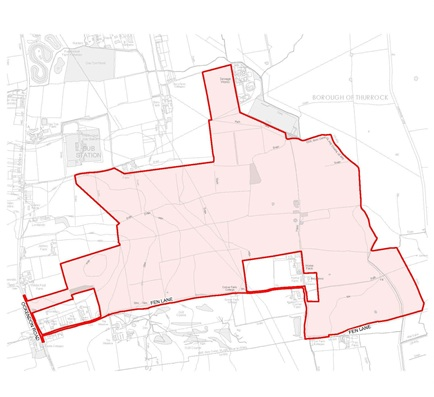
The proposal covers about 218 hectares of green belt land and includes a 113-hectare publicly accessible ecology park, commercial horticulture using waste heat, and a district heating network. Project material puts total private investment at £14.7 billion and estimates that the completed development could support 620 permanent operating roles, alongside construction employment over a programme extending for roughly two decades.
However, the scale of the computing infrastructure produces a very different set of numbers in the project’s environmental documentation. Planning material reported this week projects annual emissions of more than 1.2 million tonnes of carbon dioxide equivalent and electricity consumption of about 2.65 billion kWh a year at 50% utilisation, figures that remain forecasts because the campus has not yet been built.
The project describes itself as having a net-zero operational design, including no on-site fossil fuel use, which does not mean the wider electricity consumed by the facility produces no associated carbon. The difference between an efficient building and the emissions attributable to the power it draws from the grid is increasingly important as AI facilities become large enough for energy procurement and electricity-system assumptions to dominate their environmental footprint.
Computing becomes an infrastructure decision
The UK government designated data centres as Critical National Infrastructure in 2024, recognising that finance, healthcare, communications, public services, and much of the wider economy now depend on the facilities in which digital systems run. At the same time, AI has increased the maximum size of individual projects because training clusters require dense concentrations of processors and dependable electricity supplies.
The East Havering project says the site was chosen after a search for a location combining sufficient land with high-capacity power, a pairing that has become difficult to secure around London. Across Europe, large AI projects are already turning telecommunications and power infrastructure into strategic assets for new computing capacity.
Havering has been progressing the proposal through a Local Development Order, with public consultation taking place between March and April. The approach can establish planning permission for development meeting specified conditions across a defined site, but it still requires the environmental, transport, drainage, ecology, energy, and other consequences of a project of this scale to be examined.
Consequently, the dispute is broader than whether another commercial building should occupy green belt land. A campus consuming electricity measured in billions of kilowatt-hours creates questions about grid reinforcement, generation, carbon accounting, land allocation, and whether the benefits associated with digital infrastructure compensate for the physical resources consumed to host it.
Waste heat changes only part of the equation
The developer has incorporated several measures intended to use resources that would otherwise be wasted, including a 50,000-square-metre horticultural facility heated with recovered energy from the data centre. The 113-hectare ecology park is designed to produce substantial biodiversity gains, while a district heat network could potentially allow energy rejected by computing equipment to serve neighbouring uses.
Those elements can improve the overall efficiency of the development without cancelling its electricity demand. Waste heat can reduce energy use elsewhere, and habitat work can improve ecological outcomes compared with a conventional industrial estate, but neither automatically offsets the carbon associated with generating the power consumed by the servers.
The eventual outcome will depend heavily on the energy mix available over the campus’s operating life, the actual utilisation of its computing equipment, the source of any contracted renewable power, and the way residual emissions are treated. Those variables are particularly important for infrastructure expected to operate for decades because the electricity grid itself is changing as fossil generation is replaced and demand rises from transport, heating, industry, and computing.
The project’s economic claims are substantial as well. Its material estimates a £281 million annual contribution to the local economy once fully operational, while the wider value of the facility would extend beyond the people employed on site because cloud and AI capacity can serve organisations across a much larger geography.
Yet those benefits leave councils and national policymakers with a harder planning problem than the one presented by conventional commercial property. Britain wants more domestic computing capacity and has designated data centres as nationally important infrastructure, while the same facilities compete for electricity, land, and environmental headroom needed elsewhere in the economy. East Havering brings those policy ambitions and physical limits together on a single site, making the planning process a test of how the country intends to reconcile the two.


