Summary
- AI adoption is increasing the importance of trusted data, resilient infrastructure, sovereignty, governance, and recoverability across enterprise environments.
- Solidigm and Scality focus on changing AI data demands and infrastructure complexity, while Keepit and Veeam emphasise resilience, control, and recovery.
- The article argues that enterprise AI maturity will depend as much on confidence in the underlying data and infrastructure as on model capability.
By Federica Monsone, CEO and Founder, A3 Communications
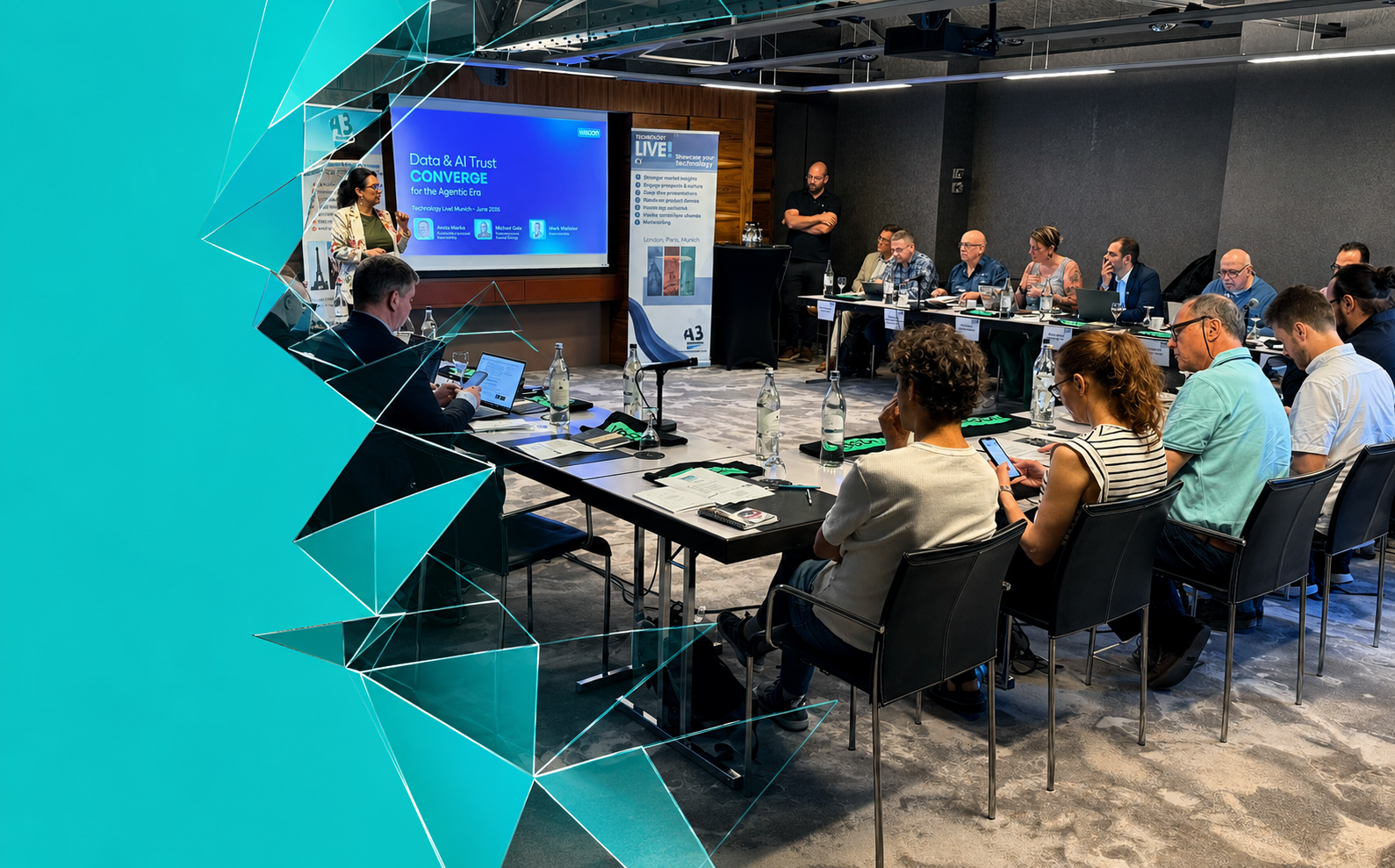
Artificial intelligence (AI) dominated discussions throughout the latest edition of Technology Live! in June, but the most compelling conversations were not about models, GPUs, or the latest AI applications. Instead, speakers from Keepit, Scality, Solidigm, and Veeam revealed a broader shift taking place across enterprise technology. While each company approached AI from a different perspective, a common theme emerged – as AI adoption accelerates, the ability to trust, govern, protect, and recover the data that underpins it is becoming just as important as the AI systems themselves.
Rather than focusing solely on what AI can do, the presenters explored what organisations need to put in place to support AI at scale. From changing data behaviours and resilient infrastructure to sovereignty, governance and recovery, the discussions suggested the next phase of enterprise AI will be defined as much by trust as by innovation.
AI is changing both data and organisations
Solidigm explored how AI is changing both the nature of enterprise data and the way organisations adopt new technology. Rather than describing AI data growth as simply increasing in volume, the presentation suggested it is becoming increasingly volumetric, driven by growing inference complexity, richer multimodal data, and operational persistence. As AI matures, organisations are not only managing more information, but also more diverse and continuously evolving data, placing new demands on enterprise infrastructure.
The discussion then shifted from technology to organisational change. Drawing on Solidigm’s own experience, Lawrence Franklyn, CIO at Solidigm, reflected on the company’s eight-quarter internal AI transformation programme, explaining how embedding AI required more than deploying new tools. It involved changing behaviours, encouraging adoption, and helping employees understand where AI could deliver genuine value. As Franklyn explained, “AI isn’t a tool you deploy. It’s a change you make.”
He highlighted that successful AI strategies depend on more than infrastructure investment alone. As enterprise data becomes increasingly complex and AI capabilities continue to evolve, organisations must also evolve the way they work, ensuring technology adoption is supported by the people, processes, and the operational change needed to realise its full potential.
Resilience is becoming a strategic business capability
If Solidigm focused on how AI is changing enterprise data, Keepit concentrated on what that means for resilience.
Presenting with Keepit was channel partner and customer Steffen Pohlenz, CEO of ARC at All4Cloud Group. He summarised the discussion with the observation that “digital resilience is not a luxury.” Rather than viewing resilience purely through the lens of disaster recovery or backup, he explored how geopolitical uncertainty, increasing cyber threats, and growing dependence on SaaS platforms are reshaping organisational priorities.
Alongside updates to the Keepit platform and its expanding SaaS protection capabilities, the narrative repeatedly returned to the importance of maintaining control over business-critical data through independent infrastructure.
Kim Larsen, Group Chief Information Security Officer at Keepit, highlighted how global instability is increasing demand for greater data control, local access, migration capability, and data sovereignty.
He suggested that as organisations become increasingly dependent on SaaS platforms, digital resilience is expanding beyond traditional recovery planning. Maintaining independent access to business-critical data, preserving organisational control, and ensuring recoverability under a wide range of scenarios are becoming central considerations for enterprises operating in an increasingly uncertain world.
AI infrastructure is becoming more complex
While Keepit focused on resilience, Scality examined the infrastructure challenges created by increasingly diverse AI environments.
Presenting the company’s vision for the recently launched Scality ADI (Autonomous Data Infrastructure), Christoph Storzum, VP of Sales, Europe, described a future in which infrastructure increasingly automates routine operational decisions while leaving governance firmly in the hands of the organisation.
As he observed, “There is no single AI workload.” Training, inference, retrieval-augmented generation (RAG), analytics, edge AI, and long-term retention each have different infrastructure requirements, meaning organisations can no longer optimise for a single outcome.
That deceptively simple statement captured one of the day’s recurring themes. Enterprise AI no longer revolves around a single use case. Organisations are simultaneously supporting model training, inference, retrieval-augmented generation, analytics, edge computing, and long-term retention, each placing different demands on storage, performance, and governance.
Rather than presenting Scality ADI simply as another storage platform, Scality positioned it as a new operating model designed to balance performance, resilience, cost efficiency, and sovereignty across increasingly diverse AI environments. Throughout the presentation, the emphasis remained on giving organisations greater operational simplicity without sacrificing visibility or control. Autonomous infrastructure, the company suggested, should automate execution while ensuring governance, policy, and accountability remain with the customer.
The discussion also reflected a wider shift taking place across enterprise IT. As AI workloads become more dynamic and distributed, infrastructure decisions are becoming business decisions, with organisations needing platforms capable of adapting automatically while continuing to meet regulatory, operational, and resilience requirements.
The missing layer in enterprise AI
Veeam explored how enterprise resilience is evolving alongside AI. Rather than describing resilience purely through backup and recovery, the company introduced a progression from Assume Restore to Assume Breach, and now Assume Drift, recognising that AI systems and autonomous agents continuously evolve, creating new operational challenges for organisations.
Michael Cade, Senior Director of Product Strategy, observed that “infrastructure to trust AI hasn’t kept up,” reflecting the company’s view that the rapid pace of AI innovation is creating new demands for resilience, governance, and operational confidence.
Building on this theme, Veeam introduced its Data and AI Trust strategy, describing it as the missing layer within today’s AI stack. Alongside this vision, the presentation showcased enhancements planned for Veeam Data Platform v13.1, including expanded identity resilience capabilities and broader workload protection, illustrating how the company is extending resilience beyond traditional backup to support organisations operating in increasingly AI-driven environments.
Veeam went on to suggest that as AI becomes embedded within critical business processes, trust increasingly depends on organisations having confidence not only in their data, but also in their ability to protect, govern, and recover it.
Different technologies, one common direction
Although the four presentations focused on different technologies, they repeatedly returned to remarkably similar questions: how do organisations maintain trust as AI becomes more autonomous? How do they govern increasingly valuable data? How do they ensure resilience when workloads span multiple clouds and jurisdictions? How do they retain control while embracing innovation?
None of the vendors suggested the same technical answer, nor would anyone expect them to. Keepit examined resilience, sovereignty, and independent data control. Scality explored autonomous infrastructure capable of supporting increasingly diverse AI workloads. Solidigm focused on the changing role of enterprise data and organisational adoption. Veeam highlighted the emerging need for trusted data frameworks that sit alongside AI itself.
Collectively the speakers painted a picture of an industry moving beyond AI deployment towards AI maturity.
The organisations that succeed over the coming decade may not simply be those deploying the most advanced models or investing in the largest AI infrastructure. They are likely to be those that can demonstrate confidence in the integrity, governance, resilience, and recoverability of the data those systems depend upon.
If there was one clear takeaway from the discussions, it was that trust is no longer a supporting capability. It is becoming a fundamental part of enterprise infrastructure, shaping how organisations build, manage, and scale AI for the long term.
| About the author | |
|
Founder and CEO of A3 Communications, Federica (Fred) Monsone is an enthusiastic communications consultant whose career spans multiple markets from telecommunications to networking, from mobile computing to consumer technology, and from storage to the channel. Throughout her career Fred has worked with over 150 organisations in the data storage and related markets, and has been instrumental in creating and delivering communications strategies that make a difference. She has put start-ups on the map, helped reposition businesses looking to break into new markets, and helped established companies inject creativity into traditional activities. |
|