Summary
- OpenAI has agreed to take about 8GW of IT capacity at SB Energy’s PORTS-Pike campus in Ohio under a 20-year lease, with initial capacity expected from 2028.
- Nvidia will invest $1.5 billion in SB Energy and provide credit support for land, power, and shell infrastructure associated with the initial 4.25GW phase.
- The structure shows AI infrastructure moving beyond technology procurement into credit, project finance, grid investment, and long-duration commitments between chip suppliers and their largest customers.
Nvidia is using its balance sheet to help secure one of the largest AI infrastructure developments yet attempted, committing credit support to an Ohio data-centre campus where OpenAI has agreed to take roughly eight gigawatts of computing capacity over a 20-year lease. The arrangement moves the chipmaker further beyond selling processors and into the financing architecture required to ensure that its largest customers can obtain enough land, power, buildings, and grid capacity to deploy them.
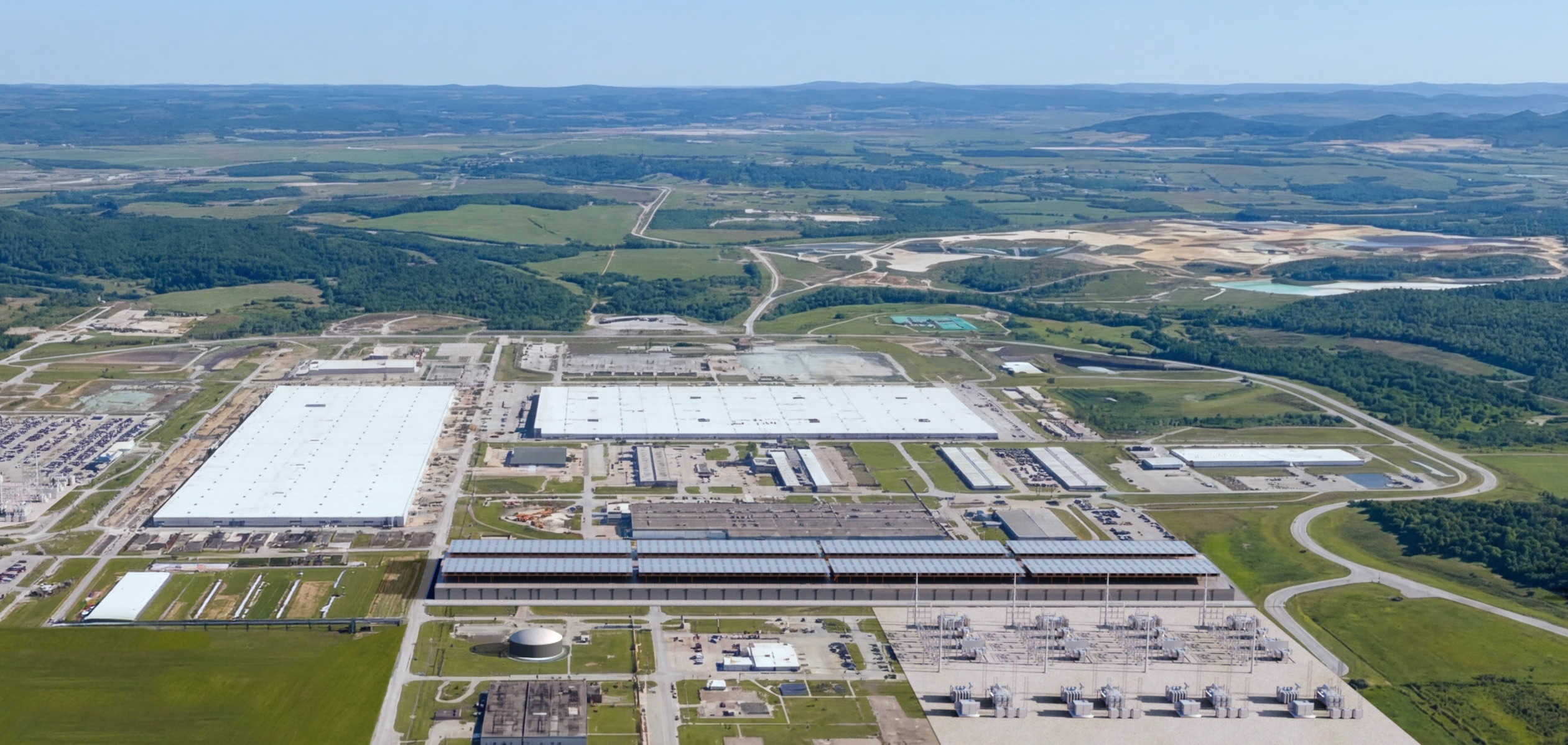
SB Energy will build, own, and operate the PORTS-Pike Technology Campus in Pike County, with OpenAI leasing capacity as it becomes available. The initial phase is designed around 4.25GW of IT capacity, while Nvidia has the option to extend its involvement across another 3.75GW. The first 800MW is expected to become available in 2028, with later stages dependent on new generation, transmission, permitting, financing, and other infrastructure.
Nvidia will invest $1.5 billion in SB Energy and provide credit support for the land, power, and shell infrastructure associated with the initial phase. Reuters puts the maximum guarantee at $105 billion, although Nvidia’s own explanation is narrower than that headline number can imply: it says its support covers defined portions of lease and power payments together with a residual-value commitment rather than the entire project cost or all of OpenAI’s obligations. The guarantee becomes effective progressively as completed capacity enters service between 2028 and 2030.
The structure is intended to make an enormous long-lived property and energy commitment financeable even though the end customer operates under a different financial profile from the hyperscale cloud companies that traditionally sign the largest data-centre leases. Nvidia acknowledges that frontier AI laboratories can have strong demand and fast-growing revenue while lacking the decades of balance-sheet history and investment-grade credit that infrastructure owners and lenders prefer when committing billions of dollars to assets expected to operate for twenty years or more.
Compute demand turns into credit demand
The arrangement exposes an economic constraint sitting underneath the AI industry’s discussion of model capability. Training and serving frontier models requires accelerators, but those chips cannot operate without substations, transmission lines, generation, cooling, buildings, networking, and large parcels of suitably connected land. As individual projects move into multi-gigawatt territory, the problem begins to resemble financing a heavy industrial complex rather than buying enterprise IT equipment.
Infrastructure developers typically fund large projects through combinations of equity, debt, long-term customer contracts, and assumptions about what the assets would be worth if the original customer disappeared. A highly creditworthy tenant can lower financing costs because lenders have greater confidence that rental payments will continue for decades. A younger AI laboratory may offer compelling growth but does not provide the same historic evidence, leaving developers to find other ways of strengthening the credit proposition.
Nvidia is using its own strategic interest in future GPU demand to narrow that gap. Its guarantee gives lenders and SB Energy additional protection around parts of the infrastructure while ensuring that the campus exclusively hosts Nvidia compute. The chip company estimates that each generation deployed across the initial site could represent about 1.5 million GPUs and between $150 billion and $200 billion of Nvidia revenue, with hardware capable of being replaced through several upgrade cycles during the life of the property.
That alignment explains why questions about circular financing have followed the transaction. Nvidia invests in infrastructure supporting an AI company that will buy large volumes of Nvidia technology, while stronger infrastructure financing can in turn allow the customer to buy more compute. Nvidia rejects the circular-financing description, arguing that OpenAI will pay its lease and that the company is securing a scarce input in much the same way that it secures semiconductor manufacturing capacity.
AI infrastructure reaches the grid balance sheet
The physical scale extends beyond the data-centre buildings themselves. SB Energy says at least 10GW of new energy generation is planned to support the eight gigawatts of eventual IT capacity, alongside at least $4.2 billion of regional grid investment with AEP Ohio. OpenAI says the first 800MW can rely largely on existing infrastructure, whereas later development will require new generation, including natural gas, together with additional transmission.
Those numbers show why European AI infrastructure cannot be considered separately from what happens in the United States. Data-centre developers, utilities, investors, and technology companies compete internationally for many of the same transformers, turbines, electrical equipment, accelerator systems, engineering capacity, and capital. A project capable of absorbing gigawatts of computing infrastructure and hundreds of billions of dollars of hardware over successive generations can influence supply markets well beyond Ohio.
Europe faces a different set of planning, grid, and energy-market conditions, but the financing question is becoming similar. As AI-focused data-centre contracts expand, landlords need confidence that newer compute providers can support long leases, which is why European operators are already demanding deposits, letters of credit, and other protections from some neocloud customers. The PORTS-Pike structure takes that logic considerably further by bringing the dominant accelerator supplier directly into the credit arrangement.
It also changes Nvidia’s exposure. Selling a GPU usually creates revenue without making the manufacturer responsible for whether the buyer can finance a twenty-year property commitment. Providing guarantees links part of Nvidia’s financial position to the utilisation and residual value of infrastructure designed specifically to host its computing platform, even if the company argues that the site could be transferred to another qualified customer if OpenAI no longer required it.
PORTS-Pike will take years to build, and OpenAI itself says later phases depend on infrastructure, permits, environmental reviews, and financing being secured. The economic assumptions underpinning the campus will therefore be tested across several generations of AI models and accelerators before the development reaches full scale.
Nvidia is no longer waiting at the end of the infrastructure chain for a data-centre customer to arrive with enough power and financing to place an order; it is helping assemble the conditions that make the order possible. As AI projects reach industrial scale, competitive advantage around processors is expanding into access to land, electricity, credit, and long-term infrastructure, where technology companies increasingly need financial muscle alongside technical performance.